• Skip to primary navigation
  • Skip to main content
  • Skip to primary sidebar
  • Skip to footer
Jennifer Marohasy

Jennifer Marohasy

a forum for the discussion of issues concerning the natural environment

  • Home
  • About
  • Publications
  • Speaker
  • Blog
  • Temperatures
  • Coral Reefs
  • Contact
  • Subscribe

Water

Australian Water Market Report

November 5, 2008 By admin

Dear Waterfind subscriber,

Waterfind has today publically released our 2007-08 Annual Water Market Report. As a part of Waterfind’s dedication to providing an integrated water brokerage service, we strive to provide our clients with the most up to date and comprehensive information about the Australian water market. 

The report provides information on the state of our National water resources, major policy announcements and trading activity for the 2007-08 irrigation season, and provides some analysis on how these factors impacted the water market throughout the season. 

 Key findings of the report include: 

1.  Major northern water storages above the NSW–QLD border line were not adversely affected by the current drought conditions being experienced in Australia, holding on average 90% of their capacity compared to 20% on average for major southern storages. 


2.  The largest volume of water stored in Australia was in Lake Argyle in Western Australia, with over 10 million ML of actual water storage, more than the other 9 largest water storages in Australia combined. 


3.  The price of water in Australia’s largest water markets in the Southern Murray Darling regions experienced extreme volatility during the 07-08 season, peaking at $1200 per ML in November 2007 only to drop to below $300 per ML in February 2008.  This was influenced by water resource availability and major policy/allocation announcements during the season.


4.  Early observations indicate that water market activity in the 2008-09 season has been lower than in 2007-08, with prices being recorded at up to 50% less than the same period last year.  This has been attributed to grower concerns about last season’s record high prices and current uncertainty of water resource availability. 


To view the full 2007-08 Annual Water Market Report, visit www.waterfind.com.au/water-report-signup.html.


Regards, 

Waterfind Pty Ltd
NATIONAL WATER BROKERS

Filed Under: Community, News Tagged With: Water

How Melbourne’s Climate Has Changed: A reply to Dr David Jones (Part 5)

October 27, 2008 By Nichole Hoskin

Dr David Jones, the head of climate analysis at the Australian Bureau of Meteorology, in an opinion piece, ‘Our hot, dry future’ has argued that over the past 11 years Melbourne’s rainfall has been about 20% below the long-term average   experienced declining rainfall over the past 11 years . 

In response, Dr Jennifer Marohasy posted ‘How Melbourne’s Climate Has Changed: A reply to Dr David Jones (Part 3)’, which included a graph of high quality data of rainfall at Yan Yean, Victoria, because of its proximity to Melbourne. 

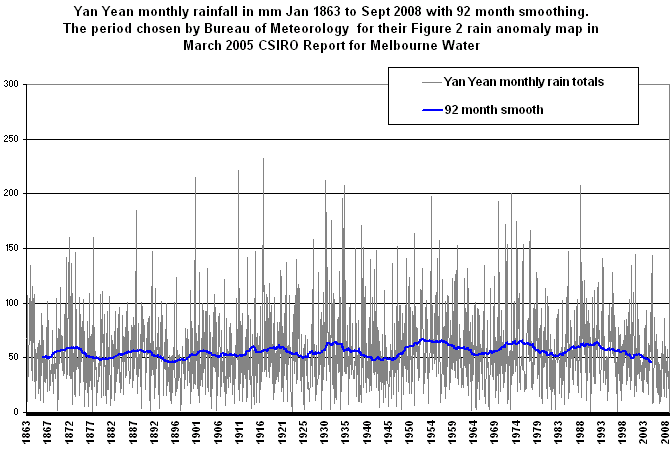
The graph is from Mr Warwick Hughes based on Bureau of Meteorology data and shows that recent rainfall decline at Yan Yean is comparable to declines during previous droughts.

I have also graphed Bureau data for some of Melbourne’s catchment areas.  While I couldn’t find a site with data extending back as far as the Yan Yean site, the Maroondah and O’Shanneyssy stations show a significant recent decline in rainfall that is greater than previous droughts in the 1896, 1925 and 1945.

Some of the Melbourne catchment areas rainfall data shows recent significant decline, but there are a number of problems with using bureau rainfall data for the Melbourne catchment.  A main problem is that the Bureau does not have rainfall data for Melbourne’s largest reservoirs, Upper Yarra and Thomson back more than 30 years.

The best publicly available data on catchment area rainfall comes from Melbourne Water. However, Melbourne Water’s publicly available data is only from 1998 to 2008.

Without long-term high quality data of catchment area rainfall for all catchment areas, it is impossible to know whether the longer-term trend shows dramatic declines at many, or just some, places in the Melbourne catchment. 

Nichole Hoskin
Blue Mountains, Australia

Filed Under: Opinion Tagged With: Climate & Climate Change, Water

How Melbourne’s Climate Has Changed: A reply to Dr David Jones (Part 3)

October 25, 2008 By jennifer

IN an opinion piece entitled ‘Our hot, dry future’ published by Melbourne’s The Age newspaper on October 6, 2008, Dr David Jones, head of climate analysis at the Australian Bureau of Meteorology, suggested global warming was responsible for the current long drought in Melbourne and that there was worse to come.  

I don’t think the article was very convincing. I am annoyed that it didn’t include any real data.  While Dr Jones claimed that “We know that over the past 11 years Melbourne’s rainfall has been about 20% below the long-term average”, he didn’t explain what period this “long-term average” covers and what is the relevance of the last 11 years given it is accepted that over this period there has been a dominance of El Nino, and therefore dry conditions.   

Key Australian Institutions have claimed for some time that we have a water crisis because of climate change. 

Indeed in 2005 CSIRO published a “Melbourne Water Climate Change Study” claiming  “…the greater Melbourne Region has had its lowest rainfall on record compared to all other periods of similar length.” 

But as blogger, Warwick Hughes, showed some time ago, the period chosen was just 92 months, from October 1996 to May 2004.

In order to put their statement in some context Mr Hughes graphed high quality rainfall data for the weather station closest to Melbourne, Yan Yean, back to January 1863 – and he has just updated the chart to the end of September 2008. 

A high quality version of this chart can be found at Mr Hughes’ website, click here.

The chart indicates that Melbourne experiences dry periods every so often and that the current drought is similar in magnitude to the droughts of 1896, 1925 and 1945.  The chart showing 145 years of data, does not support the claim, made by Dr Jones in his article in Melbourne’s The Age, that there has been recent unusual climate change in Melbourne.  Indeed periods of drought and flood are a natural hazard.

*************************************
Read Part 1 here:
https://jennifermarohasy.com.dev.internet-thinking.com.au/blog/2008/10/how-melbourne%e2%80%99s-climate-has-changed-a-reply-to-dr-david-jones-part-2/ 
Read Part 2 here:
https://jennifermarohasy.com.dev.internet-thinking.com.au/blog/2008/10/how-melbourne%e2%80%99s-climate-has-changed-a-reply-to-dr-david-jones-part-1/

Filed Under: News, Opinion Tagged With: Climate & Climate Change, Drought, Water

Dying, I’m Not: A Poem from the Murrumbidgee

September 26, 2008 By admin

I begin as a trickle, of melting snowflakes,

High in the mountains as Springtime awakes.

I ooze from the sedges, and springs neath the ground.

Drawn by gravity, it’s downward I’m bound.

I’m one of the elements of antiquity,

The basis of life, I begin clear and free.

It’s water I am, the compound H two O.

They say I am scarce, but it’s really not so.

Most abundant I am on this wonderful earth,

Without me nature, would have been a stillbirth.


 As I gurgle along, in my search for the sea,

I’ve been given a name, the Murrunbidgee.

Over rocks past Kiandra, I flow clear and free,

Then I nurture all life in our own A.C.T.

Because that is my votive, my reason for being,

The lifeblood of life, for everything living.

So sing in the rain, but save my runoff,

Lest in the future the rainfall’s far-off.

Though perpetual I am, I’m not here to waste,

For all life depends on my aquatic embrace.


With the Goodradigbee I rest, in old Barren Jack,

Before meandering through our arid outback.

‘Cross the Riverine plains, where for millions of years,

I’ve laid down a profile of rich earth veneers,

Just needing my lifeblood to grow and to bloom,

With the food for this world, before I resume,

My journey to where I’m joined by my brothers

That’s Lachlan and Murray, before nature ushers

Into our fold, the Darling, our sister you see;

For our journey of destiny, to our Mother the sea.

 But now I am ailing, but dying I’m not.


So what ailment afflicts me I now hear you ask?

Well believe not those, who all seem to bask,

In the self serving glory of media headlines.

Of pillage and plunder that always maligns,

Those who care most for my health and welfare.

These green charlatans all, who seem not to care,

That I’ve been infected with the terrible cancer,

Of European carp and they have not the answer.

For this ecological disaster that is ailing me so,

Now turbid and muddy, my reed beds don’t grow.

It’s ailing I am, but dying I’m not.


As I flow on to the lake, called Alexandrina.

I hereby refute what is claimed in the media.

My great river gums, are not dead or dying.

Of those who profess this, well frankly they’re lying.

These gnarled old eucalypts, survive without floods.

They’ve done so for decades, on just a few scuds.

It is only Mother Nature, can send floods so great.

That my dry lakes and wet lands begin to gestate,

With a food chain of plenty, that may last for years.

 Until drought once again, brings back the tears.

It’s ailing I am, but dying I’m not.


I now join my Mother the source of all life;

I’m cleaned and refreshed, away from lands strife.

Subsumed in the bounteous source of the clouds,

I begin a new journey as one of the shrouds.

Those cumulonimbus, cirrus, strata and all;

We race over the sea and become a snowfall,

On a high mountain pass I softly alight.

As a protective blanket, all fluffy and white.

I begin as a trickle, of melting snowflakes,

I’m now in the Andes as springtime awakes.


Pikey

Murrumbidgee Valley

New South Wales, Australia

Filed Under: Opinion Tagged With: Water

Residents of Adelaide Waste Water?

September 14, 2008 By jennifer

The Queensland Farmers’ Federation have suggested that residents of Adelaide should use less water rather than continually demanding that more water be sent to South Australia.  According to ABC Online: 

“Executive officer John Cherry says 55,000 megalitres of water a year would be saved if Adelaide residents lived under the same water restrictions as Brisbane.

“Last year, Adelaide households used an average of 235 litres per day compared with 153 litres in Brisbane.”

Filed Under: News Tagged With: Water

WWF Spills ‘Virtual Water’

August 20, 2008 By Paul

WWF used to be the World Wildlife Fund, but these days it has a rather different agenda at the forefront of climate alarmism. In their latest ‘report,’ WWF have used the concepts of a ‘Water Footprint’ and ‘Virtual Water.’ The UK Telegraph reports that, “The average person in the UK uses over 1000 gallons of water a day, making the country one of the biggest water importers in the world.” If you haven’t drowned, and have nothing better to do, read more here.

Filed Under: Uncategorized Tagged With: Water

  • « Go to Previous Page
  • Go to page 1
  • Interim pages omitted …
  • Go to page 3
  • Go to page 4
  • Go to page 5
  • Go to page 6
  • Go to page 7
  • Interim pages omitted …
  • Go to page 19
  • Go to Next Page »

Primary Sidebar

Recent Comments

  • Ian Thomson on Vax-ed as Sick as Unvax-ed, Amongst My Friends
  • Dave Ross on Vax-ed as Sick as Unvax-ed, Amongst My Friends
  • Dave Ross on Vax-ed as Sick as Unvax-ed, Amongst My Friends
  • Alex on Incarceration Nation: Frightened of Ivermectin, and Dihydrogen monoxide
  • Wilhelm Grimm III on Incarceration Nation: Frightened of Ivermectin, and Dihydrogen monoxide

Subscribe For News Updates

  • This field is for validation purposes and should be left unchanged.

December 2025
M T W T F S S
1234567
891011121314
15161718192021
22232425262728
293031  
« Jan    

Archives

Footer

About Me

Jennifer Marohasy Jennifer Marohasy BSc PhD has worked in industry and government. She is currently researching a novel technique for long-range weather forecasting funded by the B. Macfie Family Foundation. Read more
Subscribe For News Updates

Subscribe Me

Contact Me

To get in touch with Jennifer call 0418873222 or international call +61418873222.

Email: jennifermarohasy at gmail.com

Connect With Me

  • Facebook
  • LinkedIn
  • RSS
  • Twitter
  • YouTube

Copyright © 2014 - 2018 Jennifer Marohasy. All rights reserved. | Legal

Website by 46digital