• Skip to primary navigation
  • Skip to main content
  • Skip to primary sidebar
  • Skip to footer
Jennifer Marohasy

Jennifer Marohasy

a forum for the discussion of issues concerning the natural environment

  • Home
  • About
  • Publications
  • Speaker
  • Blog
  • Temperatures
  • Coral Reefs
  • Contact
  • Subscribe

Porites

Naming a First Old Porites, Craig

February 5, 2021 By jennifer

Knowing the truth has always been a challenge requiring an amount of discipline. And it is getting that much harder in this age of disinformation. How can we distinguish reality from fantasy, truth from propaganda?

Science used to be so useful for this. But many government-funded reef research programs now amass data to prove a bad impact from global warming, and other things. There is not much hypothesis testing as such – not even about how coral growth rates are affected by increasing sea temperatures.

Coral reefs are amongst the most diverse, species-rich and spectacularly beautiful ecosystems on Earth. The largest and best known of these is the Great Barrier Reef and there was once a program of coring, with an annual average growth rate reported for the entire Great Barrier Reef. In the beginning it was hypothesized that as temperatures increased coral growth rates would increase too, which is a good thing – right?

From Chapter 1 of Climate Change: The Facts 2017, the previous book in the series I’m editing.

In the beginning the Australian Institute of Marine Sciences (AIMS) sampled the really old large Porites. These are the bolder corals with distinct annual bands – variations in the density and length of these annual bands are an indication of changing growth rates.

Then, after 1990, they started mixing up the young (less than 15 years old) with the old (more than 100 years old) samples, which generated some confusing results. A study published in Marine Geology (volume 346) that used only data from the large old corals showed an increase in calcification rates (coral growth rates) over the last 100 years, rather than a sudden drop off after 1990.

Then AIMS just stopped coring the really old Porites and stopped calculating an annual average growth rate. It is now 16 years since AIMS published an average coral growth rate for the Great Barrier Reef. This makes it that much harder to know if the Great Barrier Reef really is dying – or if this is just scare mongering to generate research funding.

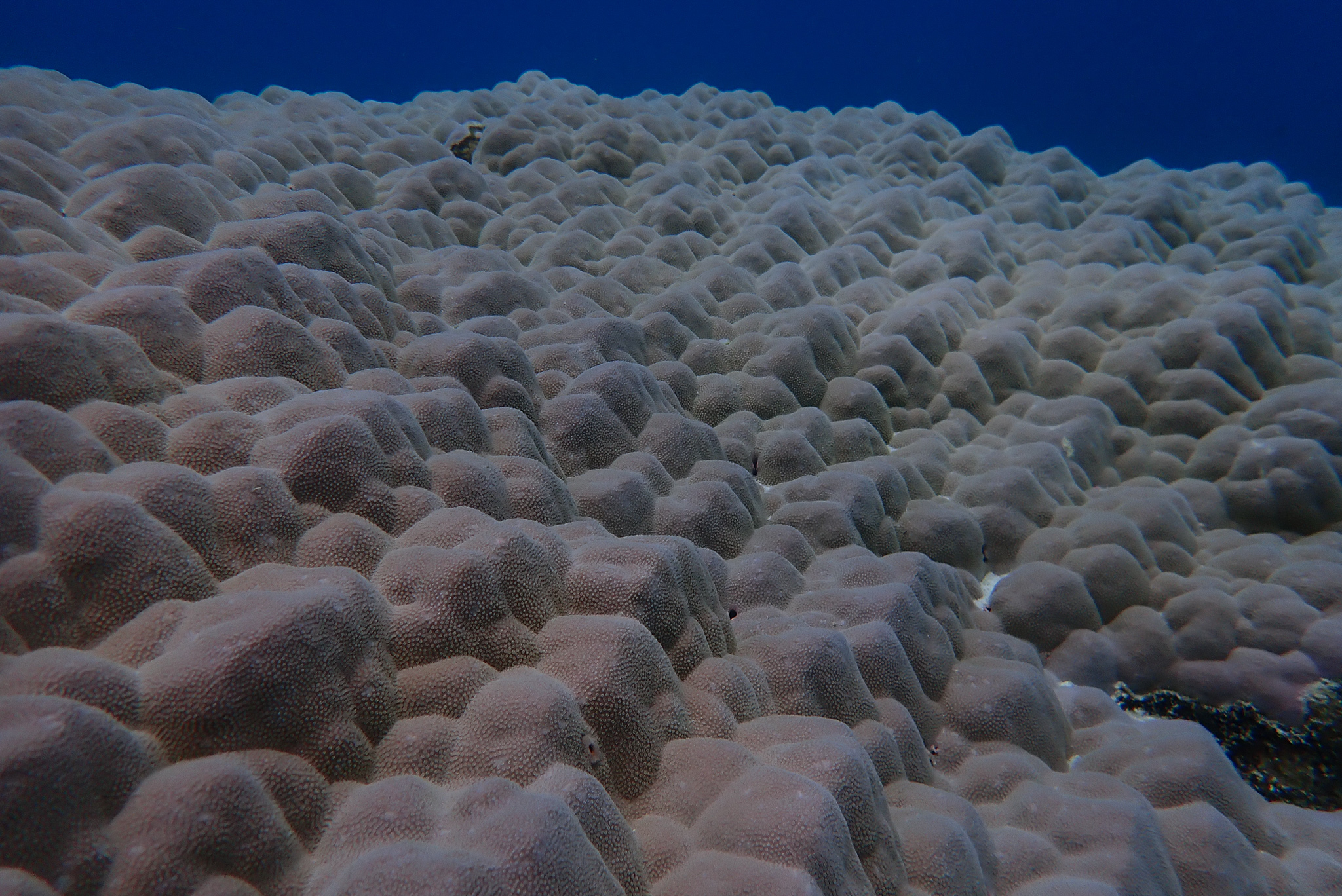
I think we should start an inventory of the oldest and largest Porites, to acknowledge and celebrate them. The largest massive bolder coral that I have measured so far is from Pixie Reef, just to the north east of Cairns.

Does anyone want to guess how high and wide this very large old Porites coral colony is? These photographs were taken on 25th November 2020.

I was wondering how we might distinguish the individual coral colonies: what we might call it? Then I remembered how it all began with naming cyclones:

It started in 1887 when Queensland’s chief weather man Clement Wragge began naming tropical cyclones after the Greek alphabet, fabulous beasts, and politicians who annoyed him.

After Wragge retired in 1908, the naming of cyclones and storms occurred much less frequently, with only a handful of countries informally naming cyclones. It was almost 60 years later that the Bureau formalised the practice, with Western Australia’s Tropical Cyclone Bessie being the first Australian cyclone to be officially named on January 6, 1964.

Other countries quickly began using female names to identify the storms and cyclones that affected them.”

I was wondering what we might call this massive Porites amongst the Pixies, and then I received a phone call from my dear friend Craig Kelly MP.

Following in the early tradition of Clement Wragge for cyclones, I though we might name this Porites after Craig – a truth seeker and for many an annoying politician.
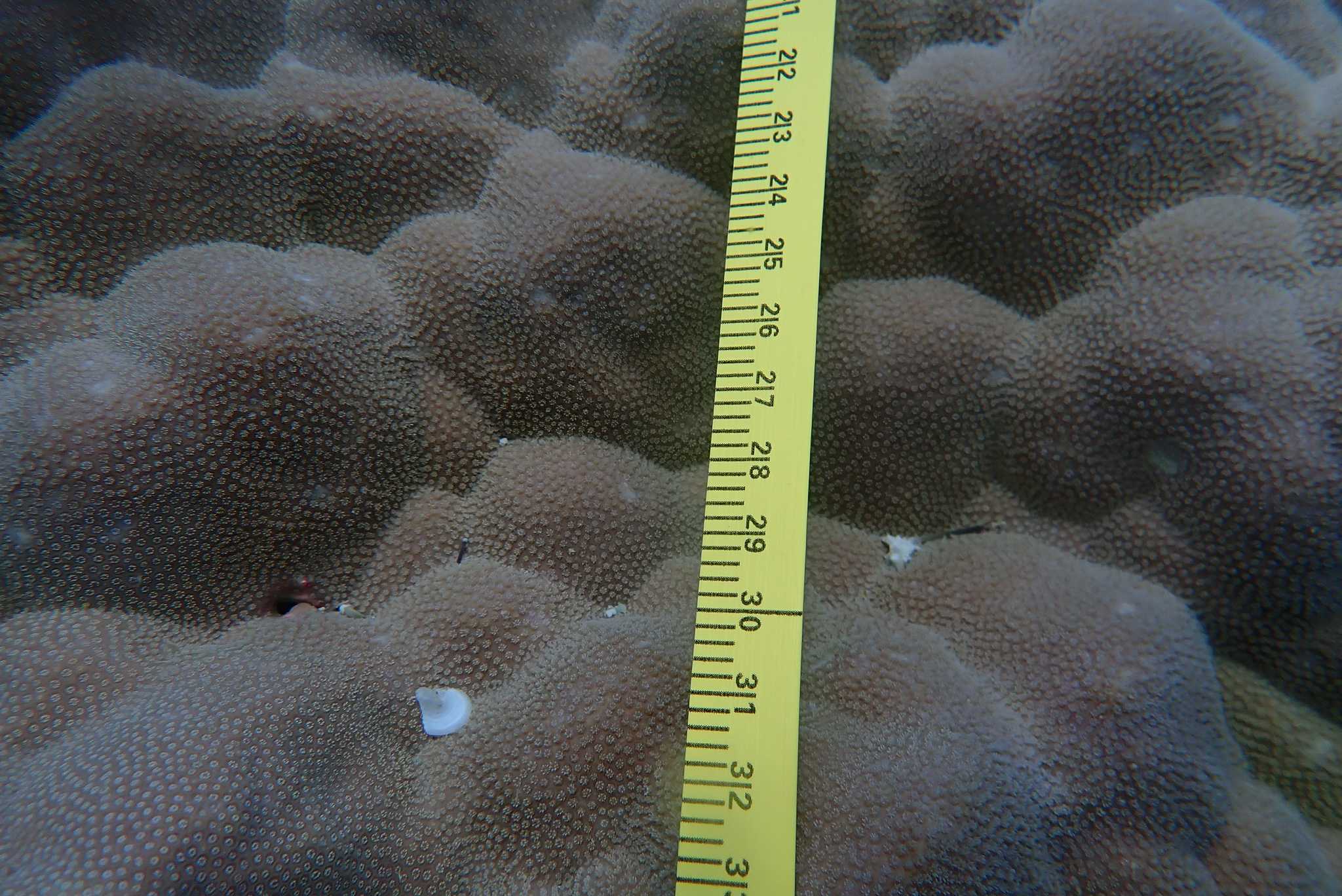
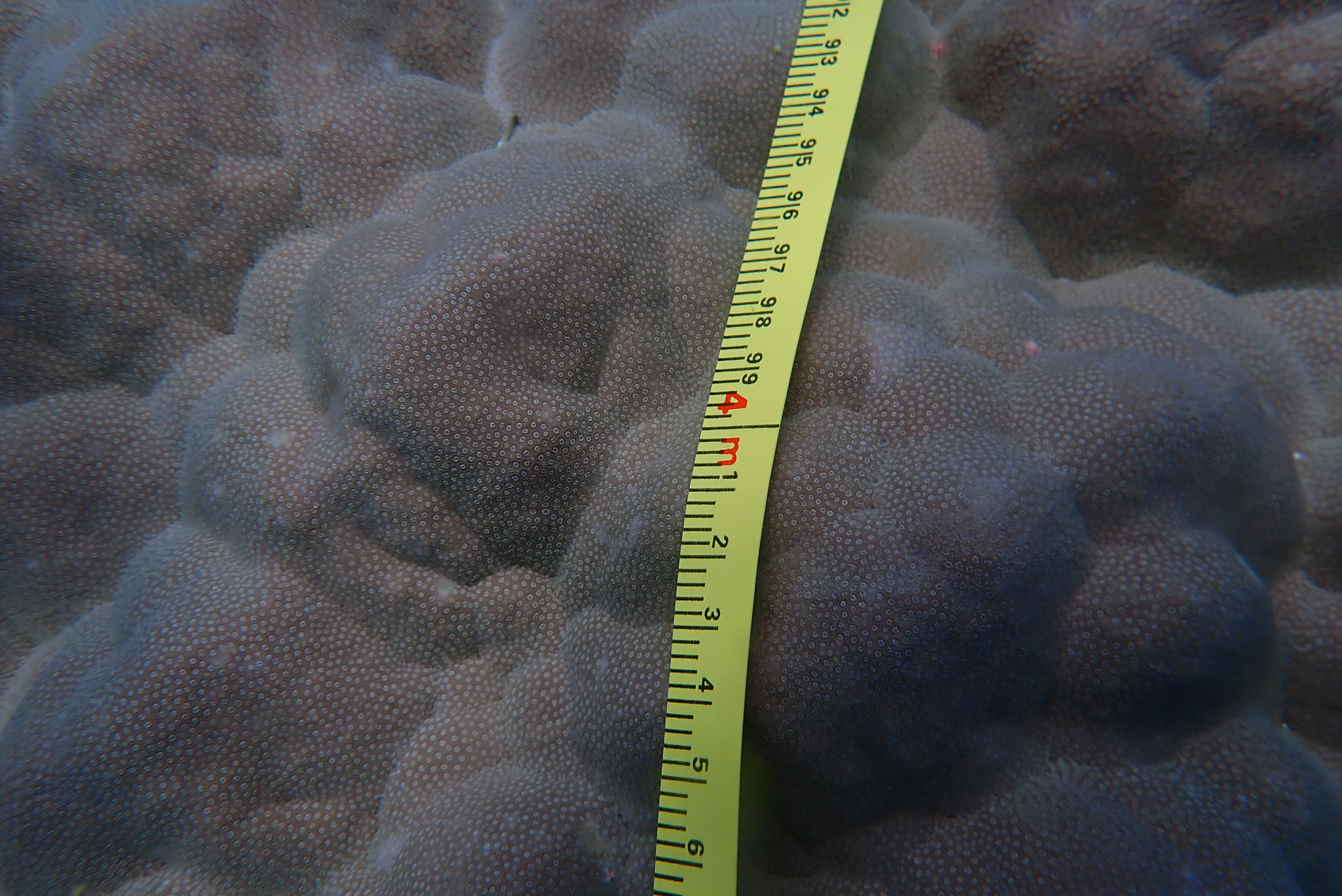
These close-up photographs of Porites Craig taken at the same time as the wide-angle images, show that the corallite wall is still intact and some have their tentacles extended. So, we can conclude Porites Craig was quite healthy on 25th November 2020. If AIMS cored this coral we could know the true climate history of this place back perhaps 500 years.

Ends.
Filed Under: Information Tagged With: Great Barrier Reef, Porites

Gardens of Old Porites, Without Sharks

December 9, 2020 By jennifer

It is often reported that the Great Barrier Reef is half dead, specifically that the corals are bleached, and the water quality is degraded with pesticides and plastics. If I didn’t know better, I might never want to visit a coral reef, lest I be forced to confront this reality – apparently all our fault. Except the coral reefs that I dived last week each made me feel so alive, and in awe of their extraordinary beauty – especially Myrmidon reef which is an ancient and detached coral reef that juts out into the Pacific Ocean on the eastern edge of the Great Barrier Reef. But we didn’t see many sharks.

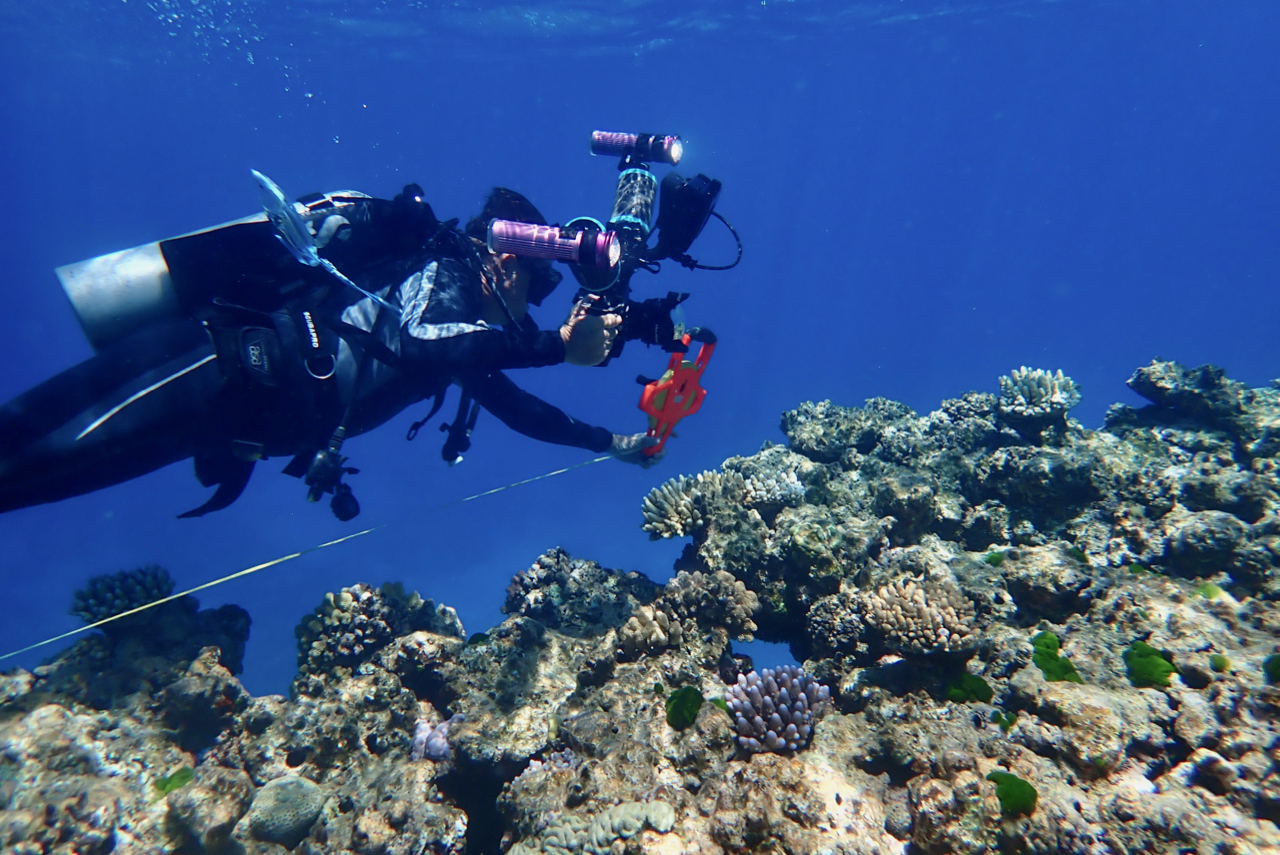
The sparse reef crest at Myrmidon with Stuart measuring out 10 metres for the first transect, while also holding his camera.

The coral reef called Myrmidon is perhaps as old as the city of Troy. In mythology, that city existed about 5,000 years ago and it was attacked by Achilles and 50 ships each carrying 50 Myrmidons. Paleo-climatologists will argue that that geological period, known as the middle Holocene (7,000 to 4,500 years ago), was much warmer than the present with sea levels at least 1.5 metres higher than they are today along the east coast of Australia including at the Great Barrier Reef.

Perhaps everything seemed unusually magical last Wednesday at Myrmidon because I dived into such crystal-clear water, and it was so sunny. Looking back over the video footage, Myrmidon reef did not have particularly luxurious corals, but there was an iridescence and a beauty that I’ve not seen before. It was so evident that the live corals were growing on-top of dead corals, not one or two generations dead, but representing thousands of years of growth and destruction from cyclones and bleaching events. The reef was unashamedly beautiful yet with so much exposed that represented layers and layers of dead coral. The regrowth was so clearly on eroded antecedent surfaces.

Where we first jumped in at Myrmidon, the coral was sparse and stunted and there were piles of coral rubble some newly dead and covered in green algae. My dive-buddy Shaun, and underwater videographer Stuart, swam with me around a ledge that led us down into an underwater canyon. Green parrot fish swam metres above a giant clam with an ink black body speckled with florescent blue zooxanthellae. I knelt beside it, I was 17 metres under-the-water and feeling part of another world. Stuart was not too far away, deciding which of the massive Porites along the walls of the canyon we would measure, and Shaun would photograph – then we ran the photographic transect.

Porites are the old boulder corals, which like the oldest trees in temperate forests, can be cored to reveal a climate history. I was not at Myrmidon to core the Porites, but just to find out if any still existed and to measure and photograph them – as well as running the photographic transects. But really, I just wanted to sit next to the black clam speckled blue, which had thick olive-green shiny lips and watch it breathe and feed through its two siphons.

We cruised a total of 263 nautical miles (nearly 500 kilometres) last week in search of the old corals, the Porites.

We left Cairns on Saturday 28th November, and spent the first night moored behind Russell Island, which is part of the Franklin Island Group just to the east of the town of Babinda. On the first day we dived the fringing reef of High Island, the next day Normanby, and after that Britomart. There were so many massive Porites at the reef fringing High Island and also at Normanby. We didn’t find any Porites at Britomart. That was perhaps because we only had an afternoon to search, and I made the wrong calls in terms of where we should jump-in, which is perhaps why we didn’t find any Porites at Britomart.

At the first dive site at Britomart, which had been my call, there were huge plate corals under-the-water that I had mistaken as Porites from above the water. These corals were mostly dead, probably from a severe bleaching back in 2016 and then 2017.

But it wasn’t all death and destruction at Britomart. At the second site, where only Stuart jumped-in to the strong current with just his snorkel, he found and filmed large plate corals – so alive. There was some extraordinary biodiversity at Britomart including a school of black Dory – there was also evidence of severe bleaching. We only saw a single white tipped reef shark at that reef.

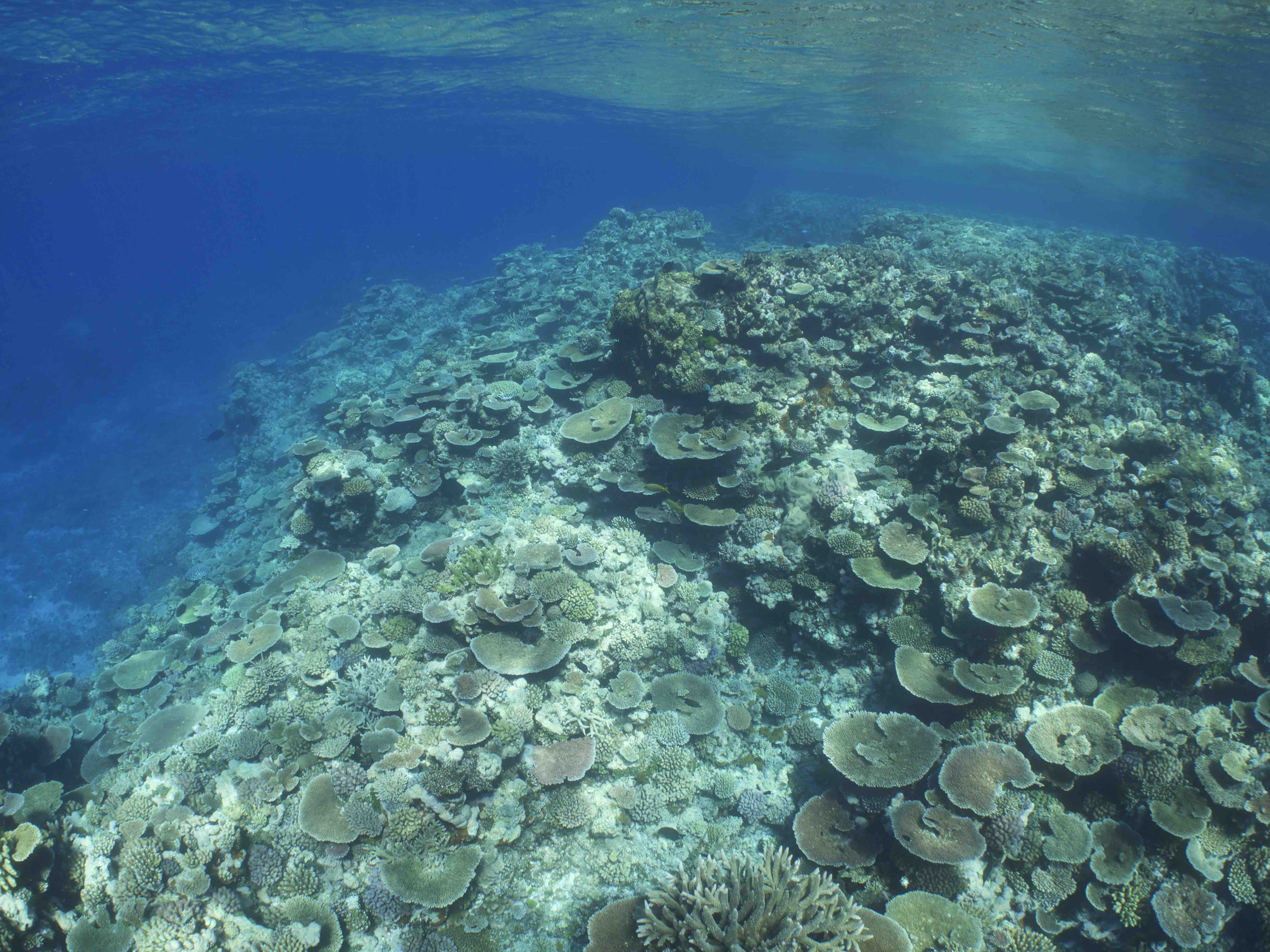
Every reef that we dived was so variable and each of the different habitats at Pixie, Britomart and Myrmidon had a different ensemble of coral species and forms. But at each reef we only found a single shark. Each of these reefs had a distinct reef crest that might have been more luxurious, and with better coral cover, some 5,000 years ago at the time of the mythical Myrmidons – simply because back then these reefs would have been younger and growing up with the sea level that was higher back then, the corals having grown-up 120 metres since the depth of the last ice age which was just 16,000 years ago. Since at least 2,500 years ago these coral reefs have had to adapt to an overall trend of falling sea levels, not with-standing the modest increase of perhaps 36 cm over the last 100 years – as reported by the United Nation’s Intergovernmental Panel on Climate Change (IPCC).

The reef crests at Britomart and Myrmidon today are flat topped and mostly dead, as they are eroded peaks now just below mean low tide growing back after bleaching events, to be smashed again by the huge waves that come with the cyclones.

Coral cover at the crests, which is the most exposed part of the reef, is generally sparser and the corals stumpy, while only a few metres further down under the water it is sometimes possible to find delicate plate corals, at Myrmidon perhaps regrowing since the last cyclone. It is so difficult to generalize about a coral reef, when there is such diversity within and between habitats even at the same reef.

Small plate corals, at Myrmidon.

It was on the second dive at Myrmidon, that we found the garden of Porites. That was a highlight of the week at sea for me. I had gone in search of Porites. I had no idea whether I would find them or not. At Myrmidon we found a whole garden of Porites – massive corals in different colours and each so healthy. In the same coral garden were blue and also a heavenly-white Acropora – so tall, and each branch had a florescent blue tip. Little Chromis fish (Damsel fish) trimmed in yellow, swam in and out.

The skipper, Rob, had warned me in the weeks leading up to the expedition that there was no guarantee we would get all the way to Myrmidon in our 14-metre boat. It all depended on the weather, he said.

Last Wednesday, a week ago, Rob not only got us to Myrmidon, but we found so many Porites and in crystal clear waters.

Stuart and Rob made the decision about where to anchor for the second dive, they found me the garden of Porites. There were perhaps 50 of these massive boulder-shaped corals many more than 2 metres in diameter not far from the boat and at just 8 metres below the water. Perhaps there are another 50 gardens of Porites at Myrmidon reef? That can be my hypothesis!

If only we had the resources to stay, search and survey we could perhaps find as many massive Porites as there were Myrmidons (50) on each of the ships (50) that sailed with Achilles to defeated Hector in the ancient Greek tale – that would make 2,500 massive Porites just at Myrmidon reef! And Myrmidon is just one of nearly 3,000 coral reefs that make up the Great Barrier Reef.

Shaun swimming over some of the massive Porites in the coral garden at Myrmidon.

There are certainly enough massive Porites still alive for scientists at the Australian Institute of Marine Science (AIMS), to calculate an average coral growth rate for the Great Barrier Reef over the last 100 to 300 years – as they used to do by coring Porites from inner, middle and outer reefs including Myrmidon. They stopped coring the Porites at Myrmidon more than 15 years ago.

We only found the one shark at Myrmidon – a small and curious white tipped reef shark that tasted Stuart’s flipper on the second dive, and almost head-butted Shaun at the beginning of their night dive. These sharks (Triaenodon obesus) are more curious than aggressive, which may explain why numbers have apparently declined over the last few decades – apparently as a minor bycatch of the Coral Reef Fin Fish Fishery. The last attempt to properly quantify their numbers is documented in a PhD thesis by William Robins published back in 2006. He claims fishing is the problem.

I’ve heard so many stories about shark finning, even in Great Barrier Reef waters as far south as Lady Elliot Island. Finning involves removing the dorsal, pelvic, pectoral and caudal fins and then throwing the live shark back into the water – where it can only sink to the bottom and die. Best estimates suggest 73 million (!) sharks are finned each year across the world to make soup for rich Asians.

There is so much money from the long-suffering Australian tax payer, via the Australian government, for activist scientists claiming the reef is at risk of climate change, but very little political will to address any of the many threats to sharks in Great Barrier Reef waters. Yet the evidence suggests shark numbers are in decline, not only from finning but also drumlines set by the Queensland government, ostensibly to protect those who swim at north Queensland beaches.

I’m hoping to go back to Pixie Reef, just to the north east of Cairns, in early February to finishing filming for the documentary about our week at sea – last week. In the new year, I want to film some more at Pixie Reef, including Shaun swimming with the resident white-tipped reef shark that Stuart often sees there.

The reefs at Myrmidon, Normanby, High Island and Pixie have so many old Porites, but so few reef sharks.

Working from evidence – including the photographic evidence amassed by us last week, from the photographs taken by Shaun along the underwater transects set by Stuart, and from Stuart’s drone photography in the air above, for at least two different habitat types at each of the reef we visited – I hope there can one day be more agreement about the current state of the corals at the Great Barrier Reef. It would certainly be helpful if some of the many scientists at AIMS returned in one of their big ships to Myrmidon and cored at least a few of the many massive old Porites. They could recommence the program of coring, beginning at Myrmidon, to test the hypothesis that as water temperatures increase coral growth rates will increase too. This could be determined from the annual growth rings once the cores were in the laboratory and under X-ray.

I would also sleep better knowing that there was funding to monitor white-tipped reef sharks. At the moment, about 600 sharks are killed each year on drumlines including reef sharks, then there is the by-catch from the legal fisheries, and then there are those who fin sharks because there is a market.

I surmise that the corals are not threatened by global warming, certainly not by sea level rise, but that the few remaining sharks at Myrmidon, and many other reefs, are at risk from those intent on defeating them, or eating their fins. Indeed, I’m hoping that as Achilles slayed Hector with the help of the Myrmidons, we can begin to acknowledge the hubris of trying to tame Zeus/the weather, while mercilessly denying everything good that sharks represent, including being curious and keeping mid-level predators in check, so that the algae-eating fish can thrive.

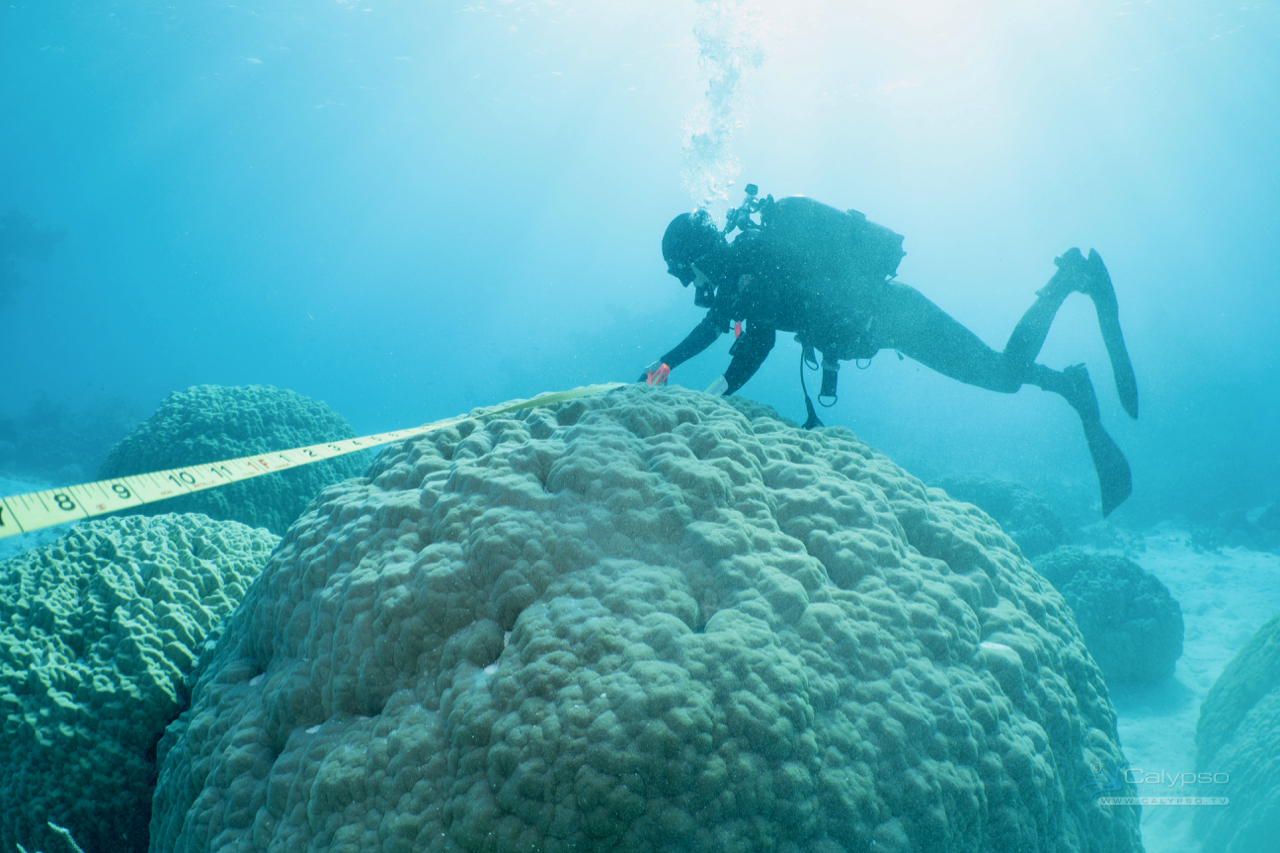
Jen measuring a massive Porites at Myrmidon.

**************
The feature image, at the very top of this blog post, is of our boat Kiama as we arrived at Myrmidon reef. The skipper, Rob McCulloch, has put some unedited aerial drone footage taken by Stuart of our boat, Kiama, sailing into Myrmidon, at his YouTube page, here: https://www.youtube.com/watch?v=jLtN4deEi10

I am so grateful to the B. Macfie Family Foundation and the Institute of Public Affairs (IPA) for funding the expedition.

Shaun and Jen/me about to jump in at Normanby reef.
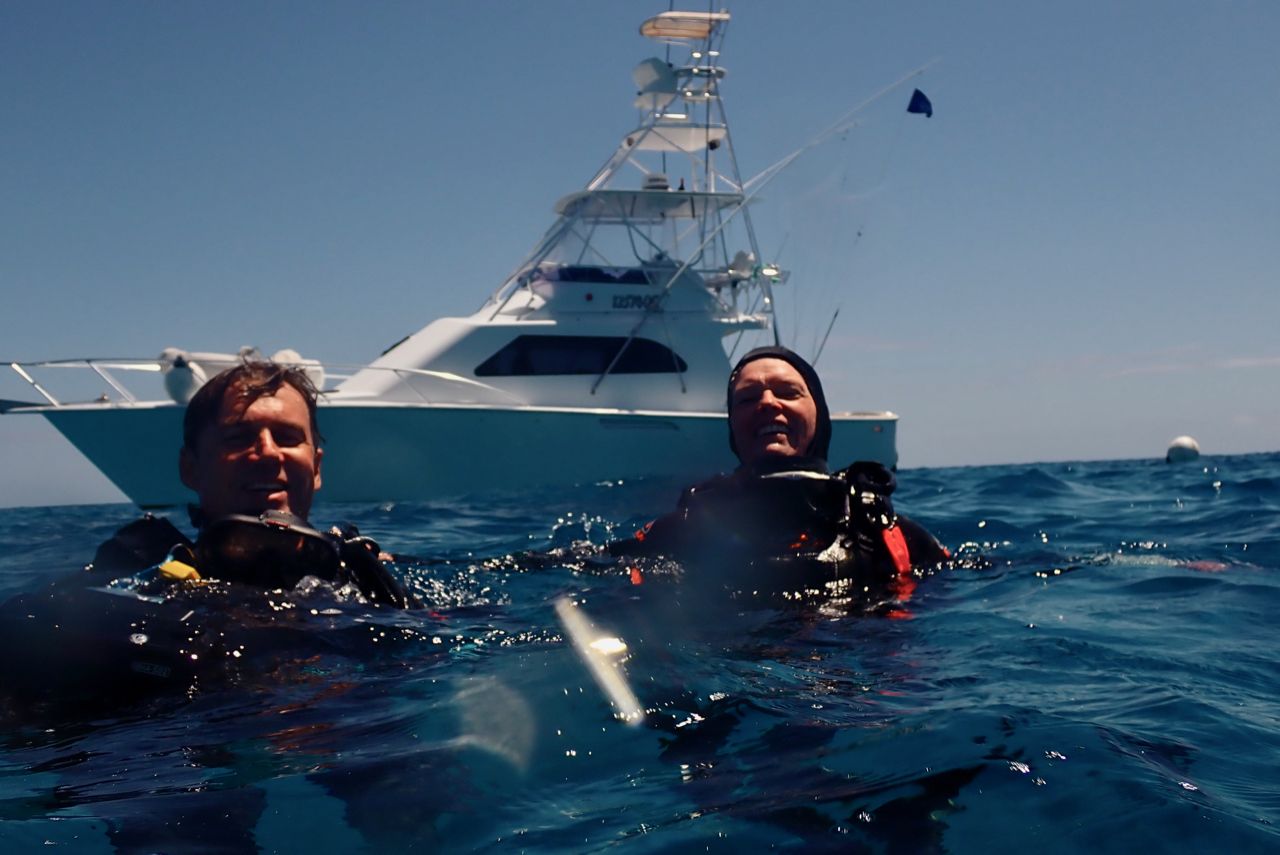
Stuart and Jen, top-side at Myrmidon after the first dive.
Wizz and Dennis on the back deck. So much thanks for looking out for us, and looking after us.
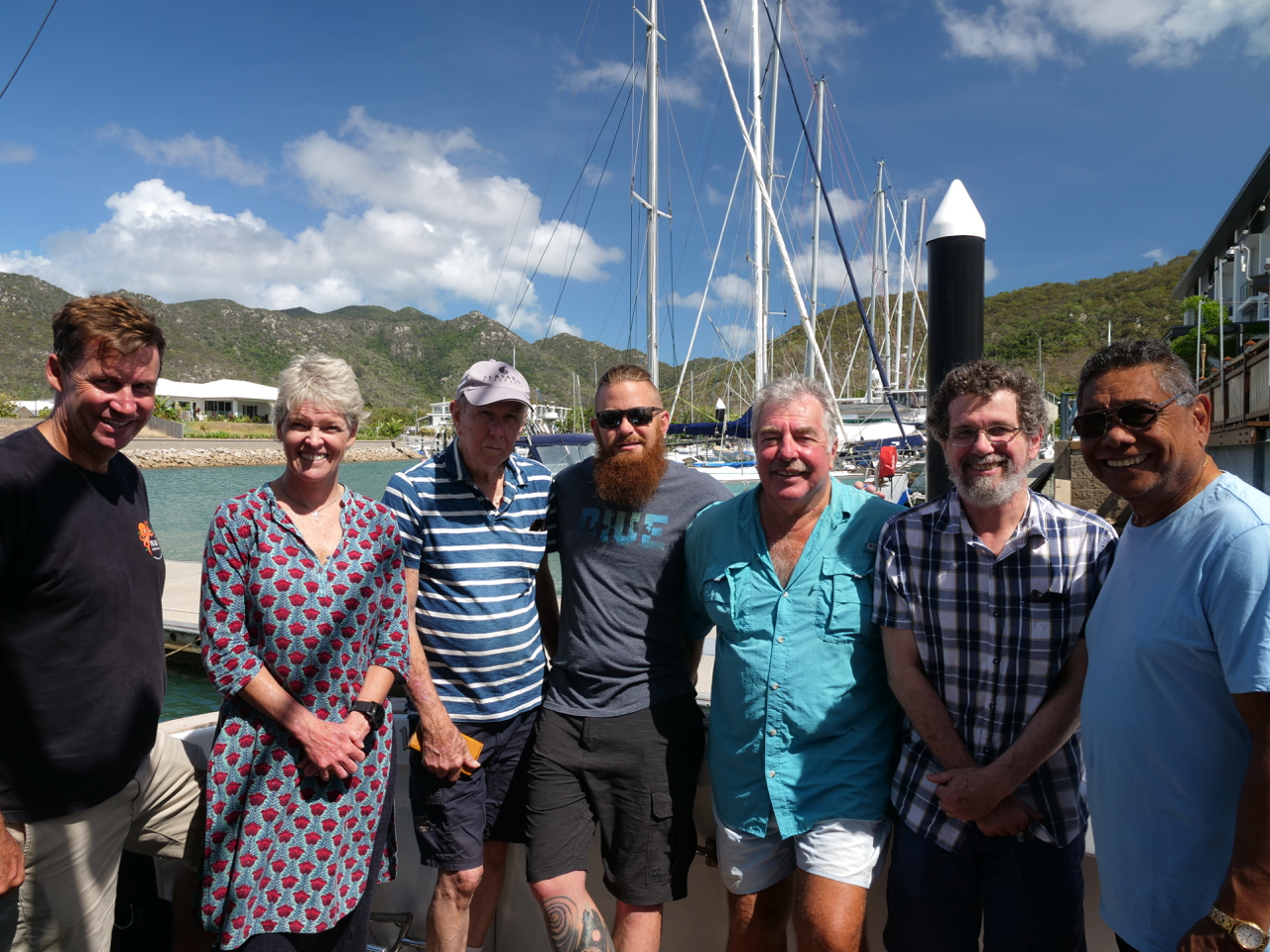
The team: Stuart, Jen, Walt (joined us at Maggie Island), Shaun, Rob, Peter Ridd and Dennis … thanks Wizz for capturing the moment.

Filed Under: Good Causes, Information Tagged With: Great Barrier Reef, Porites, sharks

Primary Sidebar

Recent Comments

  • Ian Thomson on Vax-ed as Sick as Unvax-ed, Amongst My Friends
  • Dave Ross on Vax-ed as Sick as Unvax-ed, Amongst My Friends
  • Dave Ross on Vax-ed as Sick as Unvax-ed, Amongst My Friends
  • Alex on Incarceration Nation: Frightened of Ivermectin, and Dihydrogen monoxide
  • Wilhelm Grimm III on Incarceration Nation: Frightened of Ivermectin, and Dihydrogen monoxide

Subscribe For News Updates

  • This field is for validation purposes and should be left unchanged.

December 2025
M T W T F S S
1234567
891011121314
15161718192021
22232425262728
293031  
« Jan    

Archives

Footer

About Me

Jennifer Marohasy Jennifer Marohasy BSc PhD has worked in industry and government. She is currently researching a novel technique for long-range weather forecasting funded by the B. Macfie Family Foundation. Read more

Subscribe For News Updates

Subscribe Me

Contact Me

To get in touch with Jennifer call 0418873222 or international call +61418873222.

Email: jennifermarohasy at gmail.com

Connect With Me

  • Facebook
  • LinkedIn
  • RSS
  • Twitter
  • YouTube

Copyright © 2014 - 2018 Jennifer Marohasy. All rights reserved. | Legal

Website by 46digital