Its that time of year when the bush turkeys in Queensland start their nest building. The one in our backyard wants to build right in front of the door to the shed John erected a few months ago. John sweeps the leaves away, the turkey puts them back. 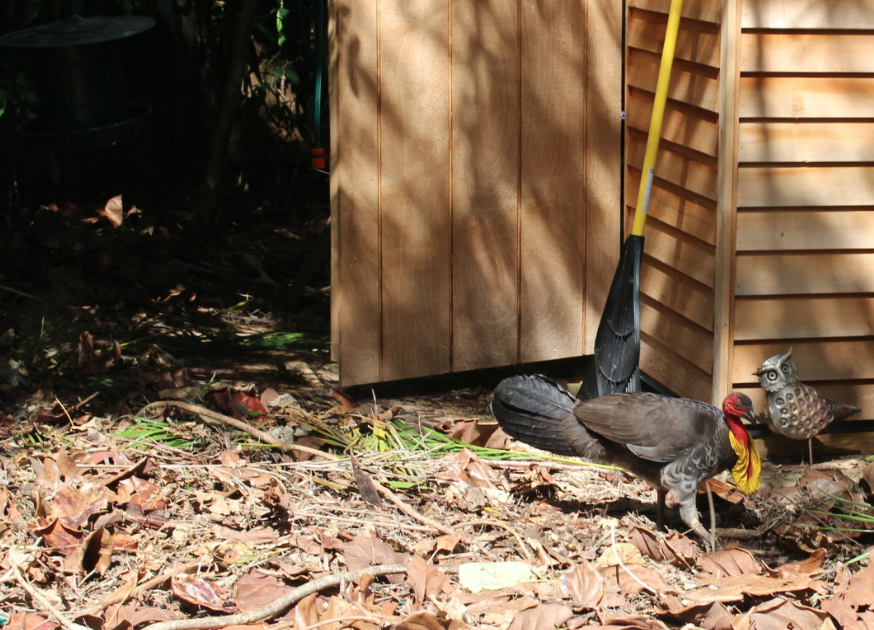
Blog
Heat is on over weather bureau ‘homogenising temperature records’
EARLIER this year Tim Flannery said “the pause” in global warming was a myth, leading medical scientists called for stronger action on climate change, and the Australian Bureau of Meteorology declared 2013 the hottest year on record. All of this was reported without any discussion of the actual temperature data. It has been assumed that there is basically one temperature series and that it’s genuine.
But I’m hoping that after today, with both a feature (page 20) and a news piece (page 9) in The Weekend Australia things have changed forever.
I’m hoping that next time Professor Flannery is interviewed he will be asked by journalists which data series he is relying on: the actual recorded temperatures or the homogenized remodeled series. Because as many skeptics have known for a long time, and as Graham Lloyd reports today for News Ltd, for any one site across this wide-brown land Australia, while the raw data may show a pause, or even cooling, the truncated and homogenized data often shows dramatic warming.
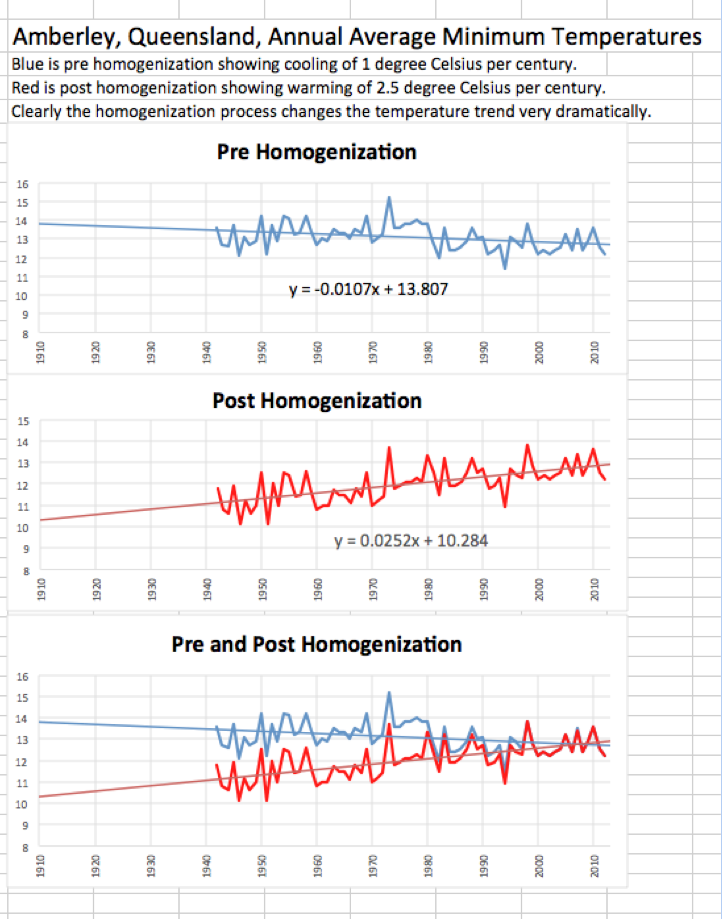
When I first sent Graham Lloyd some examples of the remodeling of the temperature series I think he may have been somewhat skeptical. I know he on-forwarded this information to the Bureau for comment, including three charts showing the homogenization of the minimum temperature series for Amberley.
Mr Lloyd is the Environment Editor for The Australian newspaper and he may have been concerned I got the numbers wrong. He sought comment and clarification from the Bureau, not just for Amberley but also for my numbers pertaining to Rutherglen and Bourke.
I understand that by way of response to Mr Lloyd, the Bureau has not disputed these calculations.
This is significant. The Bureau now admits that it changes the temperature series and quite dramatically through the process of homogenisation.
I repeat the Bureau has not disputed the figures. The Bureau admits that the data is remodelled.
What the Bureau has done, however, is try and justify the changes. In particular, for Amberley the Bureau is claiming to Mr Lloyd that there is very little available documentation for Amberley before 1990 and that information before this time may be “classified”: as in top secret. That’s right, there is apparently a reason for jumping-up the minimum temperatures for Amberley but it just can’t provide Mr Lloyd with the supporting meta-data at this point in time.
*****
The two articles in The Australian are behind a pay wall here and here. If you don’t already have a subscription to The Australian take one out today, because the articles are important and Graham Lloyd’s work is worth paying for.
Revisionist Approach Destroys Information About Natural Cycles Embedded in Climate Data
“THE process of long range forecasting is thousands of years in the making and is still used in older cultures. The Greeks inherited their knowledge from the people of the Indus Valley and Asia, Hebraic Sumerians, Chaldeans and from northern Africa. Agricultural economies needed reliable calendars and recognition of systems that both influenced and tracked seasonal fluctuations. Monitoring developed in several cultures at once over several millennia and survives today in the Near and Far East
The sacred knowledge that was passed down was that orbiting planets affect Earth and finding past matches of cycle peaks and troughs were pointers for long range predicting. It has nothing whatever to do with carbon dioxide. In exploring relationships larger planets have to each other we can observe that the so-called gas giants affect the sun when they are at certain angles. Also we can record over time how the moon causes tides in land, sea and air and how this brings cycles of, in land – earthquakes, on water – kingtides and floods, and through the atmosphere – heat waves and droughts.
Every 20 years both Jupiter and Saturn are alongside each other on one side of the sun (last in June 2000, next in November 2020) and on opposite sides of the sun (last on September 2010 and next in September 2030). From the orbits of Jupiter and Saturn comes the decadal sunspot cycle. This regularly repeating pulse of radiation affects earth’s electromagnetic field and in turn influences the atmosphere. The 11-12yr sunspot cycle correlates with Jupiter’s 11.8-yr cycle orbiting Earth
I’m quoting Ken Ring, writing for Yahoo news.
But the mainstream climate science community is intent on denying such cycles.
On page 5 of The Weekend Australian newspaper is an article by Graham Lloyd explaining how difficult it was for Australian scientist Robert Baker to get work published that suggested natural climate cycles should be taken into account when considering coastal planning and the threat of sea level rise.
In fact, as I see it, the mainstream climate science community is intent on destroying any evidence of natural climate cycles embedded in historical temperature data. I have gone into some detail, explaining the practical implications of this wanton disregard for the received evidence, in my most recent letter to Senator Simon Birmingham who has been delegated responsibility for oversight of the activities of the Bureau of Meteorology by Minister Greg Hunt.
Copies of all my correspondence to Ministers Hunt and Senator Birmingham are available online here: https://jennifermarohasy.com.dev.internet-thinking.com.au/correspondence/
If you share my concerns, what about sending the Senator your own letter or email asking that he intervene and stop the Bureau continuing with this revisionist approach to history. His contact details are here… http://www.senatorbirmingham.com.au/contact . As Edmund Burke wrote: All that is necessary for the triumph of evil is for good men to do nothing.
Open Thread
“ONLY beliefs are true or false, or sentences that express beliefs.” That’s according to Marianne Talbot, University of Oxford, explaining “critical reasoning” in a course available for download through iTunes. A theory, like anthropogenic global warming, is of course, meant to be scientifically-based so it should be open to logical argument and falsification.
Don’t Retire: Start a PhD in Paradise
BEFORE the 20th Century there was no age for retirement. There existed a leisured class who through birth or industry could choose what work they did – if and when. But, even they didn’t retire.
Retirement, like unemployment, can potentially reduce you to discussion of people, events, and lost opportunities, when great minds discuss ideas. Of course, even greater minds discuss numbers and ideas.
So if you are keen for a sea change, and are a graduate from a science or engineering discipline who enjoys problem solving, consider moving to Noosa and enrolling in a PhD or masters in weather and climate forecasting using artificial intelligence.
Applicants must be Australian citizens or permanent residents or New Zealand citizens, and must be enrolled or intending to enroll in an eligible research higher degree program at CQ University, and be based at the Noosa campus. It is expected that applicants will like problem-solving and playing with numbers; have an ability to work independently, but also be able to follow directions; and want to build a portfolio of co-authored peer-reviewed publications.
The successful applicants will each be provided with a tax-exempt living allowance scholarship for a fixed term of up to 3.5 years, with a commencing stipend of $32,000 per annum.

POSSIBLE projects include, but are not limited to, the following:
1. Forecasting El Niño-Southern Oscillation
For three decades, there has been a significant global effort to improve El Niño-Southern Oscillation (ENSO) forecasts with the focus on using fully physical ocean-atmospheric coupled general circulation models. Despite the increasing sophistication of these models, their predictive skill remains only comparable with relatively simple statistical models, with some blaming a phenomenon known as the Spring Predictability Barrier (SPB). Preliminary studies suggest that artificial neural networks can forecast through the SPB. It is possible further advances could be made through the refining of input variables building on the work of Aiming Wu (see Neural Networks, Volume 19), and possibly by also potentially considering extra-terrestrial influences including atmospheric tides (see Ken Ring, The Lunar Code).
The development of an improved method for forecasting ENSO through the elucidation of the most relevant input variables could be the focus of this project.
2. Signal processing to understand drivers of rainfall
There is a natural relationship between artificial neutral networks and signal processing. The neural network software that underpins our current prototype models was developed at the University of Florida by researchers in their department of electrical engineering with expertise in signal processing. Our prototype models, however, do not explicitly decompose the rainfall time-series signals into components. If the component signals were elucidated it would potentially aid understanding of the drivers of rainfall, and potentially improve forecasts.
Exploration of these concepts could form the central theme of a project that would best suite a graduate with a background in signal processing and/or electrical engineering.
3. Considering cyclical changes at the Antarctic to forecast rainfall in the Murray Darling
Australian farmers have long sought advice from long-range weather forecasters who operate independently of the Bureau of Meteorology, perhaps beginning with the work of astronomer Inigo Owen Jones. Modern forecasters using the same cyclical variations claims a strong relationship between higher sea ice averages in the Antarctic and periods of below average rainfall for eastern Australia and heavier late season frosts (see Kevin Long, www.thelongview.com.au). The Antarctic Oscillation (also known as the Southern Annular Mode or SAM) is also thought to be an important driver of rainfall variability in southern Australia (see Australian Bureau of Meteorology, http://www.bom.gov.au/climate/enso/history/ln-2010-12/SAM-what.shtml).
The focus of this project could be input selection and optimisation for monthly rainfall forecasting in the Murray Darling, including a consideration of the Antarctic Oscillation and changes in sea ice extent.
4. Modelling past temperatures and forecasting future temperatures – globally and locally
General circulation models, that underpin the current dominant paradigm in climate science and forecast global warming, simulate climate based on an assumed first principles understanding of the physical process. In contrast, ANNs rely on historical climate data to acquire knowledge, learn relationships, model and measure relationships and then use this information to make forecasts.
ANNs could be used to both provide an independent forecast of future temperatures, and as an independent method of GCM validation under future climate. Limited research is already occurring in this area (e.g. Kisi and Shiri, International Journal of Climatology Volume 34) and could be the focus of more than one PhD and/or Masters project. Such projects could also explore local, regional and global variability in temperatures historically and into the future.
The integrity of historical temperature data is largely irrelevant to the performance of a GCM, but critical to the operation of an ANN. So projects that focused on the use of ANN for forecasting future climate, would very likely benefit from first developing a technique for creating continuous series of high quality temperature data for individual locations as an input variable. While such temperature series theoretically already exist, they are not stable over time and often represent a modelled version of the temperatures originally recorded (see Zhang et al, Theoretical and Applied Climatology, Volume 115; Stockwell and Stewart, Energy & Environment, Volume 23; J. Nova http://joannenova.com.au/tag/homogenization-temperature-data/ T. Heller http://stevengoddard.wordpress.com/2014/07/18/nasa-hacking-australia/; B. Dedekind http://wattsupwiththat.com/2014/06/10/why-automatic-temperature-adjustments-dont-work/; Marohasy et al., The Sydney Papers Online, Issue 26).
5. Forecasting rainfall to aid mine scheduling
There is a need for more skillful medium-term rainfall forecasts for the Bowen Basin, a key coal-mining region in Queensland. Official seasonal forecasts are currently based on general circulation models, are not reliable, and do not provide adequate information in terms of timing and strength of rainfall for mine scheduling and pro-active risk management. V.S. Sharma and colleagues detail these issues in a report published by the National Climate Change Adaptation Research Facility in 2012.
The focus of a PhD or masters could include investigation of the possibility of using ANNs to generate forecasts for shorter time intervals (2 weeks and 1 week) and shorter lead times (2 weeks and 1 week) and using humidity, atmospheric pressure, cloudiness, wind direction and speed, as well as key climate indices as input variables.

NEXT STEP, if you are interesting in applying, or just want more information, please contact me on mobile 041 887 32 22 or email jennifermarohasy at gmail.com. Closing date for applications is 30th October 2014.
THERE is more information on the scholarships at the CQ University website at:
http://www.cqu.edu.au/research/future-candidates/scholarships
General information about ANNs is taught as part of machine learning courses. Yaser Abu-Mostafa at the California Institute of Technology offers such an introductory online course, which includes some theory, algorithms and applications, available for download and viewing at https://work.caltech.edu/telecourse.html.
Our ANNs are based on software developed by Neurosolutions. More information on this software is available at http://www.neurosolutions.com .
Recent relevant publications by John Abbot and me include:
Abbot J., Marohasy J., 2015. Using artificial intelligence to forecast monthly rainfall under present and future climates for the Bowen Basin, Queensland, Australia. International Journal of Sustainable Development and Planning. In press
Abbot J., Marohasy J., 2014. Input selection and optimization for monthly rainfall forecasting in Queensland, Australia, using artificial neural networks. Atmospheric Research 128 (3), 166-178
Abbot J., Marohasy J., 2013. The potential benefits of using artificial intelligence for monthly rainfall forecasting for the Bowen Basin, Queensland, Australia, In: Brebbia, C.A. (Ed.), Water Resources Management VII, WIT Press, Southhampton, (on-line) doi:10.2495/WRM130261
Abbot J., Marohasy J., 2012. Application of Artificial Neural Networks to rainfall forecasting in Queensland, Australia. Advances in Atmospheric Science 29, 717-730
Relevant other references include:
Australian Bureau of Meteorology, 2014. The Southern Annular Mode (SAM) http://www.bom.gov.au/climate/enso/history/ln-2010-12/SAM-what.shtml
Dedekind, B. 2014. Why automatic temperature adjustments don’t work http://wattsupwiththat.com/2014/06/10/why-automatic-temperature-adjustments-dont-work/
Heller A., 2014. NASA Hacking Australia http://stevengoddard.wordpress.com/2014/07/18/nasa-hacking-australia/
Halide H., Ridd P., 2008. Complicated ENSO models do not significantly outperform very simple ENSO models. International Journal of Climatology 28, 219–233
Kisi O., Shiri J., 2014. Prediction of long-term monthly air temperatures using geographical inputs. International Journal of Climatology 34, 179-186
Long K., 2014. Current forecasts http://www.thelongview.com.au/forecast.html
Marohasy J., Abbot J., Stewart K., Jensen D., 2014. Modelling Australian and Global Temperatures: What’s Wrong? Bourke and Amberley as Case Studies. The Sydney Papers Online, Issue 26. http://www.thesydneyinstitute.com.au/paper/modelling-global-temperatures-whats-wrong-bourke-amberley-as-case-studies/
Ring K., 2006. The Lunar Code. Random House, New Zealand, pp 208
Risbey J. S., 2009. On the remote drivers of rainfall variability in Australia. Monthly Weather Review 137, 3233-3253
Sharma V.S, et al. 2012. Extractive resource development in a changing climate: Learning the lessons from extreme weather events in Queensland, Australia, National Climate Change Adaptation Research Facility, Gold Coast, pp. 110.
Stockwell D., Stewart K, 2012. Biases in the Australian High Quality Temperature Network, Energy & Environment, Vol. 23, 10.1260/0958-305X.23.8.1273
Wu A., Hsieh W.W., Tang B., 2006. Neural network forecasts of the tropical Pacific sea surface temperatures. Neural Networks 19, 145–154
Zhang L. et al. 2014. Effect of data homogenization on estimate of temperature trend: a case of Huairou station in Beijing Municipality. Theoretical and Applied Climatology 115, 365-373

Tangled Temperature Trends
ON 10th June 2014 I sent the Hon Greg Hunt MP, Minister for the Environment, an email suggesting that a cooling temperature trend was establishing across northeastern Australia.
I recently received a reply from the Bureau with a covering letter from Senator Simon Birmingham, in response to this email and also my letter of 4th March. I will reply in due course.
Interestingly on the sixth page of this document, the Bureau both makes the point that 2013 was the hottest year on record for Queensland, while conceding that the period 2002-2013 shows short-term cooling.
This potential tangling of trends is not acknowledged, let alone reconciled in the document from the Bureau.
According to the Bureau the cooling is consistent with increases in monsoonal rainfall. But I thought there was drought over much of this period, that is from 2002-2013?
At the top of the next page (scroll to page 7), the Bureau points out that over time periods sufficiently long for ENSO-related variability to be smoothed out, there is a clear and sustained warming signal from the 1950s onwards.
I don’t think I ever disputed that the late 20th Century experienced warming, but the point that seems to be lost on the Bureau is that a cooling trend may have since set-in. Indeed, Table 1 (reproduced from my email to the Minister of 10th June) suggests quite dramatic cooling.
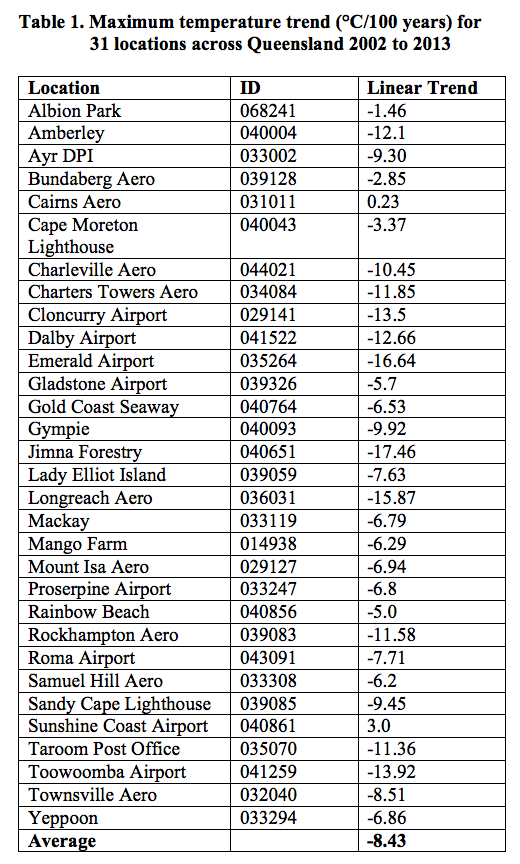
Of course in my email of 10th June I explained why this cooling is irreconcilable with the claims in the State of the Climate Report 2014 of record warming. It comes down to the apparent recent record warm years being a consequence of the two-step homogenisation process providing a revisionist approach to ensure the official temperature statistics are politically correct.
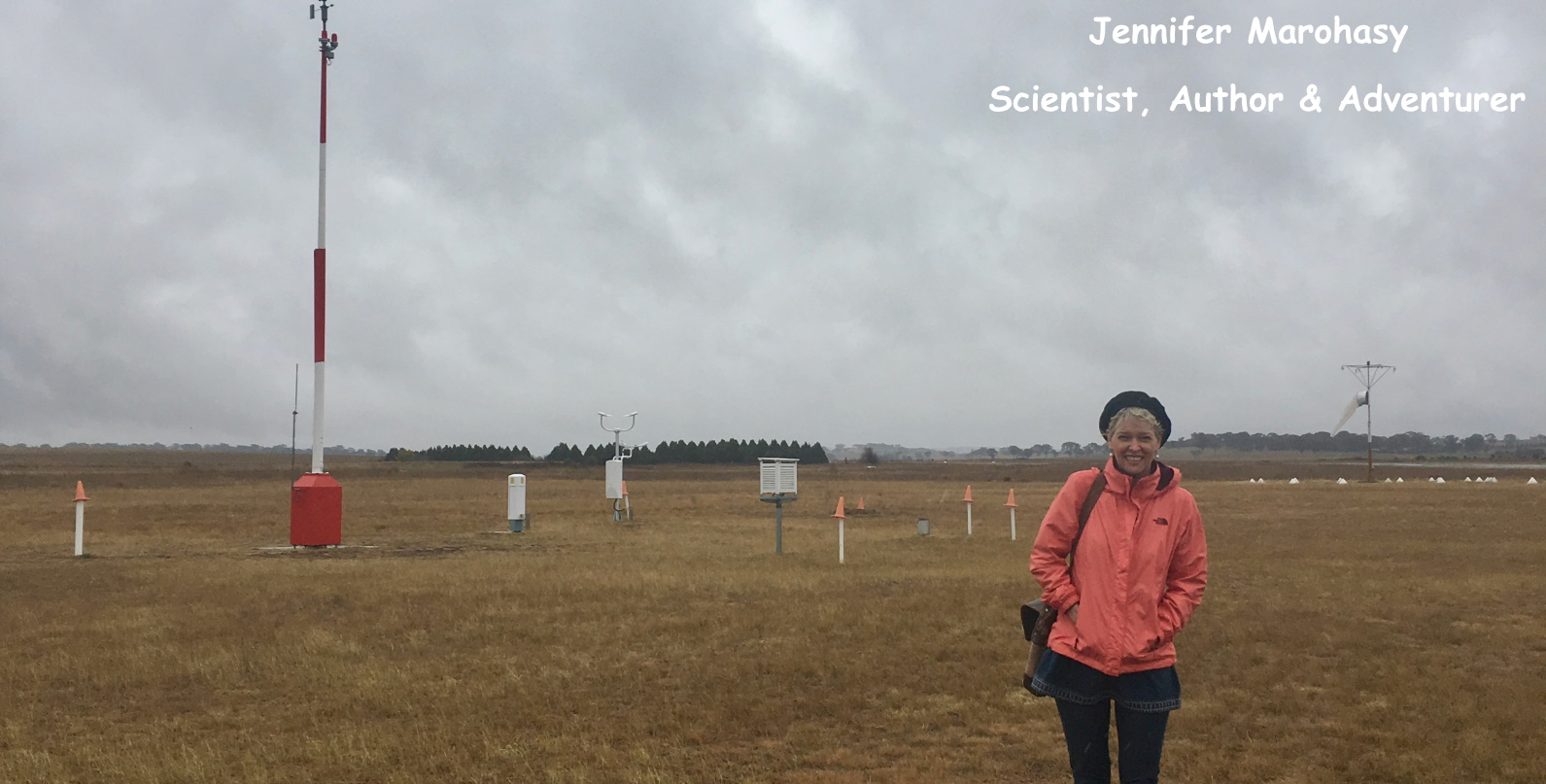
 Jennifer Marohasy BSc PhD has worked in industry and government. She is currently researching a novel technique for long-range weather forecasting funded by the B. Macfie Family Foundation.