• Skip to primary navigation
  • Skip to main content
  • Skip to primary sidebar
  • Skip to footer
Jennifer Marohasy

Jennifer Marohasy

a forum for the discussion of issues concerning the natural environment

  • Home
  • About
  • Publications
  • Speaker
  • Blog
  • Temperatures
  • Coral Reefs
  • Contact
  • Subscribe

Blog

Climate Change: The Facts 2017

June 3, 2017 By jennifer

Today’s Weekend Australian includes an article that begins:

“Iconic, ailing Australian satirist Clive James has penned a savage essay on climate change alarmism, controversially cooking everyone from Barack Obama to Kevin Rudd to Tim Flannery to Al Gore to Donald Trump in the boiled and rising ocean of his wit…”

The essay in The Inquirer section of the same newspaper is an extract from chapter 22 of the book I have been working on for many months now.



front cover of book

Contributors to Climate Change: The Facts 2017 do not conform to a unitary view.   As I explain in the book’s introduction:

“An advantage of my approach in the compiling of the chapters for this book – an approach where there has been no real attempt to put everything into neat boxes – is that there are many surprises. I am referring to the snippets of apparently anomalous information scattered through the chapters. These can, hopefully, one day, be reconciled. As this occurs, we may begin to see the emergence of a coherent theory of climate – where output from computer-simulation models bears some resemblance to real-world measurements that have not first been ‘homogenised’.

“There are many chapters in this book about ‘homogenisation’ (chapters 5, 6, 7, 8 and 9 by Anthony Watts, Tony Heller, Dr Tom Quirk, Jo Nova and me, respectively). Homogenisation, in essence, involves the remodelling of data, and is now a technique integral to the development of key official national and global measures of climate variability and change – including those endorsed by the IPCC.

It is generally stated that without homogenisation temperature series are unintelligible. But Dr Jaco Vlok from the University of Tasmania and I dispute this – clearly showing that there exists a very high degree of synchrony in all the maximum temperature series from the State of Victoria, Australia – beginning in January 1856 and ending in December 2016 (chapter 10). The individual temperature series move in unison suggesting they are an accurate recording of climate variability and change. But there is no long-term warming trend. There are, however, cycles of warming and cooling, with the warmest periods corresponding with times of drought.

Indeed, some climate sceptics consider the homogenisation technique used in the development of the official temperature trends to be intrinsically unscientific. They consider homogenisation a technique designed to generate output consistent with the computer-simulation models, which, in turn, are integral to the belief that there are consistent year-on-year temperature increases – contrary to the actual measurements. Temperature series that are a product of homogenisation could be considered ‘alternative facts’ – although, ironically, this is a term newly minted by those who generally agree with these self-same homogenised (remodelled) temperature constructs.”

Climate Change: The Facts 2017 is available for pre-order http://thefacts2017.ipa.org.au

Media enquiries should be directed to the IPA’s Media and Communications Manager, Evan Mulholland on 0405 140 780 or emulholland@ipa.org.au
Filed Under: Books Tagged With: climate change

Australia’s Hottest Day on Record Ever – Deleted

February 13, 2017 By jennifer

The last few days have been very hot across eastern Australia. The mainstream media have been reporting ‘unprecedented’ conditions. This fits a popular narrative, but its inconsistent with the original historical record.

It was very hot in Australia in the late 1800s and the early years of the 1900s, particularly in outback Australia – at places like Bourke. Many of the extremely hot days were recorded using non-standard equipment, and so they are not recognised by Australia’s Bureau of Meteorology. Outrageously though, the Bureau has deleted from the raw digitised record the hottest day ever recorded in standard equipment at an official weather station. Ostensibly, because it was recorded on a Sunday – the day that the temperature-recorders normally had off in the days of manual temperature recordings.

No doubt the fellow who recorded temperatures from the thermometer in the Stevenson screen at the Bourke post office got up on the morning of Sunday 3rd January 1909, and decided he was going to work anyway. He was not going to miss what did turn out to be the hottest day of the century.

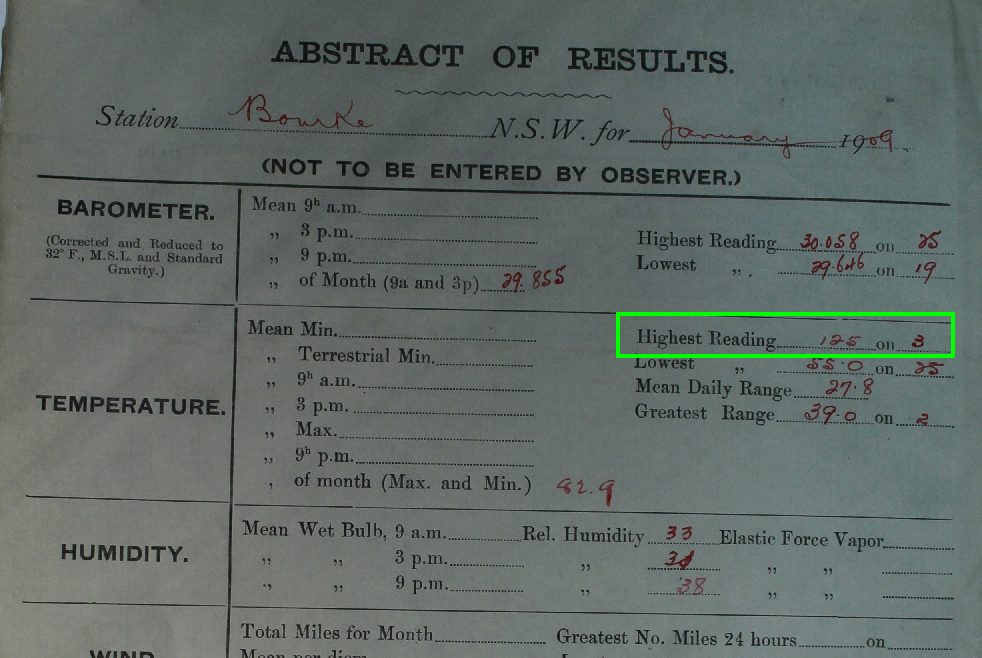
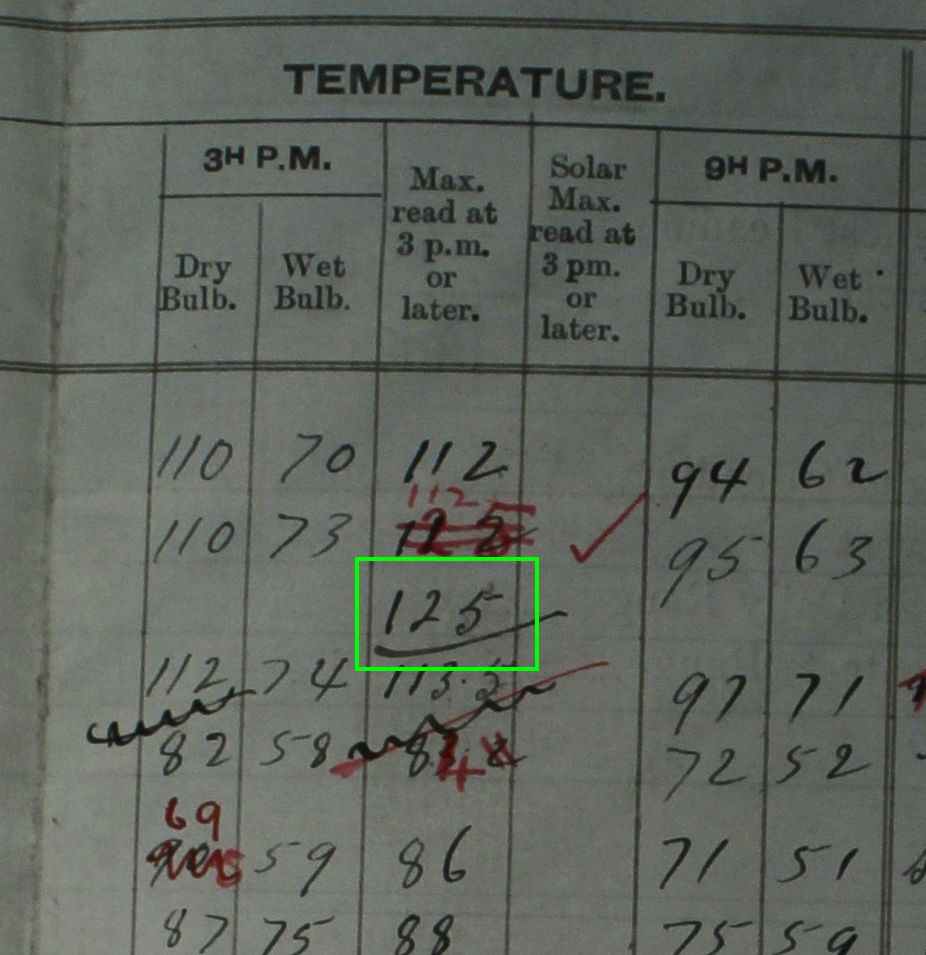
So, when I went to the trouble of getting access to the log book, now held by the National Archives of Australia, I could see that the fellow had not only written in 125 degree Fahrenheit (equivalent to 51.6 degree Celsius) – he had also underlined it!

I took a photograph of the entry, Exhibit 1.

Exhibit 1. Photograph from log book of temperature recording as made at Bourke post office in January 1909.   Photograph taken by Jennifer Marohasy at National Archives of Australia, Chester Hill reading room, on 26 June 2014.
Exhibit 1. Photograph from log book of temperature recording as made at Bourke post office in January 1909. Photograph taken by Jennifer Marohasy at National Archives of Australia, Chester Hill reading room, on 26 June 2014.

Back then the person who recorded the temperatures each day, known as the ‘Observer’, was not the same person who compiled the ‘Abstract of Results’ at the end of the month. This supervisor (who used a red pen) sometimes made changes to temperatures as recorded by the Observer; and seems to have been initially confused as to the actual temperature on Saturday 2nd January 1909 at Bourke (originally changing it from 112 to 125).

Exhibit 2. 'Abstract of Results' page from the log book.   Photograph taken by Jennifer Marohasy at the National Archives of Australia, Chester Hill reading room on 26 June 2014.
Exhibit 2. ‘Abstract of Results’ page from the log book. Photograph taken by Jennifer Marohasy at the National Archives of Australia, Chester Hill reading room on 26 June 2014.

The supervisor was clear in his summary though, writing in red that the highest temperature at Bourke for the month of January 1909 was 125 degree Fahrenheit recorded on 3rd January, as shown in Exhibit 2.

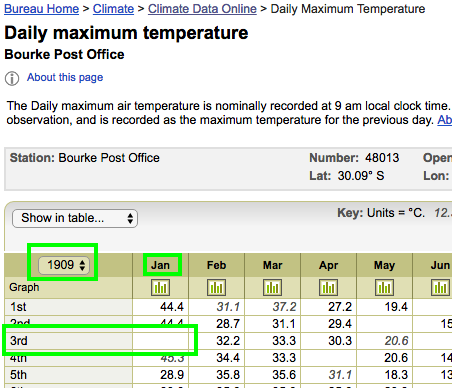
But if you go to the raw temperature data at the Australian Bureau of Meteorology’s website, there is no entry for this date, as shown in Exhibit 3.

Exhibit 3.  The 'raw data' as archived at the Bureau of Meteorology website has no entry for 3 January 1909.
Exhibit 3. The ‘raw data’ as archived at the Bureau of Meteorology website has no entry for 3 January 1909.

****

If you like what I do, consider making a goodwill contribution.

Filed Under: Information Tagged With: Temperatures

Homogenisation Used to Embed Artificial Warming Trend in Colorado Temperature Record

January 22, 2017 By jennifer

After looking at hundreds of temperature series from different locations across Australia, I’ve come to understand that only cities show the type of warming reported by the IPCC, and other such government-funded institutions. Much of this warming is due to what is known as the Urban Heat Island (UHI) effect: bitumen, tall-buildings, air-conditioners, and fewer and fewer trees, means that urban areas become hotter and hotter.

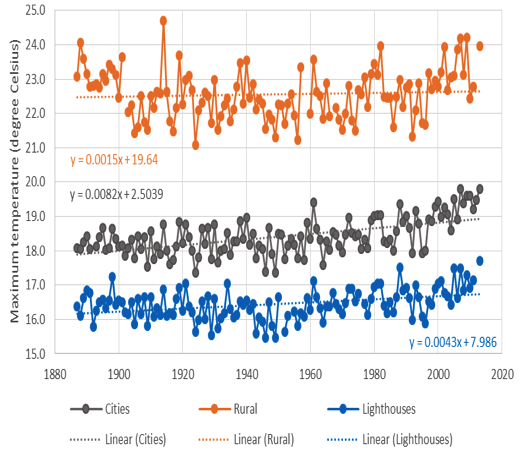
For example, in a recent study of temperature variability and change for south-east Australia it is evident that maximum temperatures in the cities of Melbourne and Hobart are increasing at a rate of about 0.8 degree Celsius per century; while the rate of increase at the nearby lighthouses is half of this.

While the trend of about 0.4 degree Celsius per century at the lighthouses – as shown in Chart 1 – is arguably an accurate record of temperature change, the Australian Bureau of Meteorology changes this. To be clear, the Bureau changes a perfectly good temperature series from Cape Otway lighthouse by remodeling it so that it has Melbourne’s temperature signal – all through the process of homogenisation.

In developing the series for south-east Australia, I combined the longest continuous series from rural and urban locations and also lighthouses.  The trends from these locations is very different: the cities are effected by UHI, the rural locations by floods and droughts, while lighthouse temperatures reflect the maritime influence.
In developing the series for south-east Australia, I combined the longest continuous series from rural and urban locations and also lighthouses. The trends from these locations is very different: the cities are effected by UHI, the rural locations by floods and droughts, while lighthouse temperatures reflect the maritime influence.

Government agencies in the USA have done exactly the same thing to temperature records for Colorado. This is all explained in detail in this new video by Monte Naylor:
 
https://vimeo.com/196878603/b9ea716a74

The video runs for about 40 minutes, and is quite technical.

The conclusions from this study have been summarized by Monte as follows:

(1) The USHCN Fort Collins station temperature record was not recognized by NOAA as having the heat bias from expanding UHI which has been easily identified by other researchers.

(2) NOAA’s homogenization program adjusted the USHCN Boulder station temperature history in a fashion that does not match any of the four other nearby rural/suburban long-term temperature histories. Nor does the NOAA-homogenized Boulder temperature history resemble the average temperature trend found by this study.

(3) NOAA’s homogenization program adjusted the Boulder temperature history to resemble the UHI-contaminated temperature history of the Fort Collins station.

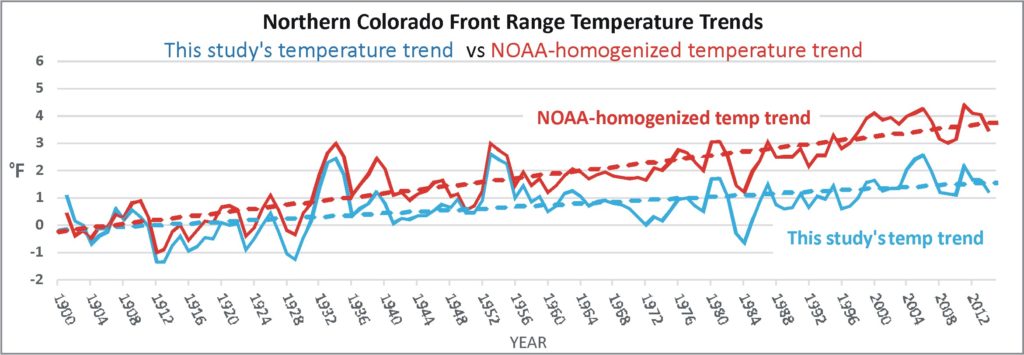
(4) The best estimate of the northern Colorado Front Range temperature trend is obtained by using the TOB-adjusted Group of 5 average which shows a warming temperature trend of 1.7 °F (0.95 °C) from 1900 to 2015. The NOAA temperature trend, about 4 °F over 115 years, is more than twice the best estimate of this study.

(5) About 70% of the warming shown in the Group of 5 average temperature trend occurred before 1932. Temperatures trends of recent decades do not show anomalous warming.  Distinct warm temperature events occurred in the 1930’s and 1950’s that were much warmer than those observed since the turn of the 21st century.

(6) The Northern Front Range Group of 5 average temperature trend does not increase in a fashion consistent with increasing atmospheric carbon dioxide.

This chart compares the homogenised-temperature trend with a trend based on simple statistical averaging - both series are purported to represent climate variability and change for the Northern Colorado Front Range, 1900 to 2015.
This chart compares the homogenised-temperature trend with a trend based on simple statistical averaging – both series are purported to represent climate variability and change for the Northern Colorado Front Range, 1900 to 2015.

Filed Under: Information Tagged With: Temperatures

Somewhat Contrived: The Bureau’s Approach to Calculating Warmest Years

January 6, 2017 By jennifer

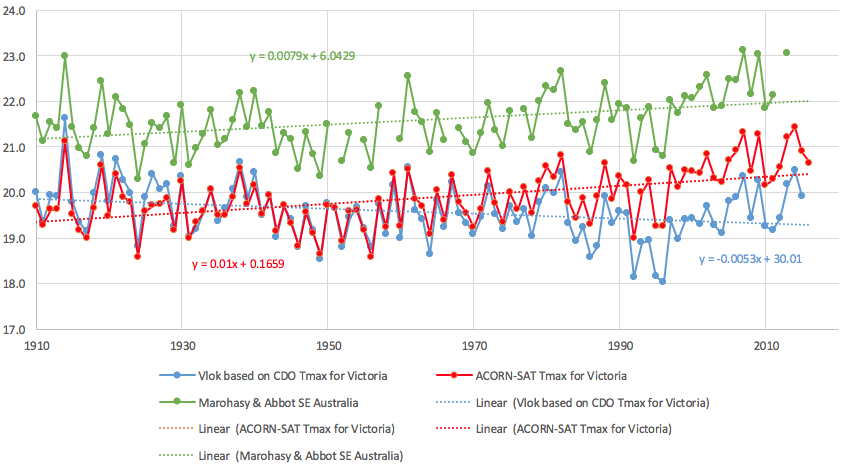
Media reports yesterday claimed that 2016 was another record hot year. However, close scrutiny of all the temperature data from the state of Victoria paints quite a different picture. When all 289 temperature series from Victoria are simply combined, the hottest years are in the early part of the record. In particular, 1914 is very evidently the hottest year on record – see blue time series in Chart 1. This finding builds on a recently published book chapter focused on south-east Australia, and is part of a larger study working towards a realistic reconstruction of Australia’s temperature history.

Chart 1. Two temperature reconstructions for the state of Victoria (blue and red lines), and also a reconstruction for the south-east of Australia (green line) – showing annual mean maximum temperatures from 1910. The three time-series are based on very different methodologies, and show a high degree of inter-annual synchrony – but very different overall temperature trends. The different methods used to construct these three series, and the resulting statistics, are detailed in Table 1.

Yesterday the Australian Bureau of Meteorology released its Annual Climate Statement, claiming 2016 to be the fourth-warmest year on record for Australia – and also an unusually wet year. Wet years are usually much cooler years, but because the overall trend in the ACORN-SAT* time series shows significant warming, even a wet year comes out as relatively hot.

Of course there is no one place in Australia where the average temperature can be measured; so the Bureau relies on a reconstruction to determine how hot 2016 was, relative to the historical record. Their method, however, is quite subjective in terms of choice of locations to include, the method used to remodel the individual temperature series before they are combined (this is refered to as homogenisation*), and the area weighting applied – with the weighting changing on a daily and monthly basis.

Late last year, I had a book chapter, co-authored with John Abbot and published by Elsevier*, which shows historical temperature trends for south-east Australia from 1887 to 2013 based on a more transparent system – that can be easily replicated. We choose the longest continuous series, used the same series to calculate every value, and applied an area weighting based on topography and landuse – and did not remodel individual temperature series. In the chapter we conclude that temperature trends for south-east Australia are best described as showing statistically significant cooling (yes cooling) of 1.5 degree Celsius from 1887 to 1949, followed by warming of nearly 2 degrees Celsius from 1950 to 2013. The warmest year in this reconstruction is 2007, followed very closely by 1914.

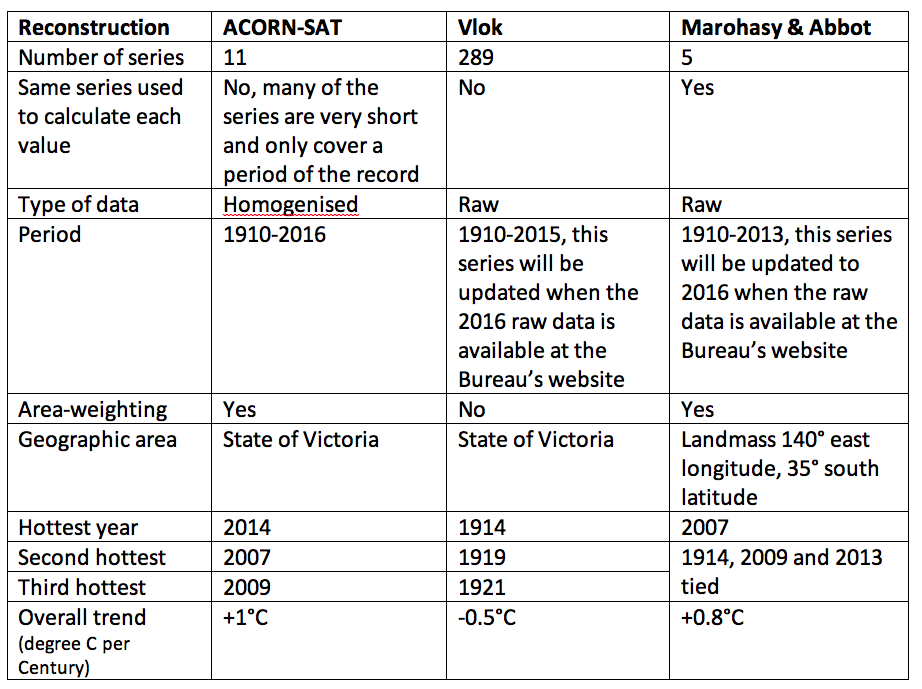
A colleague at the University of Tasmania, Jaco Vlok, has compared our south-east reconstruction with a reconstruction based on all 289 temperature series for Victoria – but only from 1910. The different methodologies used to generate these reconstructions, and also the official ACORN-SAT series for Victoria, which is the series used by the Bureau to calculate the official statistics for Australia, are detailed in Table 1.

Table 1.  Statistics for the three temperature reconstructions, and contrasting methods used to construct the series.
Table 1. Statistics for the three temperature reconstructions, and contrasting methods used to construct the series.

There is a very high degree of synchrony between the reconstructions, though when all the raw data is simply combined – Vlok’s approach – the hottest years are all in the earlier part of the record: 1914 (hottest) followed by 1919, 1921, 1938, 1961 and then 2014.

Postscript: I have expanded on this analysis in an article just now published by Graham Young at OLO. Jennifer, Noosa, Monday 9th January, 2017.

_____

* ACORN-SAT stands for Australian Climate Australian Climate Observations Reference Network – Surface Air Temperature and is a dataset developed by the Bureau based on a subset of available temperature series, almost all homogenised, and then combined with an area weighting and used to report climate variability and change. The annual climate statement for 2016, based on this ACORN-SAT dataset, is here: http://media.bom.gov.au/releases/333/2016-a-year-of-extreme-weather-events/

* Homogenisation involves changes to measured temperature values ostensibly to correct for non-climatic variables. These changes to the observational data are quite different from quality assurance. For example, the need for homogenisation most often results from a ‘statistical test’ detecting a break point, these breakpoints often occur after a period of missing data. In response all values preceding the breakpoint are often reduced by a specific amount back to 1910. The amount by which the measured observational values are reduced is determined through the application of algorithms and calculated relative to what are referred to as ‘neighbouring’ stations, which may be Urban Heat Island (UHI) effected, and/or located many hundreds of kilometers from the target location.

* Marohasy, J. & Abbot, J. 2016. Southeast Australian Maximum Temperature Trends, 1887–2013: An Evidence-Based Reappraisal.  In: Evidence-Based Climate Science (Second Edition), Pages 83-99. http://dx.doi.org/10.1016/B978-0-12-804588-6.00005-7 You can read more about this series here: https://jennifermarohasy.com.dev.internet-thinking.com.au/2016/12/temperatures-trends-southeast-australia-1887-part/

Filed Under: Information Tagged With: Temperatures

Temperatures Trends, Southeast Australia from 1887 – Part A

December 17, 2016 By jennifer

Charts that show year-on-year increases in temperature have become a symbol of all that is wrong with the world – or at least modernity and Western Civilization. So, why then, when such a chart was shown to a studio audience of opinion leaders, did it caused them to break-out in spontaneous applause? The Sydney Q&A audience could not conceivably have been applauding global warming – more likely this audience was applauding the affirmation that was being afforded their belief in global warming?


Of course, the chart that particle physicist Brian Cox held-up to the audience (as shown in the above Youtube video) is an historical reconstruction. There is no one place on Earth where the world’s temperature can be measured – and this particular chart is based on a variable number of homogenised temperatures series. By ‘homogenised’ I mean remodelled – ostensibly to ensure “non-climatic influences are minimised”; but in the process trends are changed.

I’ve just had a book chapter, which I co-authored with John Abbot, published that shows historical temperature trends for southeast Australia back to 1887 – using unhomogenised temperature series.

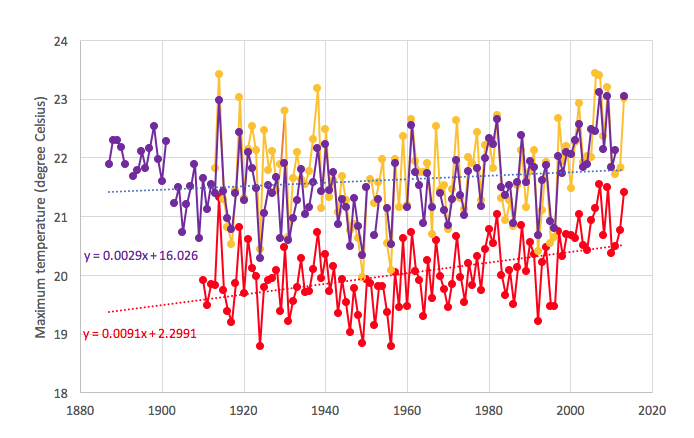
This reconstruction is shown by the purple line in Chart 1 (see below). It suggests a rate of warming less than half that shown in Cox’s global homogenised reconstruction; and might be better described as exhibiting considerable inter-annual variability – with cycles of cooling and warming.

Chart 1. Southeast Australian temperature reconstruction (based on area weighting of maximum temperature series from Melbourne, Echuca, Deniliquin, Cape Otway and Wilson Promontory lighthouses), compared with the shorter Rutherglen series, and also ACORN-SAT maximum temperatures just for the state of Victoria.

The method used to develop this reconstruction perhaps represents an important first step in developing an Australian-wide reconstruction based on un-homogenised data.

Our chapter concludes that the series for southeast Australia is best described as showing statistically significant cooling (yes cooling) of 1.5 degree Celsius to 1949, followed by warming of nearly 2 degrees Celsius to the present. (If you would like a pdf copy of the chapter, email me: j.marohasy at climatelab.com.au).

The official Bureau of Meteorology reconstruction for the state of Victoria is shown in red in Chart 1; and is based on ACORN-SAT. The homogenised ACORN-SAT database only begins in 1910. It is used by the Bureau, and also CSIRO, to report climate variability and change. Eleven locations are used in the ACORN-SAT reconstruction for Victoria – with some of the series from these locations very short, and with a lot of missing data; all were remodolled.

Our southeast reconstruction is based on the same five long and continuous series with only three adjustments made to two of the series (Deniliquin and Cape Otway) to correct for equipment changes in 1908 and 1898 – as detailed in the chapter.

Despite the very different methodologies used, the reconstructions are surprisingly similar. Both reconstrucions show considerable inter-annual variability, with almost synchronous peaks and troughs: see Chart 1. In both reconstructions, 2007 is the hottest recent year, though temperatures were almost as hot back in 1914. In large part because the ACORN-SAT database only starts in 1910, which corresponds with a dip in the record, this official series for Victoria indicates an overall rate of warming of 0.9 degree Celsius per century – compared to 0.3 degree Celsius for the southeast reconstruction.

Both reconstructions are of maximum temperatures. Global warming is typically reported as an increase in the mean temperature, which is the average of the maximum and minimum temperatures. The maximum temperature is the daytime temperature; and an arguably better measure of regional temperature variation because of the higher rates of turbulent mixing of the atmosphere during the day time.

In Chart 1, I’ve also plotted temperature maxima as measured at the agricultural research station near Rutherglen in northern central Victoria – this is the series shown in yellow. This is an exceptionally high quality series because it has been measured using standard equipment at the same rural site for over 100 years. But it was not part of the southeast reconstruction because we only used series that began on, or before, 1887 for the southeast reconstruction.

Temperature minima and maxima do not always trend in the same direction. In the case of Rutherglen, temperature minima actually show cooling – consistent with other series from this region. This cooling is most obvious in spring, and probably associated with the extensive development of irrigation. Through the homogenisation process the Bureau change the cooling in the Rutherglen temperature minima to warming before including Rutherglen in the official ACORN-SAT database. I’ve written extensively about this, including in a recent research paper entitled simply ‘Temperature change at Rutherglen in south-east Australia’.


Key Reference/New book chapter

Marohasy, J. & Abbot, J. 2016. Southeast Australian Maximum Temperature Trends, 1887–2013: An Evidence-Based Reappraisal.  In: Evidence-Based Climate Science (Second Edition), Pages 83-99. http://dx.doi.org/10.1016/B978-0-12-804588-6.00005-7

Filed Under: Information Tagged With: Temperatures

No QA of bureau temperature data by CSIRO bushfire modellers

October 27, 2016 By jennifer

Despite an exceptionally cool end to this October, the CSIRO and Bureau of Meteorology have just put out a joint report claiming that there is going to be an increase in the number of hot days and thus an increased risk of devastating bushfires — based on homogenised (remodelled) temperatures, of course.

CSIRO experts forecast bushfire risk based on Bureau temperature data, but they don’t first undertake any quality assurance of the Bureau’s data.

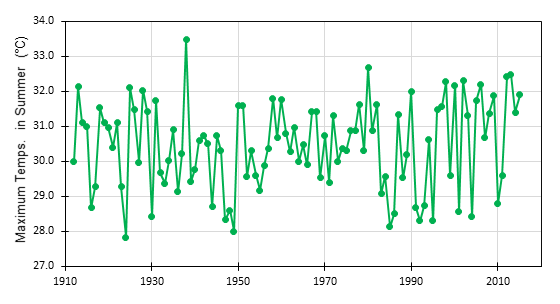
If we consider one of the best long and continuous temperature series for southern Australia, which is the Rutherglen raw temperature data, and just maximum temperatures in summer: the hottest summer was back in 1938-1939, as shown in this chart.

Mean Maximum temperatures as measured at Rutherglen during summer (December 1912 to February 2016). Full report at http://climatelab.com.au/newclimate/10.22221/nc.2016.001/
Mean Maximum temperatures as measured at Rutherglen during summer (December 1912 to February 2016). More more information see http://dx.doi.org/10.22221/nc.2016.001.

On 13 January 1939 this region experienced one of the worst bushfire disasters in Australia’s history; it became known as Black Friday.

At 33.5°C, the summer of 1938–39 was 2.2°C hotter than the average maximum temperature during the ten most recent summers at Rutherglen, and a full 3°C hotter than the average maximum summer temperature at Rutherglen for the entire period of the record.

And yet today the Bureau and CSIRO are suggesting we should be concerned by a 1°C increase in average temperature over the last 100 years.

Rather than fear mongering, the CSIRO would do well to actually consider the actual integrity of the data being provided by its partner – the Bureau of Meteorology.

In a recent article published by On Line Opinion, I explained that the difference between the official-adjusted maximum temperature for Rutherglen on 13th January 1939 versus the actual measured value is rather large– more than 5 °C. Historical temperature data is used to model and forecast the likely impact of future bushfires, with Fire Danger Indices sensitive to small changes in temperature.

********************
1. The BOM-CSIRO State of the Climate report is here http://media.bom.gov.au/releases/308/state-of-the-climate-2016-delivers-the-latest-science-on-our-changing-climate/ , some media is here http://www.abc.net.au/news/2016-10-27/bom-csiro-forecast-more-hot-days-fire-season-climate-change/7968992

2. Homogenised temperatures, and planning for bushfires
http://www.onlineopinion.com.au/view.asp?article=18490&page=1

Filed Under: Information, Uncategorized Tagged With: Bushfires

  • « Go to Previous Page
  • Go to page 1
  • Interim pages omitted …
  • Go to page 23
  • Go to page 24
  • Go to page 25
  • Go to page 26
  • Go to page 27
  • Interim pages omitted …
  • Go to page 607
  • Go to Next Page »

Primary Sidebar

Recent Comments

  • Ian Thomson on Vax-ed as Sick as Unvax-ed, Amongst My Friends
  • Dave Ross on Vax-ed as Sick as Unvax-ed, Amongst My Friends
  • Dave Ross on Vax-ed as Sick as Unvax-ed, Amongst My Friends
  • Alex on Incarceration Nation: Frightened of Ivermectin, and Dihydrogen monoxide
  • Wilhelm Grimm III on Incarceration Nation: Frightened of Ivermectin, and Dihydrogen monoxide

Subscribe For News Updates

  • This field is for validation purposes and should be left unchanged.

December 2025
M T W T F S S
1234567
891011121314
15161718192021
22232425262728
293031  
« Jan    

Archives

Footer

About Me

Jennifer Marohasy Jennifer Marohasy BSc PhD has worked in industry and government. She is currently researching a novel technique for long-range weather forecasting funded by the B. Macfie Family Foundation. Read more

Subscribe For News Updates

Subscribe Me

Contact Me

To get in touch with Jennifer call 0418873222 or international call +61418873222.

Email: jennifermarohasy at gmail.com

Connect With Me

  • Facebook
  • LinkedIn
  • RSS
  • Twitter
  • YouTube

Copyright © 2014 - 2018 Jennifer Marohasy. All rights reserved. | Legal

Website by 46digital