• Skip to primary navigation
  • Skip to main content
  • Skip to primary sidebar
  • Skip to footer
Jennifer Marohasy

Jennifer Marohasy

a forum for the discussion of issues concerning the natural environment

  • Home
  • About
  • Publications
  • Speaker
  • Blog
  • Temperatures
  • Coral Reefs
  • Contact
  • Subscribe

Blog

BoM Blast for Dubious Record Hot Day

February 11, 2018 By jennifer

IN September 2017, the Australian Bureau of Meteorology (BoM) claimed a series of new record hot days across south eastern Australia, including on 23 September at Mildura. At that time, the mainstream media reported this as a new record for the state of Victoria, specifically claiming it was the hottest September day ever recorded – all the way-back to September 1889. This claim, however, cannot be verified because the BoM uses a non-standard method for recording temperatures at Mildura, and furthermore the parallel data provided to me in December 2017 as proof of equivalence is flawed and deficient.

Background

On 23 September 2017, a new record hot day for Victoria was claimed at the Mildura airport using an electronic probe in an automatic weather station (AWS) housed in a Stevenson screen.

The BoM claims that measurements from such devices are ‘comparable’ to measurements from traditional mercury thermometers, which were used to measure official air temperatures at Mildura from 13 June 1889 until 1 November 1996.

There is no documentation, however, supporting this contention for Mildura or any of the other nearly 500 AWS spread across the Australian continent. Furthermore, the BoM does not have World Meteorological Organisation, or any other form of accreditation (i.e. ISO 17025) for any of its AWS. In addition, the BoM uses a non-standard method of recording temperatures from such devices. Specifically, while one­-minute averaging of one­-second readings is standard across the world (e.g. in India, UK, Germany, Holland, Switzerland, Saudi Arabia and Kuwait) the BoM records the instantaneous highest one-second readings from a probe as the maximum temperature for that location for that day.

Given electronic probes generally respond more quickly to fluctuations in air temperature than mercury thermometers, it follows that this method – instantaneous recordings from an electronic probe – would result in new temperature maxima under the same weather conditions. The BoM, however, claims that temperature measurements from electronic probes are nevertheless ‘comparable’ with measurements from mercury thermometers because the BoM’s ‘purpose-designed’ probes ‘closely mirror’ the behaviour of liquid-in-glass thermometers, including the time constant.

While this is theoretically possible, to know if it is being achieved in practice it is necessary to analyse parallel measurements i.e. data from an electronic probe and mercury thermometer operating side-by-side for a period of time.

While the BoM has never released reports with parallel data supporting the claim of equivalence, in late October and early December 2017 a first and second lot of A8 forms were released to me – this followed my request to Minister Josh Freydenberg on 26 September for parallel measurements, and more specifically on 22 October for these A8 forms… immediately after I was informed by a whistle-blower that these forms contained the relevant information.

Parallel data from Mildura – preliminary findings

After I manually transcribed and analysed relevant data from a subset of the first batch of over 4,000 scanned A8 forms received on 28 October, I wrote to Minister Freydenberg on 12 November explaining that the values recorded manually on the A8 forms from the mercury thermometers for the period November 1996 to December 2000 at Mildura are significantly different from the official values recorded from the electronic probes.

Just considering the values for September, the mean difference is statistically significant at the 0.05 level of probability, and is +0.34 °C, +0.27 °C and +0.28 °C for the years 1997, 1998 and 1999, respectively. Somewhat surprisingly, the automatic weather stations at Mildura for these three Septembers recorded statistically significantly cooler temperatures than the mercury thermometers.

Analysis of the second lot of forms, received on 4 December, has proven more problematic because of the quality of the available data, and absence of critically important data.

The electronic probe that measured the record hot day on 23 September 2017 was installed on 27 June 2012 and I was initially told that there was parallel data only available through until January 2015. So, there is no reading from a mercury thermometer for Mildura for 23 September 2017.

After scrutiny of the A8 forms actually provided, however, it appeared that the extent of parallel readings for the probe installed on 27 June 2012 would be limited to just the eight months July 2012 to February 2013… except that the BoM had omitted to scan September 2012 – the one month that could provide a direct measure of the equivalence of the relevant probe for that time of year at that location. After informing the BoM of this omission, I have been told it is being looked-into… that the relevant officer will follow-up on the missing month of data.

Meanwhile, if we consider the residual available parallel data… the very hottest days according to readings from the electronic probe (30 November 2012, 18 January 2013, 5 January 2013, 8 January 2013, 6 January 2013, 1 December 2013, highest to lowest) have no equivalent reading from a mercury thermometer. In short, it appears that on the hottest days in Mildura – during the period that manual readings were being taken after installation of the most recent probe – no one was turning-up to take the manual reading from the mercury thermometer. As a consequence, the data for this period from the mercury thermometer is not normally distributed, as shown in Figure 1. This makes statistical analysis using standard techniques impossible as assumptions implicit, for example in a standard paired T-test, are violated.
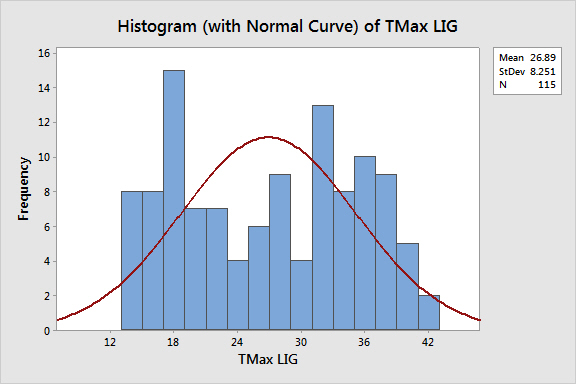
Fig. 1. When the frequency of specific temperatures/data points as measured from the mercury thermometer at Mildura after July 2012 are plotted, it is evident that the data is not normally distributed. This makes statistical comparisons with measurements from the electronic probe problematic.

There are many more maximum temperatures measurements available for the electronic probe (n=948) than for the mercury thermometer (n=115), and the distribution is quite different, with a somewhat more normal distribution for the probe data, as shown in Figure 2.
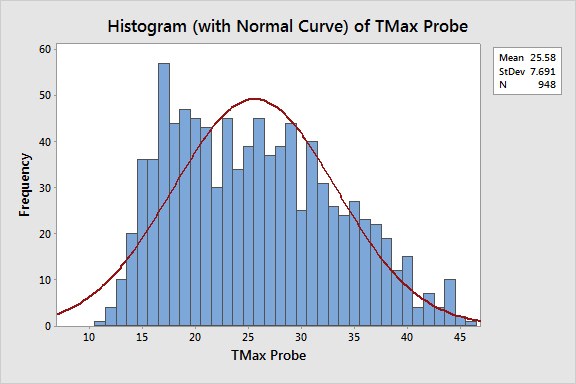
Fig 2. Distribution of measurements from the electronic probe recording in an AWS.

Considering days when there is parallel data available in the temperature band of interest (the claimed-record hot day in September 2017 measured 37.7 degrees Celsius) the new probe has been found to measure up to 0.4 degrees hotter (e.g. 26 February 2013 the recording for the probe is 37.3, while the mercury thermometer recorded 36.9 on the A8 form). In fact, Table 1 shows that for the last month of available parallel measurements the electronic probe (Tmax-Probe) often recorded considerably warmer than the mercury thermometer (Tmax-LIG).
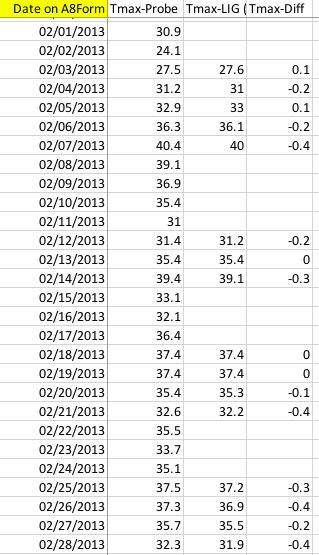
Tbl 1. This screenshot of the Excel file where I record the transcribed values shows that for the very last month of parallel recordings at Mildura, the electronic probe was often recording hotter than the mercury thermometer by up to 0.4 degree Celsius. (The abbreviation LIG stands for liquid-in-glass i.e. mercury and alcohol thermometers. Also, note that the measurements/data points shown here are as recorded on the A8 forms that are one full day different from the values in the CDO and ADAM databases… this is because the actual recording is of the temperature the afternoon before.)

In conclusion

While it is official BoM policy to ensure that there is approximately five-years of overlapping parallel data when there is a site move or equipment change at an official weather station, this policy appears to be rarely implemented. Indeed, while it would seem reasonable to assume that there would be dozens of reports detailing the results from such parallel studies – none have been made publicly available.

In the case of Mildura, the quality and length of the available parallel data makes it difficult to draw any real conclusions about the equivalence of measurements from the electronic probe installed in July 2012, with measurements from earlier probes and/or the mercury thermometer first installed back in 1889.

The issue of verifying the claimed record hot day on 23 September 2017 is compounded by the BoM’s method of measuring temperatures – in particular the absence of averaging over at least one minute which is standard for electronic probes.

****
The second chart and table were added to this post the next morning (12 Feb. 2018) – to aid understanding, and add clarity.

Filed Under: Information Tagged With: Temperatures

Peter Ridd Asks for your Help – Now

February 1, 2018 By jennifer

PROFESSOR Peter Ridd is a physicist at James Cook University who has dared to question scientific findings that purport to show the Great Barrier Reef is in trouble. Specifically, he has been formally censured by the University and told to remain quiet about the matter – or risk his job.

The issue dates back to August 2017, and comments he made on television promoting the book I edited last year – Climate Change: The Facts 2017.

Peter wrote the first chapter in this book, and in it he suggests that there are major problems with quality assurance when it comes to claims of the imminent demise of the reef. He has also published in the scientific literature detailing his concerns about the methodology used to measure calcification rates, including a technical paper in Marine Geology (volume 65).

After some reflection over the last couple of months, and some thousands of dollars on legal fees – so far paid by the Institute of Public Affairs (IPA) that first published the book that got him into trouble – Professor Ridd has decided to fight the final censure.

In short, he has decided he would rather be fired than be quiet.

But he is now going to have to find about A$95,000!

So, this university Professor has set-up a crowdfunding account. It is now your turn to show support and help fight the case.

https://www.gofundme.com/peter-ridd-legal-action-fund

Peter Ridd and Jennifer Marohasy speaking about the need for quality assurance in science last November in Sydney.

*******************
UPDATE – Saturday morning

This screenshot was snapped early Saturday morning (Queensland, Australia – time).

So, we have reached and exceeded the target in just two days!

Peter Ridd is exceedingly grateful to everyone who donated.

Also, a huge thank you to Anthony Watts who owns and manages https://wattsupwiththat.com/ for so actively supporting this campaign, and also the Executive Director of the IPA, John Roskam, who has backed Peter Ridd on this from the beginning. I would also like to thank ‘BM’ for his very generous donation, and also my Mum for her A$100.

Filed Under: Community, Good Causes Tagged With: Coral Reefs

Avoid Fake News: Listen to Alternative Perspectives

January 25, 2018 By jennifer

IT was all over the news this morning: Pope Francis condemning ‘fake news’, which he defined as:

The spreading of disinformation… It has to do with false information based on non-existent or distorted data meant to deceive and manipulate the reader.

In fact, the Pope is guilty of exactly what he preaches against, particularly with his encyclical on climate change issued back in 2015.

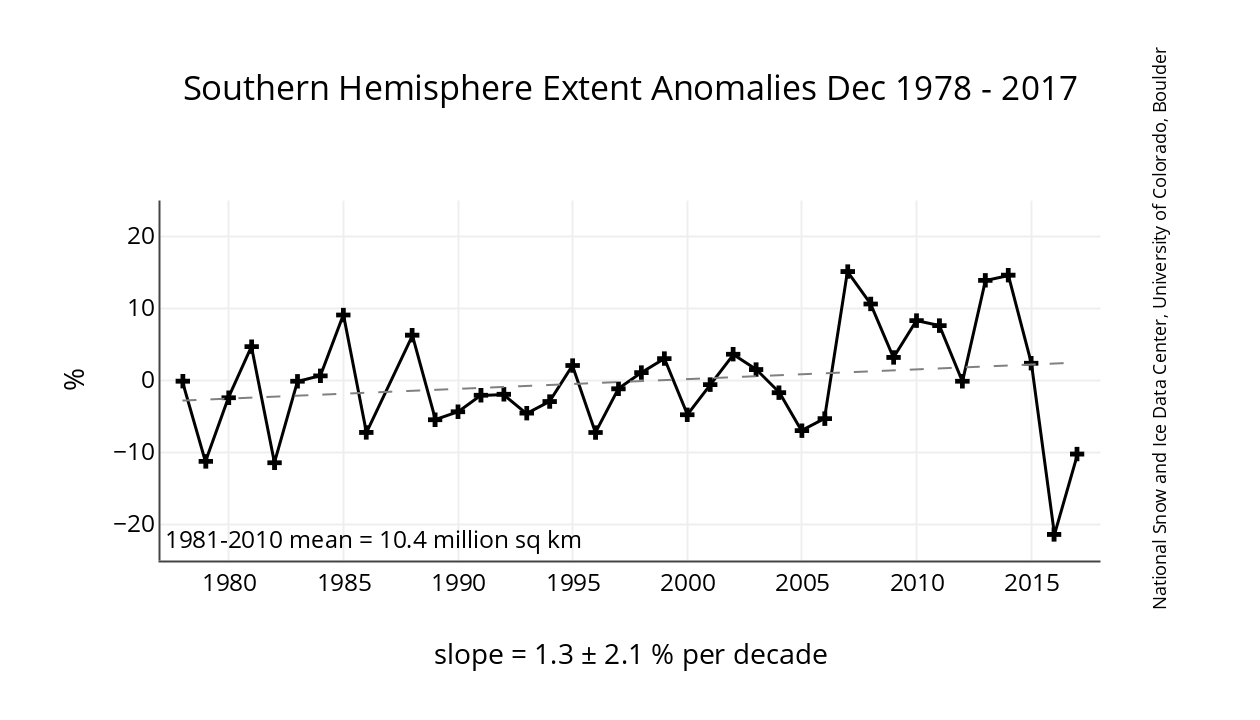
In that document, the Pope made various unsubstantiated claims suggesting that carbon dioxide was directly responsible for the melting of the polar ice caps, as just one example. In reality, at that time, while there had been significant melting at the North Pole, the South Pole had been gaining ice for some decades.

This plot of changes in the extent of sea ice suggests that the South Pole was gaining in ice from at least 1980 to 2015, contrary to the Pope’s encyclical issued in 2015. The significant ‘melt’ in 2016 corresponded with the super El Nino and minimum declination of the moon.

In his new message entitled ‘Fake news and journalism for peace’, the Pope suggests that one possible solution to fake news is to engage in healthy dialogue:

The difficulty of unmasking and eliminating fake news is due also to the fact that many people interact in homogeneous digital environments impervious to differing perspectives and opinions. Disinformation thus thrives on the absence of healthy confrontation with other sources of information that could effectively challenge prejudices and generate constructive dialogue…

This is perhaps just another way of suggesting we become more informed. Of course, this can be best achieved by being curious and asking questions. Indeed, Socrates said:

True wisdom comes to each of us when we realize how little we understand about life, ourselves and the world around us.

The Pope ended his message with a prayer that included:

Where there is superficiality, let us raise real questions.

Fake news is not an issue that will be easily solved. But the individual who has the wisdom to doubt, the courage to ask hard questions, and the fortitude to listen to alternative perspectives will get much closer to the truth and much more quickly.

********

Paul Driessen details some of the misinformation in Pope Francis’ 2015 encyclical on climate change in chapter 16 of the book I edited last year: ‘Climate Change: The Facts 2017’. Consider buying two copies, and sending one copy of the book with a polite letter to Pope Francis. Suggest he engage in dialogue with the sceptics on this issue.

Filed Under: Information Tagged With: fake news

Already Hottest January on Record for St Helens, Tasmania

January 22, 2018 By jennifer

LAST week, Andrew Johnson, CEO of the Australian Bureau of Meteorology, wrote that the Bureau’s “stewardship of Australia’s temperature record” had been found to be scientifically sound [1]. He also claimed it was in accordance with World Meteorological Organisation guidelines.

In fact, it’s not.

If it was scientifically sound, or in accordance with WMO guidelines, then it might at least be accredited – but it’s not.

“The Bureau has quality system certification in place (ISO 9001) for its aviation forecasting activities, to conform with the regulations of the International Civil Aviation Organization. This certification covers the management tools and processes ensuring that all the 80 or so meteorological products the Bureau produces meet client needs. The certification does not extend to measurement quality, including AWS data and messages, nor to the associated derived quantities and data streams.

“To address measurement quality, the WMO recommends that national meteorological agencies have ISO 17025 accreditation of key measurement processes. Accreditation covers the technical procedures and processes that ensure the traceability and integrity of measurements, as well as the technical competence of the staff making the measurements. While the Bureau does not currently hold ISO 17025 accreditation, it has internal processes, technical procedures, and measurement traceability and integrity that are largely in accordance with ISO 17025 requirements.”

The above two paragraphs are a direct quote from page 11 of a document entitled ‘Review of the Bureau of Meteorology’s Automatic Weather Stations’ published by the Bureau in September 2017.

To be clear, we have an organisation, costing the Australian tax payer about 1 million dollars per day, that operates largely in accordance with its own standards – that are ever changing.

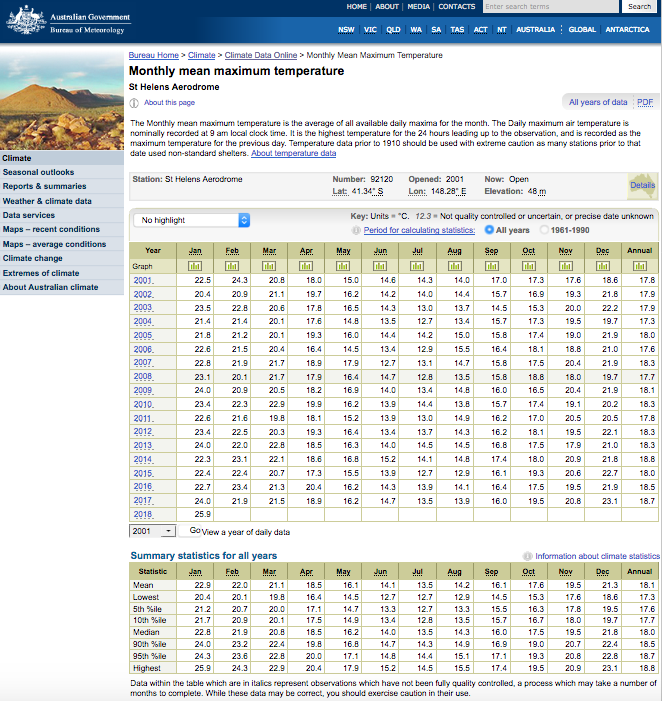
This January, for the very first time ever, we even have weather stations that have already computed the monthly average maximum temperature for January.

Screen shot of the ‘Monthly mean maximum temperature’ page for St Helens Aerodrome at the Bureau’s website

I am writing and posting this note at my blog on Monday 22nd January – a full 9 days before the end of the month, before all the daily values are in for January 2018.

Of course, the already published value for January 2018 indicates that this January 2018 was the hottest ever at St Helens – measuring 25.9 degrees Celsius, when the monthly mean maximum temperature is 22.9. That makes this January a full 3 degrees warmer at St Helens – consistent with man-made global warming theory.

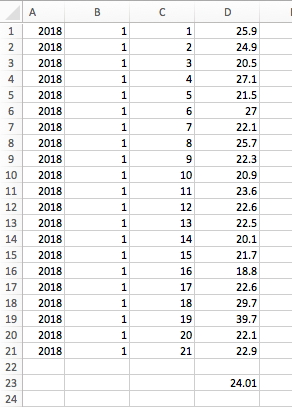
Considering the daily maximum temperature values so far for St Helens… the running average is 24 degrees Celsius.

The daily maximum temperatures so far actually recorded at St Helens this January 2018

This premonition that January’s mean monthly maximum temperature at St Helen is 25.9 degrees Celsius may all be an administrative error or a technical glitch. It may be easily explained and corrected. Then again, climate scientists across the world have form on this sort of thing. Remember the Climategate email sent from Geoff Jenkins to Phil Jones on 22 November 1996 suggesting they just make-up a value for Australia for December 1996 [2].

*****

[1]

Letter from Andrew Johnson, CEO, Bureau of Meteorology to The Australian newspaper published 18th January 2018

[2]

From: gjjenkins@meto.gov.uk
To: p.jones@uea.ac.uk, deparker@meadow.meto.govt.uk
Subject: 1996 global temperatures
Date: Fri, 22 Nov 1996 11:23 +0000 (GMT)
Cc: llivingston@meadow.meto.govt.uk, djcarson@meadow.meto.govt.uk, ckfolland@meadow.meto.govt.uk

Phil

Remember all the fun we had last year over 1995 global temperatures,
with early release of information (via Oz), “inventing” the December
monthly value, letters to Nature etc etc?

I think we should have a cunning plan about what to do this year,
simply to avoid a lot of wasted time.

I have been discussing with David P and suggest the following:

1. By 20 Dec we will have land and sea data up to Nov

2. David (?) computes the December land anomaly based on 500hPa
heights up to 20 Dec.

3. We assume that Dec SST anomaly is the same as Nov

4. We can therefore give a good estimate of 1996 global temps by 20
Dec

5. We feed this selectively to Nick Nuttall (who has had this in the
past and seems now to expect special treatment) so that he can write
an article for the silly season. We could also give this to Neville
Nicholls??

6. We explain that data is provisional and how the data has been
created so early (ie the estimate for Dec) and also

7. We explain why the globe is 0.23k (or whatever the final figure is)
cooler than 95 (NAO reversal, slight La Nina). Also that global annual
avg is only accuirate to a few hundredths of a degree (we said this
last year – can we be more exact, eg PS/MS 0.05K or is this to big??)

8. FROM NOW ON WE ANSWER NO MORE ENQUIRIES ABOUT 1996 GLOBAL TEMPS BUT
EXPLAIN THAT IT WILL BE RELEASED IN JANUARY.

9. We relesae the final estimate on 20 Jan, with a joint UEA/MetO
press release. It may not evoke any interest by then.

10. For questions after the release to Nuttall, (I late Dec, early
Jan) we give the same answer as we gave him.

Are you happy with this, or can you suggest something better (ie
simpler)? I know it sound a bit cloak-and-dagger but its just meant to
save time in the long run.

Im copying this to DEP and CKF also for comments.

Cheers

Geoff

*********
UPDATE: Within hours of this blog post the value for January 2018 was removed by the Bureau for St Helens, and other sites.

Filed Under: Information Tagged With: temperates

A Law Unto Themselves: The Australian Bureau of Meteorology

November 13, 2017 By jennifer

Sunday, 12th November 2017 – 4PM

Honourable Josh Frydenberg MP
Minister for Environment and Energy

Dear Minister

Re: Suspend announcement of new record hot days – Inform WMO that Bureau’s measurements are currently not comparable with mercury thermometers – Give directive for release of more A8 forms – Establish an audit mechanism

1. BACKGROUND

I write to confirm my receipt of some preliminary information from Mildura – you may remember that I wrote to you on 26th September suggesting that the new record hot day for Mildura announced by the Bureau of Meteorology of 37.7 degrees Celsius recorded on Saturday 23rd September, was unlikely to be a valid record because it was not measured consistent with calibration.

The Bureau have since acknowledged that their method of recording temperatures from electronic sensors is not accredited, though they claim it nevertheless gives readings equivalent to mercury thermometers. Interestingly, your office emailed a journalist, backing them up – claiming that a single electronic sensor can “mirror the behaviour of liquid in glass thermometers”. This is nonsense, because mercury and alcohol thermometers have different time constants. This is one reason the World Meteorological Organisation (WMO) insist on numerical averaging: alcohol thermometers (that measure temperature minima) have longer time constants than mercury thermometers (that measure temperature maxima).

Historically, alcohol thermometers were used to measure minimum temperatures, and mercury thermometers were used to measure maximum temperatures – across Australia. Then on 1 November 1996, the Bureau changed their ‘primary instrument’ to electronic sensors.

Anyway, I am grateful for the information recently received from the Bureau (following your directive), which does enable some comparison of measurements from a mercury thermometer with measurements from an electronic sensor, but only for Mildura for the period November 1996 to December 2000. I received this information in the form of over 4,000 scanned A8 forms, and have personally transcribed much of the relevant information, specifically the handwritten manual recording from the mercury thermometers.

2. MY PRELIMINARY FINDINGS

I can confirm, that the values recorded manually on the A8 forms from the mercury thermometers for the period November 1996 to December 2000 are significantly different from the official values recorded from the electronic sensors. If we consider just the values for September, the mean difference is statistically significant at the 0.05 level of probability, and is +0.34 °C, +0.27 °C and +0.28 °C for the years 1997, 1998 and 1999, respectively.

Somewhat surprisingly, the automatic weather stations at Mildura for these three Septembers recorded statistically significantly cooler temperatures than the mercury thermometers. (This is generally consistent with other values on the A8 forms, though winter and summer differences may be more extreme.)

This could suggest that the recent record hot day was in fact an underestimation of temperature. However, I’ve since been shown photographs that prove the electronic sensor in place at Mildura for those three years (1997, 1998, 1999) was shorter and thicker (with a correspondingly significantly longer time constant), than the Rosemount sensor that was in place on 23rd September 2017. Furthermore, the Bureau’s own documentation indicates that the Stevenson screen size has also changed – introducing yet another variable. Additionally, it has been brought to my attention that at that time – back in 1997, 1998 and 1999 – the official recorded temperatures were likely to be a numerical average taken over at least one-minute. The recent record was a one second-spot reading. I have confirmed this from the one-minute data for Mildura for 23rd September, also made available to me recently – following your directive.

While the current head, Andrew Johnson, claims the Bureau has always taken one-second readings from electronic sensors, this is at odds with a letter from Sue Barrell, Bureau of Meteorology, to Dr Peter Cornish dated 6th February 2013, available online here. The letter details a methodology much more consistent with World Meteorological Guidelines – specifically reference is made to numerical averaging.

The bottom line is that since the introduction of automatic weather stations over 20 years ago, there has been no documented standard against which Australian temperatures at Mildura, or anywhere else, have been recorded. Of most concern to me is the muddling, (including by your staffers), of the numerical averaging-period with the time constant. The Bureau somewhat confusingly often refers to the time constant as the sensor “averages”.

3. HISTORICAL TEMPERATURE RECORD

I have been reliably informed that when the various variables for Mildura are eventually determined – as they must – the actual hottest day on record for September for Mildura may be 22nd September 2003 or the 28th of September 1928 if temperatures before 1910 are ignored.

Interestingly, the hottest day ever for Mildura according to the official ACORN-SAT record is 10th January 1939; that summer of 1938-39 was exceptionally hot across south-eastern Australia. When I was researching the longer historical temperature record for Mildura a couple of years ago (at the same time I was correcting for Stevenson screen installations and moves from the post office to the airport in back-of-the-envelope type calculations), I determined that the hottest summer on record at Mildura was likely 1905/1906.

Backing this up, a relatively recent study published by Lucinda Coates and colleagues (Environmental Science and Policy, Volume 42, 2014) identified Januaries in 1879, 1896, 1906 and 1908 as being months with ‘significant heat events’ in Australia.

Our Bureau ignores this early pre-1910 historical temperature record, and after 1910 corrects for its political incorrectness through homogenisation as I have detailed elsewhere.

4. ECONOMIC IMPLICATIONS

Whilst the historical temperature record issued by the Bureau may have only been of limited, or academic interest, in the past this is no longer the case in view of the current scientific and public policy debate about global warming. These temperature recordings are now the primary input data which determine a range of scientific predictions, projections and model outputs with enormous, fiscal, economic and political implications both for Australia and internationally. If these temperature recordings are wrong then all the consequent scientific, fiscal, economic and political decisions based on this data may be wrong also.

On this basis, given the importance of the temperature record, I would suggest that there needs to be an ongoing and independent oversight audit mechanism/group established to ensure that you and the government can be confident that you are receiving reliable and accurate temperature records on which to base government policy decisions both nationally and internationally.

The fiscal records of government agencies are independently and regularly audited for amounts far less than the fiscal and economic impacts of global warming policies so it would seem only prudent and reasonable that the temperature records of the Bureau of Meteorology, which have such huge fiscal and economic impacts, should be subject to a similar audit regime to ensure their accuracy, integrity and reliability.

Historical temperature records back to 1880 are the primary input data which determine the range of scientific predictions, projections and model output with enormous fiscal, economic and political implications both for Australia and internationally.

Current and historical temperature records for Mildura, as measured and collated by the Bureau, are included in the calculation of global temperatures by the UK Meteorological office and NASA – subsequently relied upon by the United Nations Intergovernmental Panel on Climate Change informing the Paris Accord.

Perhaps unbeknownst to these organisations, our Bureau has a ‘novel’ method of recording temperatures from electronic sensors in automatic weather stations that cannot logically give readings consistent with the liquid-in-glass thermometers, which were the primary instruments for Australian temperature measurements until 1 November 1996.

5. RECOMMENDATIONS

Given the importance of the temperature record being correct: there is a need for an ongoing and independent oversight audit.

Inform the WMO that the temperatures recorded by our Bureau are not consistent with calibration, nor any international standard.

Direct the Bureau to desist from announcing new record hot days – not only for Mildura but for all 563 automatic weather stations recording surface temperatures across Australia.

Also, I would be grateful to receive more scanned A8 forms, specifically for the period 1 January 2001 until 30 September 2017 for Mildura. (It could be that I have only received A8 forms for Mildura until December 2000, as the Bureau is awaiting your directive to release the forms after this date.) I also await advice regarding the availability of scanned A8 forms from the other 38 locations with parallel data, as I detailed in my letter to you of 22nd October 2017.

Yours sincerely

Jennifer Marohasy BSc PhD
Senior Fellow, Institute of Public Affairs
Founder, Climate Modelling Laboratory, Noosa
Member, International AltMet Network

The assistance of AltMet Network members LP, KS, JV, MN, PC, PM and RM is gratefully acknowledged in the drafting of this letter.

Filed Under: Information Tagged With: Temperatures

Averaging by Convention – or Not

October 17, 2017 By jennifer

FOR some time, weather enthusiasts across Australia have been noticing rapid temperature fluctuations at the ‘latest observations’ page at the Australian Bureau of Meteorology’s website. For example, Peter Cornish, a retired hydrologist, wrote to the Bureau on 17 December 2012 asking whether the 1.5 degrees Celsius drop in temperature in the space of one minute at Sydney’s Observatory Hill could be a quirk of the new electronic temperature sensors. Ken Stewart, a retired school principal, requested temperature data for Hervey Bay after noticing a 2.1 degrees Celsius temperature change in the space of one minute on 22 February 2017.

So, begins my article to be published later today at The Spectator online, perhaps to be entitled ‘More Hot Days Caused by Purpose-Designed Temperature Sensors’. [That article was eventually published at both The Spectator and WUWT.]

But if you read a bit beyond the headline you will see that my issue is not so much with the temperature sensors as the way in which the Bureau is not averaging according to calibration. In particular, and to paraphrase some more from the article…

Beginning some twenty years ago, electronic sensors have progressively replaced mercury thermometers in weather stations across Australia. The sensors can respond much more quickly to changes in temperature, and on a hot day, the air is warmed by turbulent streams of ground-heated air that can fluctuate by more than 2 degrees on a scale of seconds. So, if the Bureau simply changed from mercury thermometers to electronic sensors, it could increase the daily range of temperatures, and potentially even generate record hot days simply because of the faster response time of the sensors.

Except to ensure consistency with measurements from mercury thermometers there is an international literature, and international standards, that specify how spot-readings from sensors need to be averaged – a literature and methodology being ignored by the Bureau.

To be clear, the UK Met office takes 60 x 1 second samples each minute from its sensors, and then averages these. In the US, they have decided this is too short a period, and the standard there is to average over a fixed 5-minute period. In Australia, however, the Bureau takes not five-minute averages, nor even one-minute averages, but just one second spot-readings.

Check temperatures at the ‘latest observations’ page at the Bureau’s website and you would assume the value had been averaged over perhaps 10 minutes. But it is dangerous to assume anything when it comes to our Bureau. The values listed at the ‘observations’ page actually represent the last second of the last minute. The daily maximum (which you can find at a different page) is the highest one-second reading for the previous 24-hour period: a spot one-second reading in contravention of every international standard. There is absolutely no averaging.

Then again, how many of you knew that the mean daily temperature as reported by meteorological offices around the world is not an average of temperatures recorded through the day but rather the highest and the lowest divided by two – as is the convention.

This convention developed because (surface) temperature measurements were originally instantaneous measurements from mercury thermometers recorded manually each morning (providing the minima) and afternoon (providing the maxima).

So, in the UK the daily maximum from a weather station with an electronic sensor will be the highest value derived from the averaging of 60 samples over that one minute interval, while in Australia, the daily maximum will be the highest one-second spot reading.

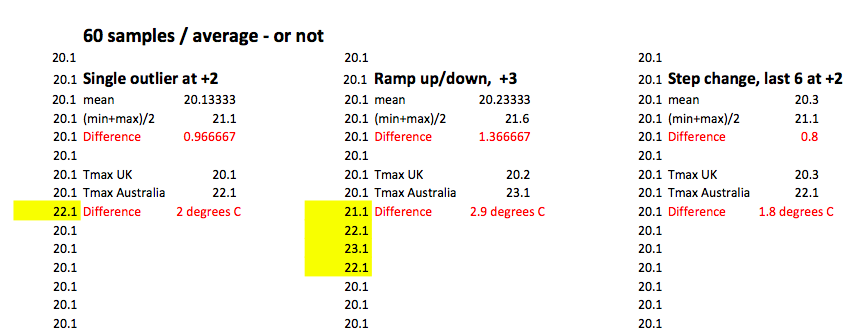
And, the method for averaging from the sensors does matter, as shown in the attached spreadsheet using synthetic values to illustrate this point, and summarized in Figure 1.

Scroll to the end of this post to download the entire spreadsheet with all 60 numbers for each worked example.

The values shown in the three-worked example fall well within the general range of variation possible within a one-minute interval considering highest, lowest and last second values as shown in some of the datasets purchased by Ken Stewart from the Bureau earlier this year.

In the first example, which could be symptomatic of ‘sensor noise’, there is a single outlier of 22.1 in the 60 one-second readings from the sensor. If these are averaged, as is done by the UK Met office, then the recorded temperature measurement for that minute is 20.1 degrees Celsius. If, however, the highest one-second value is recorded, which is the method applied in Australia, the recorded temperature would be 22.1 degrees Celsius. There is a whole 2 degrees of difference. If we apply the meteorological convention for generating mean daily values, then the difference is 1 degrees Celsius (0.9666 rounded).

In the second example, which could reflect a wind direction change, or jet plane exhaust, the difference between the UK Met office method of averaging over 1 minute versus the Australian method of taking a one second spot reading is the rather large 2.9 degrees Celsius.

In the third example, where there is a step change, the difference between the UK and Australian methods for treatment of sub-minute readings is 1.8 degrees Celsius.

More recently the Bureau have attempted to suggest yet another method of averaging, as detailed in their Fast Facts. But this is really just obfuscation, in more recent correspondence with me CEO Andrew Johnson has used the correct term when calculating how long it takes a sensor to adjust to a step change in temperature, which is ‘time constant’.

*****

The spreadsheet detailing the different averaging methods can be downloaded here: Averaging-NF-JM

I am blessed to be part of an Alt-Met network that includes Kneel (who sent me a first version of this spread sheet), Ken Stewart, Lance Pidgeon, Phill and others… thanks for the conversations.

Filed Under: Information Tagged With: Temperatures

  • « Go to Previous Page
  • Go to page 1
  • Interim pages omitted …
  • Go to page 19
  • Go to page 20
  • Go to page 21
  • Go to page 22
  • Go to page 23
  • Interim pages omitted …
  • Go to page 607
  • Go to Next Page »

Primary Sidebar

Recent Comments

  • Ian Thomson on Vax-ed as Sick as Unvax-ed, Amongst My Friends
  • Dave Ross on Vax-ed as Sick as Unvax-ed, Amongst My Friends
  • Dave Ross on Vax-ed as Sick as Unvax-ed, Amongst My Friends
  • Alex on Incarceration Nation: Frightened of Ivermectin, and Dihydrogen monoxide
  • Wilhelm Grimm III on Incarceration Nation: Frightened of Ivermectin, and Dihydrogen monoxide

Subscribe For News Updates

  • This field is for validation purposes and should be left unchanged.

December 2025
M T W T F S S
1234567
891011121314
15161718192021
22232425262728
293031  
« Jan    

Archives

Footer

About Me

Jennifer Marohasy Jennifer Marohasy BSc PhD has worked in industry and government. She is currently researching a novel technique for long-range weather forecasting funded by the B. Macfie Family Foundation. Read more

Subscribe For News Updates

Subscribe Me

Contact Me

To get in touch with Jennifer call 0418873222 or international call +61418873222.

Email: jennifermarohasy at gmail.com

Connect With Me

  • Facebook
  • LinkedIn
  • RSS
  • Twitter
  • YouTube

Copyright © 2014 - 2018 Jennifer Marohasy. All rights reserved. | Legal

Website by 46digital