• Skip to primary navigation
  • Skip to main content
  • Skip to primary sidebar
  • Skip to footer
Jennifer Marohasy

Jennifer Marohasy

a forum for the discussion of issues concerning the natural environment

  • Home
  • About
  • Publications
  • Speaker
  • Blog
  • Temperatures
  • Coral Reefs
  • Contact
  • Subscribe

Blog

Two Truths at the Heart of Peter Ridd’s Sacking

March 19, 2019 By jennifer

FORMER James Cook University Professor Peter Ridd will be in the Brisbane Federal Court next week attempting to get his job back. The case may be fought on legal interpretations of his obligation as a university employee to be collegial and discrete versus his right to academic freedom. This avoids the need to consider the two truths at the heart of this matter:

1. The Great Barrier Reef may be in good health, while
2. Our academic institutions may be rotten to the core.

The issue of academic freedom is certainly an important one. As Peter Ridd explains in a YouTube video launched today, universities are now run by administrators who take an increasingly conformist and corporatist approach.

This is fundamentally alien to the approach of the true scientist that must be logical, evidence-based, and always tolerant of the alternative perspective because fundamental to science is the potential for falsification.

As the new video explains, Peter Ridd has spent his whole career studying the reef.

He began with the Marine Geophysical Laboratory in 1989. During the 1990s his colleagues, Piers Larcombe and Ken Woolfe, published several seminal papers concluding that the south-easterly trade winds, which blow for about nine months of the year, have a dominant influence on the muddiness of reef waters. The wind and resulting waves produce a current that flows northward. This current traps sediments in north-facing bays and prevents it from reaching the middle and outer reefs. Importantly, this research established that the amount of sediment in the water – its turbidity – is controlled by the size of the waves, not the volume of sediment. This fact means that any additional sediment coming down the rivers will have no effect on the muddiness of the waters of the Great Barrier Reef.

Yet key research institutions have promoted the notion that sediment from farming and mining is damaging the Great Barrier Reef. In particular, a series of photographs have been promoted falsely suggesting that the coral reefs off Stone Island have been destroyed by this sediment.

Peter Ridd took photographs of the same area showing spectacular healthy corals, and sent these photographs to News Ltd journalist Peter Michael. Rather than investigate, journalist Peter Michael sent the photographs showing healthy corals and Peter’s correspondence back to the very researcher promoting the fake news. That correspondence was subsequently passed immediately to the University management, and then used to censor Peter Ridd. He was sacked after being censored a second time.

Seeing is believing. Yet the truth in the photographs was ignored, while a process begun by the university that would eventually lead to Peter Ridd’s sacking.

The photographs are but anecdotal evidence. Of course, a true scientist undertakes proper studies, and has them published in the best scientific journals.

Peter Ridd has over 100 such technical papers published in scientific journals, including a key rebuttal published in Marine Geology (volume 346, pages 392-399). This paper clearly documents and explains methodological flaws in research that purport to show reduced coral calcification rates.

In short, Peter Ridd has had the courage to put the alternative perspective with specific and compelling examples to journalists at mainstream newspapers, and also to editors of key scientific journals. So far it would appear he has been most damaged by the journalists and administrators, while the scientific community has published his findings.

Next week, the Federal Court may be somewhat constrained by legal argument, but there is no reason why this case cannot begin a more general public discussion about the real state of the Great Barrier Reef. It is time the journalists stepped-up, and considered the evidence pertaining to the fundamental truths in this matter.

Peter Ridd’s correspondence to journalist Peter Michael will be tabled for all to see, and for all to judge. There is no need of scientific qualifications to see that contrary to the claims of the Great Barrier Reef Marine Park Authority and ARC Centre of Excellence for Coral Reef Studies there is still spectacular fringing coral reef off Stone Island.

Considering such truths will require some to openly question their long-held prejudices. Acknowledging such truths will require citizens to question publicly-funded science, and to consider the exceptional resilience of natural ecosystems – particularly the Great Barrier Reef. Realistically this must begin with journalists, and their editors and/or producers, prepared to push the boundaries of what politicians and university administrators have over decades determined through constant negotiation to be acceptable – which has nothing to do with the truth.

As Carl Jung famously wrote: One does not become enlightened by imagining figures of light, but by making the darkness conscious.

Peter Ridd has had the courage to confront his colleagues and the institutions with the truth.

The legal proceedings begin in the Federal Circuit Court in Brisbane on 26th March 2019. I hope to see you there.
Filed Under: Information Tagged With: Peter Ridd

Hottest Summer in Australia was 1938/1939

March 12, 2019 By jennifer

THIS last summer has been hot in Australia. But was it the hottest ever? Summer 80 years ago was arguably as hot, if not hotter. Back then more ferocious bushfires burnt larger areas.

Yet Australia’s Environment Minister, Melissa Price, recently claimed this summer’s bushfires as a consequence of climate change. I grew up with stories from my late father of terrible bushfires – infernos – back in 1939. The Black Friday bushfires destroyed four times the area of farmland and forest as the devastating February 2009 fires – and twenty times as much as burnt this last summer. Ash from that bushfire fell as far away as New Zealand.

My father described hot and hungry years in rural Victoria back then – just as John Steinbeck described farm life in the mid-west of the US in the 1930s in his famous ‘Grapes of Wrath’. There was hardship, and there were dust storms in the US and also in south-eastern Australia.

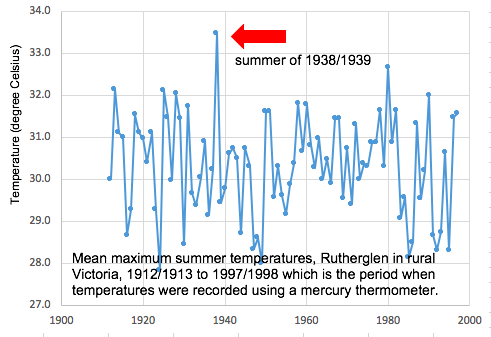
In rural Victoria, the summer of 1938-1939 was on average at least two degrees hotter than anything measured with equivalent equipment since.

Mean maximum summer temperatures as measured at Rutherglen in rural Victoria for the period when mercury thermometers were used.

Yet Minister Price denies this history – my late father’s history. She is relying on temperature data that has been extensive remodelled. This remodelling is justified by the Australian Bureau of Meteorology on the basis that temperatures are now measured using a non-standard method (spot readings) from non-standard equipment (custom built probes in automatic weather stations). Apparently, we need to know how hot it was back then, relative to the equipment used now.

On 13 January 1939 my father was living not far from Rutherglen, near Australia’s longest river, the Murray River. He described a hot wind blowing from the north west.

The Rutherglen agricultural research station has one of the longest, continuous, temperature records for anywhere in rural Victoria. Minimum and maximum temperatures were first recorded at Rutherglen using standard and calibrated equipment back in November 1912. Considering the first 85 years of summer temperatures – unadjusted/not homogenized – the very hottest summer on record at Rutherglen is the summer of 1938/1939.
While this last summer of 2018/2019 was hotter according to Minister Price, such a claim would not pass scrutiny if assessed for the Guinness Book of records – because of all the changes to the way temperatures are now measured at Rutherglen relative to that summer back in 1938/1939.

At Rutherglen, the first big change happened on 29 January 1998. That is when the mercury and alcohol thermometers were replaced with an electronic probe – custom built to the Australian Bureau of Meteorology’s own standard, with the specifications still yet to be made public.

According to Bureau policy, when such a major equipment change occurs there should be at least three years (preferably five) of overlapping/parallel temperature recordings, except the mercury and alcohol thermometers (used to measure maximum and minimum temperatures, respectively) were removed on exactly the same day the custom-built probe was placed into the Stevenson screen at Rutherglen, in direct contravention of this policy.

In 2011, the Bureau made further changes in that it stopped averaging one-second readings from the probe at Rutherglen over one minute. The maximum temperature as recorded each day at Rutherglen is now the highest one-second spot reading from the custom-built probe. That is correct – spot reading.

So, to reiterate, we now have a non-standard method of measuring (spot readings) from non-standard equipment (custom-built probes) making it impossible to establish the equivalence of recent temperatures from Rutherglen – or any of the Bureau’s other 695 probes in automatic weather stations spread across the landmass of Australia – with historical data.

Then there is the remodelling – with the most recent remodelling creating Version 2 of ACORN-SAT. This has resulted in an overall 23 per cent increase in the rate of warming between Versions 1 and 2 for the 112 weather stations that comprise ACORN-SAT. This is the database used by the Bureau and the CSIRO to monitor climate change across Australia.

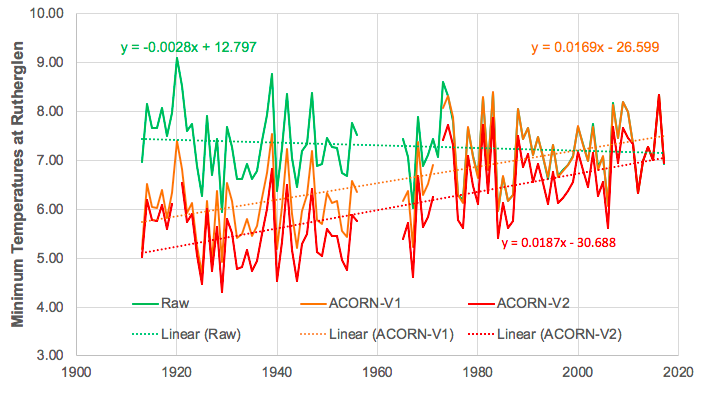
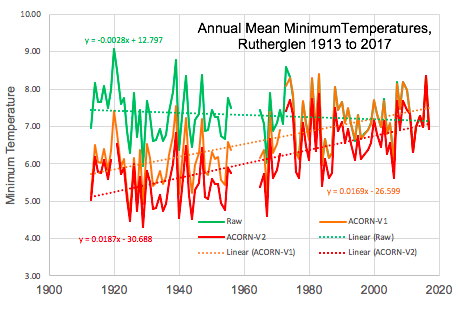
At Rutherglen, a modest rate of warming in the raw maximum temperatures of 0.7 degrees Celsius per Century has been changed to 1.3 degrees Celsius in ACORN-SAT Version 2. Changes to the minimum temperature trend are more dramatic: a slight cooling trend of 0.3 degrees Celsius has been changed to warming of 1.9 degrees in ACORN-SAT Version 2 for Rutherglen.

Annual mean minimum temperatures at Rutherglen (1913-2017). Raw temperatures (green) show a mild cooling trend, which is changed into warming in Version 1 of the remodeled ACORN-SAT. The warming is exaggerated in Version 2 of ACORN-SAT.

This remodelling – known as homogenisation – involves the detection of discontinuities and then adjustments which generally result in past temperatures being cooled relative to the present. By cooling the past, present temperatures appear hotter. For example, considering maximum temperatures at Rutherglen, the largest single drop-down (adjustment) to daily temperatures occurs from 1 January 1938 back in time. The Bureau classifies the hot summer of 1938/1939 as a ‘discontinuity’ that is ‘statistical’ in ‘cause’ and then cools all the days before 31 December 1938 by 0.6 degrees Celsius back to 1912 – the beginning of the record.*

This is an embarrassment to the scientific method, and an insult to the 71 lives lost on 13 January 1939.

To repeat, the Bureau does not deny making these changes. Rather it claims such changes to Rutherglen’s temperature history are necessary to show what the temperature would be back then, using today’s equipment. But there was no actual change in the equipment between Versions 1 and 2 of ACORN-SAT for Rutherglen. So, this reason makes no sense.

The remodelling of Rutherglen, and the other 111 stations that comprise ACORN-SAT is extensive and misleading. It was correctly described as ‘fraud’ by commentator Rowan Dean on Sky Television on Sunday 10th March.

So why did, for example, the Bureau drop the minimum daily temperatures by a further 2.6 degrees Celsius on the day of the Black Friday bushfire? To be clear, the minimum temperature on the day of the Black Friday bushfire at Rutherglen was measured as 28.3 degrees Celsius. This value is changed to 27.8 degrees Celsius in ACORN-SAT Version 1, a reduction of 0.5 degrees Celsius. In Version 2, the temperature is reduced further, now archived as just 25.7 degrees Celsius for 13 January 1939 – a reduction of 2.6 degrees from the original temperature as actually recorded on that day.

There is a real history of rural Victoria: 71 men and women did perished in that bushfire back on 13 January 1939. According to my late father, it was extraordinarily hot and the wind was blowing from the north west.

The Bureau has never put a media release out letting the Australian public know that there is a Version 2 of ACORN-SAT, with even cooler historical temperatures for Rutherglen and most of the rest of Australia than in Version 1 that was only published in 2012.

Just a few years ago, the minister then responsible for the Bureau, Greg Hunt, was claiming that ACORN-SAT Version 1 was the world’s best practice and the correct temperature history of Australia. Now, we have ACORN-SAT Version 2, and temperatures overall have been warmed a further 23 percent relative to Version 1.

The remodelling by the Bureau is industrial-scale: this is necessary to generate a consistent global warming trend that does not exist in the raw unhomogenized data from rural and regional Australia.

There are consequences for future generations in this remodelling. It affects how we understand the relationship between climate and bushfires. Also, by continually reducing past temperatures, there is potential for new record hot days, record hot summers and hottest years for even cooler weather. Recommend wellbutrin buy .

This is nonsense – consistent with how the Bureau now measures and remodels our temperature history.

A different version of this article was first published at The Spectator: https://www.spectator.com.au/2019/03/the-hottest-summer-on-record-except-for-the-ones-that-weve-changed/

—
*I’m quoting from the ‘Adjustment Summary’ for ACORN-SAT Version 1 published in September 2014.

Filed Under: Information, News Tagged With: temperates, Temperatures

Jones at Rutherglen – More Cooling Generates Global Warming

March 6, 2019 By jennifer

COOLING the past relative to the present has the general effect of making the present appear hotter – it is a way of generating more global warming for the same weather.

The Bureau of Meteorology has rewritten Australia’s temperature in this way for the second time in just six years – increasing the rate of warming by 23 percent between Version 1 and the new Version 2 of the official ACORN-SAT temperature record.

Temperatures from the Rutherglen research station in rural Victoria are one of the 112 weather stations that make-up ACORN-SAT. Temperature have been changed here by Blair Trewin, under the supervision of David Jones at the Bureau.

Dr Jones’s enthusiasm for the concept of human-caused global warming is documented in the notorious Climategate emails, during which he wrote in an email to Phil Jones at the University of East Anglia Climatic Research Unit on 7 September 2007 that:

“Truth be known, climate change here is now running so rampant that we don’t need meteorological data to see it.”

We should not jump to any conclusion that support for human-caused global warming theory is the unstated reason for the Bureau’s most recent remodelling of Rutherglen. Dr Jones is an expert meteorologist and an honourable man. We must simply keep asking,

“What are the scientifically valid reasons for the changes that the Bureau has made to the temperature records?”

In 2014, Graham Lloyd, Environmental Reporter at The Australian, quoting me, explained how a cooling trend in the minimum temperature record at Rutherglen had been changed into a warming trend by progressively reducing temperatures from 1973 back to 1913. For the year 1913, there was a large difference of 1.7 degrees Celsius between the mean annual minimum temperature, as measured at Rutherglen using standard equipment at this official weather station, and the remodelled ACORN-SAT Version 1 temperature. The Bureau responded to Lloyd, claiming that the changes were necessary because the weather recording equipment had been moved between paddocks. This is not a logical explanation in the flat local terrain, and furthermore the official ACORN-SAT catalogue clearly states that there has never been a site move.

Australians might nevertheless want to give the Bureau the benefit of the doubt and let them make a single set of apparently necessary changes. But now, just six years later, the Bureau has again changed the temperature record for Rutherglen.

In Version 2 of ACORN-SAT for Rutherglen, the minimum temperatures as recorded in the early 1900s, have been further reduced, making the present appear even warmer relative to the past. The warming trend is now 1.9 degrees Celsius per century.

The Bureau has also variously claimed that they need to cool that past at Rutherglen to make the temperature trend more consistent with trends at neighbouring locations. But this claim is not supported by the evidence. For example, the raw data at the nearby towns of Deniliquin, Echuca and Benalla also show cooling. The consistent cooling in the minimum temperatures is associated with land-use change in this region: specifically, the staged introduction of irrigation.

Australians trust the Bureau of Meteorology as our official source of weather information, wisdom and advice. So, we are entitled to ask the Bureau to explain: If the statements provided to date do not justify changing historic temperature records, what are the scientifically valid reasons for doing so?

The changes made to ACORN-SAT Version 2 begin with changes to the daily temperatures. For example, on the first day of temperature recordings at Rutherglen, 8 November 1912, the measured minimum temperature is 10.6 degrees Celsius. This measurement is changed to 7.6 degrees Celsius in ACORN-SAT Version 1. In Version 2, the already remodeled value is changed again, to 7.4 degrees Celsius – applying a further cooling of 0.2 degrees Celsius.

Considering historically significant events, for example temperatures at Rutherglen during the January 1939 bushfires that devastated large areas of Victoria, the changes made to the historical record are even more significant. The minimum temperature on the hottest day was measured as 28.3 degrees Celsius at the Rutherglen Research Station. This value was changed to 27.8 degrees Celsius in ACORN Version 1, a reduction of 0.5 degrees Celsius. In Version 2, the temperature is reduced by a further 2.6 degrees Celsius, producing a temperature of 25.7 degrees Celsius.

This type of remodelling will potentially have implications for understanding the relationship between past temperatures and bushfire behavior. Of course, changing the data in this way will also affect analysis of climate variability and change into the future. By reducing past temperature, there is potential for new record hottest days for the same weather.

Annual average minimum temperatures at Rutherglen (1913 to 2017). Raw temperatures (green) show a mild cooling trend of 0.28 degrees Celsius per 100 years. This cooling trend has been changed to warming of 1.7 degrees Celsius per 100 years in ACORN-SAT Version 1 (orange). These temperatures have been further remodeled in ACORN-SAT Version 1 (red) to give even more dramatic warming, which is now 1.9 degrees Celsius.

Filed Under: Information Tagged With: temperates

Changes to Darwin’s Climate History are Not Logical

February 23, 2019 By jennifer

THE hubris of the Australian Bureau of Meteorology is on full display with its most recent remodelling of the historic temperature record for Darwin. The Bureau has further dramatically increased the rate of global warming at Darwin by further artificially lowering historic temperatures.

This begins by shortening the historical temperature record so that it begins just after the very hot years of the Federation drought. Then by changing the daily values: that is changing the observed measured temperatures to something else.

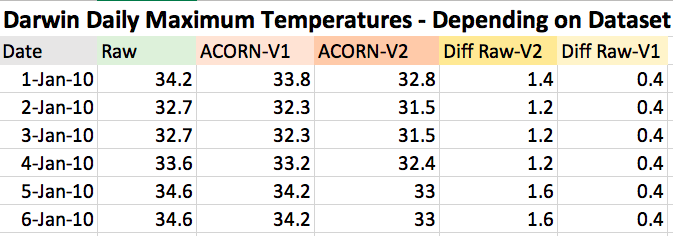
For example, on 1st January 1910 the maximum temperature recorded at the Darwin post office was 34.2 degrees Celsius.

A few years ago, the Bureau changed this to 33.8 degrees Celsius, cooling the recorded temperature by 0.4 degrees. In its most recent re-revision of Darwin’s climate history the temperature on this day has been further reduced, and is now just 32.8.

The daily maximum temperatures for early 1910 as shown in the three different datasets for Darwin

Environmental reporter for the Australian newspaper, Graham Lloyd, asked the Bureau why it had made such changes earlier in the week. A spokesperson is quoted in The Weekend Australian as follows:

“For the case of Darwin, a downward adjustment to older records is applied to account for differences between the older sites and the current site, and difference¬s between older thermometers and the current automated sensor.

“In other words, the adjustments estimate what historical temperatures would look like if they were recorded with today’s equipment at the current site.”

Yet this is a version of exactly the same reason given by the Bureau just six years ago for reducing the temperature on 1 January 1910 by ‘only’ 0.4 degrees.

Neither the equipment, nor the site has changed since ACORN-SAT Version 1 was published in 2012.

Yet another 1 degree has been shaven from the historical temperature record!

To be clear, the weather station has been at the airport since February 1941, and an automatic weather station was installed on 1 October 1990. A Stevenson screen was first installed at the post office site in 1894, and has always been used at the airport site.

So, why was the temperature dropped down by a further one degree for 1 January 1910 in the most recent revision – undertaken just a few months ago? There is no logical or reasonable explanation.

Apparently, at the Bureau, the future is certain and the past can be continually changed – history can be continually revised.

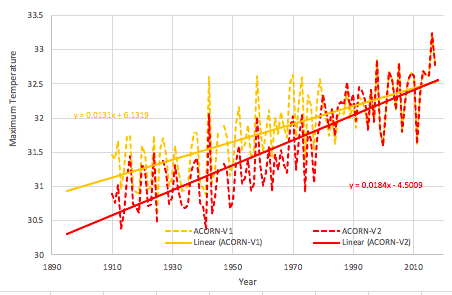
When the daily values are added-up, and compared between versions as annual mean maximum temperatures we see the magnitude of the change – and its effect on temperature trends.

The warming trend of 1.3 degrees C per 100 years in ACORN V1 has been changed to 1.8 degrees C per 100 years in Version 2. The annual average maximum temperature for 1942, as one example, has been reduced by 0.5 degrees.

The extent of global warming increases from 1.3 degrees Celsius per 100 years to 1.8 degrees Celsius in the latest revisions by the Bureau to Australia’s temperature history.

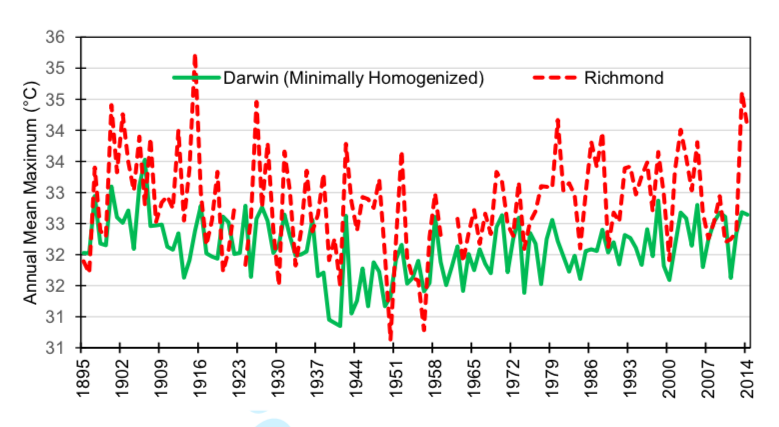
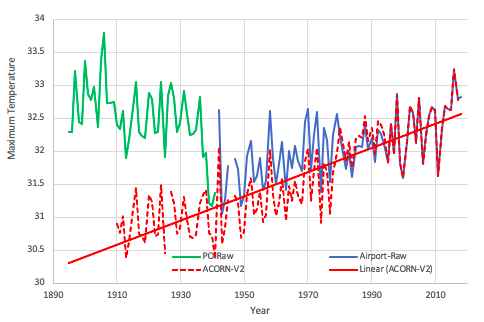
In the maximum temperature record as actually measured at Darwin from 1895 to the present — and taking into consideration the move from the airport to the post office –- there is no warming trend in the Darwin temperature record. This is consistent with other locations in northern Australia with long high-quality records, for example Richmond in north western Queensland.

Annual mean maximum temperatures as measured at Richmond, Qld, charted with a minimally homogenized series for Darwin that combines the post office and airport series into one continuous temperature series making adjustments only for the move to the airport.
Mean maximum annual temperatures as measured at the Darwin Post Office and airport shown with the new remodeled ACORN-SAT Version 2, which is the new official record for Australia.

What the Bureau has done to the historical temperature record for Darwin is indefensible. The Bureau has artificially shortened and cooled Darwin’s climate history to make it consistent with the theory of human-caused global warming.

Ends.

Filed Under: Information Tagged With: Temperatures

Bureau Rewrites History – Again, at Albany

February 16, 2019 By jennifer

THE Australian Bureau of Meteorology keeps remodelling the temperature record for Australia – and not just by a little bit. Temperatures are changed through a process known as homogenisation, and then changed again, sometimes by as much as 6.4 degrees Celsius for the one day.

The temperatures as actually measured at Albany, and other places, has been changed by the Bureau in the development of the official temperature record for Australia.

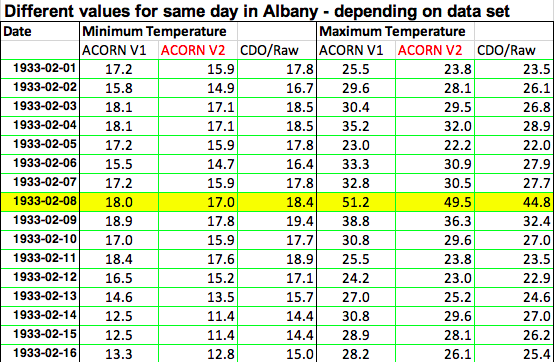
For example, on 8th February 1933 the maximum temperature as measured at Albany in Western Australia was 44.8 degrees Celsius. Then, six years ago it was changed to 51.2 degrees Celsius! Recently it was changed again, this time to 49.5.

Changing the temperature record like this is not unusual for institutions such as the Australian Bureau of Meteorology, though the extent of the change for Albany on this day in 1933, and also the direction of the change, is unusual.

Usually past temperatures are cooled relative to the present as part of remodelling, which is called ‘homogenisation’. Cooling the past relative to the present has the effect of exaggerating global warming.

Given the magnitude and direction of this change to the Albany temperatures, which was first made six years ago, several of us asked the Bureau: ‘Why’?

Why was the temperature at Albany on this day (February 8, 1933) adjusted-up by so much (6.4 degrees) in the official version 1 of the ACORN-SAT dataset that was published six years ago?

I never got an answer.

I have simply been told, mostly via the mainstream media, that homogenisation is world’s best practice, and that ACORN-SAT is scientific.

Of course, it is not scientific to make such changes to temperature measurements, though this type of change – this remodelling – is standard practice not only for our Bureau but also for the custodians of the global temperature datasets relied upon by the IPCC (United Nation’s Intergovernmental Panel on Climate Change).

While ACORN-SAT Version 1 contains remodelled temperature values that can vary from the actual recorded measurement by more than 6 degrees, the values in this same database are often referred to as ‘observations’ as though they represent real measurements. For example, when leading climate scientist Sophie Lewis and David Karoly published a paper in the American Meteorological Society journal about ‘extreme events’ they erroneous refer to ACORN-SAT Version 1 values as ‘observations’.

Indeed, ACORN-SAT Version 1 has underpinned almost all the climate change work at our universities and at CSIRO over the last 6 years.

Most climate scientists seem to want to believe that the temperature values that they are working with represent real measurements. But they don’t!

Just recently this ACORN-SAT database – used by Lewis, Karoly and thousands of other scientists here in Australia and also overseas – was updated. Dr Blair Trewin at the Bureau has re-adjusted temperature values yet again, creating ACORN-SAT Version 2.

In the case of Albany, the maximum temperature on 8th February 1933 is now shown as 49.5 degrees Celsius. In reality it the maximum temperature in Albany on that day back in 1933 was 44.8 degrees Celsius.

The integrity of the historical temperature record is of extraordinary importance. This record also underpins belief in catastrophic human-caused global warming.

Perhaps today’s front-page story in The Australian newspaper by Graham Lloyd will generate some interest in how and why our climate history can be so change, apparently at the whim of the Bureau and other such institutions around the world.

I wait, and I hope.

Filed Under: Information Tagged With: Temperatures

Season’s Greetings, Tuvalu and Thank You Mr Kelly

December 23, 2018 By jennifer

HALFWAY between Hawaii and Australia lies the tiny nation of Tuvalu, which according to popular mythology is slowly disappearing into the Pacific Ocean because of rising sea levels. Except a recent article at the ABC news website correctly explained that in the four decades to 2014, Tuvalu has actually grown by 73 hectares.

How can this be? The mainstream news media reporting something factual – even though it contradicts their catastrophic anthropogenic global warming (CAGW) meme!

It all began with my favourite federal politician, Craig Kelly MP … a relentless warrior for all that is logical and reasonable.

Craig Kelly and Jennifer Marohasy in Townsville a couple of years ago.

Mr Kelly always takes a keen interest in the detail of issues that concern his electorate in Sutherland just south of Sydney, and his objective of late has been fair electricity prices. This objective resulted in something of an obsession by Mr Kelly with the draft National Energy Guarantee legislation – the NEG. In fact, this objective, that became a concern, that developed into an obsession, brought down a Prime Minister. It also caused the ABC Fact Check team to take an interest in his speeches and recently declare him correct, at least on the issue of Tuvalu.

Let me begin this story on 13th August when then Prime Minister Malcolm Turnbull insisted that a meeting of the Coalition’s Energy and Environment Committee, which is chaired by Craig Kelly, be in the prime minister’s cabinet room in his presence at 9pm that Monday night … rather than as usual at 8am in a standard committee room, immediately before the usual party room meeting which is at 9am on the Tuesdays that federal parliament is sitting.

The NEG legislation had been in development for over one year, but Mr Kelly had only ever been given one-page summaries. From these, early in 2018, Mr Kelly had understood that the Paris Target would be for 2030 and could be backloaded, so much of the emissions reduction could be, for example, in a decade’s time after the ever-promised improvement in the reliability and price of renewable sources of energy. Further, there would be no interim target, and the cost of the intermittency of the generators would be borne by the intermittent generators themselves. This meant that those ostensibly providing electricity to the grid were obliged to provide it when called upon, or else they would pay a penalty. These points were all important provisions in the draft legislation that Mr Kelly had lobbied for.

Then, there was rumbling that there would be an interim target, and that there could even be an annual emissions reduction target … that the Prime Minister was requesting as much.

This was in perhaps June, and Mr Kelly protested. “We don’t need to make Paris more onerous than it already is,” he complained to his parliamentary colleagues.

Mr Kelly became further concerned when it became apparent in July that the cost of the intermittency of generation could be borne by the large industrial users. That is, when the wind didn’t blow the bigger manufacturers would need their own backup … their own diesel generators.

These were all concerns that Mr Kelly made known to Mr Turnbull. But most importantly, he wanted to see the actual legislation – the text, the detail.

The meeting of the Energy and Environment Committee that Monday night – held in the room normally reserved for the Cabinet, and most unusually attended by the Prime Minister – lasted about two hours. By the end of it, seven members said they would support the Prime Minister and the legislation. Former Prime Minister Tony Abbot, now a backbencher and a new member of that committee, said he was opposed to it. Queensland Liberal-National MP Ken O’Dowd said he was undecided. That was also the position of Mr Kelly: he insisted that before he could endorse the NEG he needed to see the fine print – he needed more than a one-page summary.

Mr Kelly repeated this concern the next day in the party room, while eyeballing the Prime Minister.

That week parliament finished-up on Thursday. The next day, on Friday 17th August, soon after 6pm – soon after the journalists would have filed their stories for the weekend papers – Prime Minister Turnbull made a major announcement regarding the NEG. The emissions reduction target that was being proposed at 26 percent by 2030 would be set by regulation – not parliament.

Craig Kelly was now angry, because this meant that there could be future increases in the renewable energy target at the discretion of whoever was the Minister at the time. Labour wanted the target set at 45 percent and could achieve as much if they won the next election without so much as consulting the people or the parliament. What Mr Kelly saw as a major lever of the economy – the price and reliability of electricity – could be changed at the stroke of a Minister’s pen, if Prime Minister Turnbull had his way.

Mr Kelly went into overdrive – against the NEG and the Prime Minister, and for democracy.

It was reported that Mr Kelly appeared to be on a “kamikaze mission”. Further, the mainstream media reported he was going to lose preselection because he was so out of touch and being so unreasonable.

In fact, within the week it would be Prime Minister Turnbull, not Craig Kelly, who was out of his job.

Mr Kelly spent the weekend phoning colleagues. Monday it was announced that the legislation would be withdrawn. Tuesday morning at the party room meeting Mr Turnbull stood aside, declaring a spill.

Mr Kelly didn’t have a plan for Peter Dutton or Scott Morrison to become Prime Minister, but he had had enough of Turnbull’s NEG and his concerns were resonating.

To be clear, if Craig Kelly thought that by Australians paying more for their electricity, we could save the planet, he would have supported the NEG and a high renewable energy target. But in Mr Kelly’s view arguing about a NEG of 26 or 45 percent is like arguing about how many fairies fit on a pin head – it is about chimerical wish-fantasies. Even a NEG of 100 percent would have no effect on global temperatures, but it would have a real and deleterious effect on Australian industries reliant on affordable and reliable energy and it would also negatively impact his constituents already struggling to pay their electricity bill.

And Mr Kelly’s concerns go further than this, he is of the opinion that the planet does even need saving – at least not from CAGW. Typical of many so-called sceptics, Mr Kelly is not sceptical of climate change. Rather by reading in some detail about the Earth’s history he realises that the climate has always changed.

Further, as John Abbot and I explain in our recent article in GeoResJ*, there is nothing unusual about the speed or magnitude of climate change over the last 100 or so years. For the last 1,000 to 2,000 years, temperatures have fluctuated within a channel of plus or minus 1 degree Celsius. It is only studies using remodelled data, suspect algorithms and cherrypicked datasets – that generate hockey-sticks. Considering the majority of published studies, in the best journals, global temperatures, including in Sweden, are about as hot now as they were 1,000 years ago.

I mention Sweden, because children in Australia that want the federal government to stop climate change have apparently been following the lead of a Swedish school girl: fifteen-year old Greta Thunberg who has been demonstrating outside the Swedish parliament to stop climate change. That was until she set off with her father in an electric car for the United Nations climate talks in Poland. There she explained that the climate crisis is “the biggest crisis that humanity has ever faced”.

This fake news has been reported uncritically by the world’s media. In fact, they have reported her as wise and brave … causing two fourteen-year old girls, Harriet and Milou, from Castlemaine in rural Victoria to organize the national day of school student protest in Australia.

I was in a taxi on my way to the Melbourne airport when I heard the oh-so passionate chanting on Friday 30th November. I asked the cabbie to go around the block again … I was in disbelief at the naivety of it all. Governments can, of course, be a hindrance to various things – for example, innovation. But it is hubris and nonsense to suggest they could ever stop climate change. This is what Craig Kelly has been trying to explain all year and was a key reason he was so concerned about the NEG and its negative impact on the economy, for no environmental gain.

While denied access to the text of the draft NEG legislation, Mr Kelly has been reading key technical papers on climate change. Earlier this year he read an article in the journal Nature by Paul Kench and colleagues from the University of Auckland. He repeated the conclusions from that research at a Liberal party fundraiser, attended by Get-up activists incognito. So outraged by Kelly’s claims about Tuvalu, the activists sent transcripts of his blasphemy to The Guardian and Australian Broadcasting Corporation. To the ABC’s credit they did a fact check, they even got back to Craig Kelly and asked him if he could substantiate his claims.

Mr Kelly sent them the article, which explains that despite sea level rise, there have been “positive sediment generation balances for these islands” from wave deposition. In fact, to quote more from the article “environmental” rather than “anthropogenic processes” are causing an “expansion of the majority of the islands … masking any incremental effects of rising sea levels, making attribution of sea level effects elusive, as these [environmental] processes can promote high frequency and larger magnitude changes in islands that can persist on the geomorphic record”.

Yet at least since Al Gore’s documentary ‘An Inconvenient Truth’ the world media has been claiming Tuvalu was lost to CAGW.

Every attempt by so-called sceptics to correct the record – until this latest by Craig Kelly – appeared to just generate more ridicule … specifically remembering Graham Young’s attempt to correct the record at Crikey.com back in 2006.

What neither the article in Nature that Mr Kelly quotes from, nor the recent few paragraphs of concession from our ABC, explain the complexity of the situation at Pacific Islands on an Earth where climate change and also volcanism will persist … yes volcanism.

Indeed, the great majority of oceanic islands, including in the Pacific, were formed by volcanic activity. While the volcanoes are active, the islands generally rise relative to the global averaged sea-level. When volcanic activity stops, the islands will cool and eventually start to sink … though as Paul Kench et al. explain in the Nature article wave process and shifts in wave regimes can result in the growth of atolls offsetting any rise in sea levels.

But what is needed in all of this, and especially in future ABC news items, is some context. It is fact that:

1. Since the last glacial maximum about 20,000 years ago, sea levels have risen by more than 100 metres as large ice sheets melted.

2. Globally-averaged sea levels reached a maximum height about 2,000 years ago.

3. Along the east coast of Australia sea levels have actually fallen by about 1.5 metres since then … to reiterate sea levels have fallen about 1.5 metres over the last 2,000 years.

3. But over the last 100 years there has been a slight, but measurable, increase in sea levels. Considering Sydney Harbour this has added up to about a 6.5 centimetre increase over the last 100 years … based on a documented rise of 0.65 millimetres per year between 1885 and 2010: that is the official rate of sea level rise at Fort Denison (just across from the Opera House) as reported by the US National Oceanic and Atmospheric Administration (NOAA). That is less than 1 millimetre per year.

Of course, compounded, this could add up to something catastrophic – one day. But, neither sea levels, nor temperatures, rise in a monotonic way – rather they cycle.

Considering just sea levels at any one location on this planet there is the daily tidal cycle, the monthly lunar cycle, the annual cycle associated with the sun’s declination that causes the four seasons, cycle associated with El Nino and La Nina events, and then there are the longer cycles including the cycles associated with ice ages and interglacial warm periods.

We need to hear more about this from the mainstream media … not just Mr Kelly.

There is no denying that standing for reason can be difficult, especially when the numbers and slogans are against you. But just as Craig Kelly defied a Prime Minister, and won … it is incumbent on every one of us who seeks the truth to keep asking questions and concern ourselves with the detail and most importantly to not give-up on the truth never mind the short-term consequences.

—————

*There has been a campaign against our article in GeoResJ by various high profile believers in CAGW, we respond to this in some detail here: https://jennifermarohasy.com.dev.internet-thinking.com.au/temperatures/response-to-criticism-of-abbot-marohasy-2017-georesj/

Filed Under: Good Causes, History Tagged With: sea level change

  • « Go to Previous Page
  • Go to page 1
  • Interim pages omitted …
  • Go to page 16
  • Go to page 17
  • Go to page 18
  • Go to page 19
  • Go to page 20
  • Interim pages omitted …
  • Go to page 607
  • Go to Next Page »

Primary Sidebar

Recent Comments

  • Ian Thomson on Vax-ed as Sick as Unvax-ed, Amongst My Friends
  • Dave Ross on Vax-ed as Sick as Unvax-ed, Amongst My Friends
  • Dave Ross on Vax-ed as Sick as Unvax-ed, Amongst My Friends
  • Alex on Incarceration Nation: Frightened of Ivermectin, and Dihydrogen monoxide
  • Wilhelm Grimm III on Incarceration Nation: Frightened of Ivermectin, and Dihydrogen monoxide

Subscribe For News Updates

  • This field is for validation purposes and should be left unchanged.

December 2025
M T W T F S S
1234567
891011121314
15161718192021
22232425262728
293031  
« Jan    

Archives

Footer

About Me

Jennifer Marohasy Jennifer Marohasy BSc PhD has worked in industry and government. She is currently researching a novel technique for long-range weather forecasting funded by the B. Macfie Family Foundation. Read more

Subscribe For News Updates

Subscribe Me

Contact Me

To get in touch with Jennifer call 0418873222 or international call +61418873222.

Email: jennifermarohasy at gmail.com

Connect With Me

  • Facebook
  • LinkedIn
  • RSS
  • Twitter
  • YouTube

Copyright © 2014 - 2018 Jennifer Marohasy. All rights reserved. | Legal

Website by 46digital