• Skip to primary navigation
  • Skip to main content
  • Skip to primary sidebar
  • Skip to footer
Jennifer Marohasy

Jennifer Marohasy

a forum for the discussion of issues concerning the natural environment

  • Home
  • About
  • Publications
  • Speaker
  • Blog
  • Temperatures
  • Coral Reefs
  • Contact
  • Subscribe

Blog

Towards a New Theory of Climate with a New Book

October 13, 2019 By jennifer

AS the editor of the last book, and the next book, in the Institute of Public Affairs’ Climate Change: The Facts series I spend a lot of time pondering the nature of ‘facts’. 

A fact is something that has become known as true.  A fact may be dependent on accumulated knowledge.  Facts are considered superior to an opinion or an interpretation.   But sometimes the facts change.  

There is the famous quote variously attributed to John Maynard Keynes, and sometimes Winston Churchill: “When the facts change, I change my mind. What do you do?”

Right up until the city of Brisbane in my home state of Queensland was flooded back in January 2011 — flooded following the emergency release of water from the overflowing Wivenhoe Dam — the considered opinion from Australian experts was that the dams would never fill again. This was accepted by many as a ‘fact’.

After that exceptionally wet summer, the Australian Bureau of Meteorology continued to forecast below average rainfall even for Australia’s Murray Darling Basin through the exceptionally wet spring of 2016.    Now there is drought again across much of eastern and southern Australia, and what farmers really need to know is: “When will it rain again?”  

Of course, droughts in Australia always break, and with flooding rains.  But there is no indication from the Bureau when we can expect this break.


Many claim such flood events are unpredictable. In which case, we arguably don’t have a scientific theory of climate.  A scientific theory is something substantiated: a body of facts that has been repeatedly confirmed through observation and experimentation and that can be confirmed through accurate prediction.  

There is no doubt that the Western World is currently being significantly affected by climate change activism.  But, the more rational amongst us — who are not necessarily those with a more formal education — can perhaps already see that very little of what is currently being articulated by this populist movement resembles fact.  

Currently what we see from activists is more prophecy than numerically verifiable prediction — certainly no testing of falsifiable theory through what might be considered the scientific method.  

Indeed, the leaders of the current populist movement against climate change seem unaware of the history of science or the history of climate change embedded in the geological record. And while obsessed with climate, they seem unable to make a practical forecast for next week or next year when it comes to issues such as when the drought here in Australia might break.  

This is a long introduction to the next book in the IPA’s Climate Change: The Facts series, which will be available for sale early next year.  

It will be a book by dissidents, obsessed with facts, who understand that the climate is always changing.  

As Editor, I get to choose chapter authors.   The four most important chapters will be on ‘water’ and it is my intention that they will move us towards a new theory of climate.  

The four chapters are variously about cosmic rays, cloud cover, tropical convection and water vapour.  Indeed, water — in its many forms rather than carbon dioxide — will be dominant in the new emerging theory of climate.

This theory perhaps has its origins in a little noted paper written by Richard Lindzen, Ming-Dah Chou and Arthur Hou back in 2001.  It got physicists like Peter Ridd thinking.  

Dr Ridd is contributing one of the four seminal water chapters in the next book.  He will explain how deep convection, which can be thought of as a huge heat engine — is an alternative pathway for the upward transfer of energy from greenhouse gases.  The other important chapters in this section on water are by Henrik Svensmark, Geoffrey Duffy and the great Richard Lindzen.  

I am seeking your support for the book’s publication.  

The IPA has a dedicated appeal page at www.ipa.org.au/cctf2020.  


If you can spare more than A$400, you have the option of your name being printed in the book. I am proud that will be my own name will on the front cover of the book alongside Duffy, Svensmark, Ridd, Lindzen and other fine scientists. 

The last book in the ‘Climate change the facts’ series sold more than 30,000 copies.  It has made a difference, in a small way. 

My hypothesis is that this next book will sell three times as many copies, and eventually be recognised as articulating the beginning of a new theory of climate, with Peter Ridd’s contribution significantly building on the earlier work of Richard Lindzen. 

But these four water chapters will be controversial, with technically complex elements, but 
the book will also include chapters that are easier to digest, and a few that are more philosophical. 

One of the most popular chapters in the last book (our 2017 edition) — and the least technical, and most literary chapter — was by legendary poet and writer, Clive James, which was an amusing poke at ‘climate change’ and catastrophism as popular culture. 

My colleague at the IPA, Scott Hargreaves has already written something literary for the next edition (CCTF2020) and he has drawn on Clive’s James’ translation of Dante’s Inferno to help describe the nine circles of ‘climate skepticism’.  This will perhaps be the last chapter in this next 2020 edition.  What Scott has written is so insightful and also fun. 

There will be about 20 chapters in total in the next book, including several chapters on Antarctica.  So of course, there is a chapter on penguins, and perhaps two on volcanoes. 

Antarctica is twice the size of Australia, and has a complex climate that is central to understanding global atmospheric and oceanic circulation patterns — including drought and flood cycles in Australia.  

The history of science suggests that paradigms are never disproven until they are replaced. So, now more than ever, it is important that you back this book that will challenge the current consensus, which is the current dominant paradigm. 

Physicist and philosopher, the late Thomas Kuhn, explained that competition within segments of the scientific community is the only process that historically has ever actually resulted in the replacement and then eventual rejection of one previously accepted paradigm or theory.  It is so important that alternative voices are heard, that there is opportunity for a new theory of climate to emerge.

If you are at all sceptical of the catastrophist’s claims that the current drought in Australia is the very worst on record, sea levels at record highs, and the planet about to melt — and most importantly, if you would like to contribute in a practical way to a fact-based new theory of climate change — then make a financial contribution to the IPA’s next book in the ‘Climate Change the Facts’ series via the dedicated appeal page at:  www.ipa.org.au/cctf2020

Everyone is entitled to their own opinion, but not their own facts.

***
A version of this article was first published at The Spectator and subsequently at WUWT. I appreciate many of the comments in the WUWT thread, there are so many, and I intend to action some of the recommendations.
Filed Under: Books

How to Evaluate the Evidence of Contrarians – Scientifically

September 21, 2019 By jennifer

FUNDAMENTAL to the scientific method is the assumption that reality exists independently of our belief systems; that there is such a thing as evidence, and that it matters.

There seems to be general agreement on this point from both the left and right sides of Australian politics.

Indeed, in an article in The Weekend Australian newspaper (page 18) written by Graham Lloyd entitled ‘No place in debate for contrarian hijackers’, Misha Ketchell who is the editor of the influential academic publication The Conversation is quoted claiming to care so much about the evidence that the opinions of ‘sceptics’ must be excluded.

But this begs the question: how do we define scepticism, and on what basis do we discount the opinion of a so-called sceptic?

If their opinions are at complete odds with the evidence: then wouldn’t it be more useful to show this? To use them, and their wrong claims, to explain the truth within the theory of human-caused global warming?

It is claimed that sceptics like myself have an undue and powerful political influence, repeatedly successfully thwarting attempts to implement necessary public policy change.

Indeed, if my arguments are so devoid of evidence, this should be easily proven. Except that the skills scores from my rainfall forecasts, when compared with reality, are far superior to anything forecast by the Australian Bureau of Meteorology.

There has always been a role in science for models and predictions — that can be objectively tested against reality/the evidence —- so the predictions of sceptics could be juxtaposed against predictions from the consensus.

Another way of finding universal truths is through simple observation. If we have catastrophic sea level rise, for example, then this should be evident when we visit the beach, or somewhere like Sydney Harbour. It should be evident in our coastal landscapes. I explained some of this in a recent talk I gave at the Maroochydore Surf Life Saving Club that the Institute of Public Affairs had filmed and that is now available on YouTube.

Given science is about real world phenomena, it should not be that difficult for Misha Ketchell to test the evidence repeatedly being put forward by particular individuals, like myself, against what comes to pass in the real world — what is observed.

But instead of relying on such simple tests of the truth — in my rainfall forecasts or in a coastal landscape or at a coral reef — those in authority, and who edit important journals and websites, have decided that I should be banned.

As Graham Lloyd explains on page 18 of today’s Weekend Australian, I’m listed, in, of all places, the journal Nature as a dangerous dissident who must be shunned, and denied, because, it is claimed, that I misrepresent the evidence. That so many of us are actively de-platformed is only just now being acknowledged, and I am grateful that it has today been explained in The Weekend Australian.

The conspiracy against me dates to at least 2008 when Bryant MacFie gifted $350,000 to the University of Queensland (UQ) in a donation facilitated by the Institute of Public Affairs to pay for environmental research scholarships. After I set all of this up, the Federation of Australian Scientific and Technological Societies (FASTS) intervened and told the Law and Agricultural facilities that if the program was to go ahead it must be without me … because as someone sceptical of global warming I lacked integrity.

I was replaced by Richard Burns, as the team leader. And more recently, in January just this year, after another strategic intervention perhaps involving the Bureau this time, I was removed as team leader from a project with the Queensland University of Technology (QUT).

The University of Queensland program did go ahead without me back in 2008.

I moved to Katoomba in the Blue Mountains, west of Sydney. The Blue Mountains is, of course, a great place for bush walking, which is a great way to reconnect with the natural world. It is in nature that we find evidence for the universal truths that exist independently of any and everything Misha Ketchell, and other such Australian opinion leaders, choose to publish — or not.

So, while I have repeatedly tried to escape to nature, it draws me back to science … as a method for transcending the chatter now everywhere in our scientific institutions and their publications.

I have kept showing that David Jones and Blair Trewin at the Bureau of Meteorology keep changing the temperature record, and more recently that the journal Nature publishes incorrect information from David Wachenfeld, the chief scientist at the Great Barrier Reef Marine Park Authority, as detailed in the article that follows.

Science is a method, science is never settled. We must therefore always be open-minded, tolerant and ready to be proven wrong. But history will eventually show that it is Misha Ketchell who is wrong and that this editor is not using a reasonable, or in any way evidence-based, criteria for deciding what should be published. This is so very wrong and so very harmful to science, democracy and the capacity of other opinion leaders and academics to evaluate the evidence which is so necessary if they are to get to the truth in such matters as climate change.

****************

The following article was published in The Weekend Australian on 7th September 2019.

Coral death knell exaggerated, says rebel quality assurance survey

The death of inshore corals near Bowen had been greatly exaggerated, according to the findings of a rebel quality assurance survey by reef-science outsiders Peter Ridd and Jennifer Marohasy.

The shallow reef flats of Stone Island have played a key role in divisions over the health of the – inshore Great Barrier Reef and the impact of run-off from agriculture.
Dr Ridd was disciplined for attempting to blow the whistle on the widespread use of before and after pictures taken a century apart near Stone Island that suggested coral cover had disappeared.


A follow-up paper by Queensland University reef scientist Tara Clark, co-authored by Great Barrier Reef Marine Park Authority chief scientist David Wachenfeld, confirmed the coral loss.

Despite winning his unfair dismissal case against JCU and being yesterday awarded more than $1.2m by the Federal Court, Dr Ridd effectively has been dismissed as a crank by other scientists.

An expert scientific panel last month accused him of spreading scientific misinformation like pro- tobacco lobbyists and anti-vaccination campaigners.

But Dr Ridd and Dr Marohasy have spent the past two weeks documenting the corals around Stone Island, which they found were still very much alive.

The in-the-water quality assurance snapshot of onshore corals near Bowen and the Whitsundays has been partly funded by the Institute of Public Affairs.

The hundreds of hours of aerial and aquatic footage will be archived and some of this made into a documentary.

Dr Marohasy and Dr Ridd repeated the transects used in the Clark research which found there had been a serious decline in reef health from historical photographs in the late 19th century to the present.

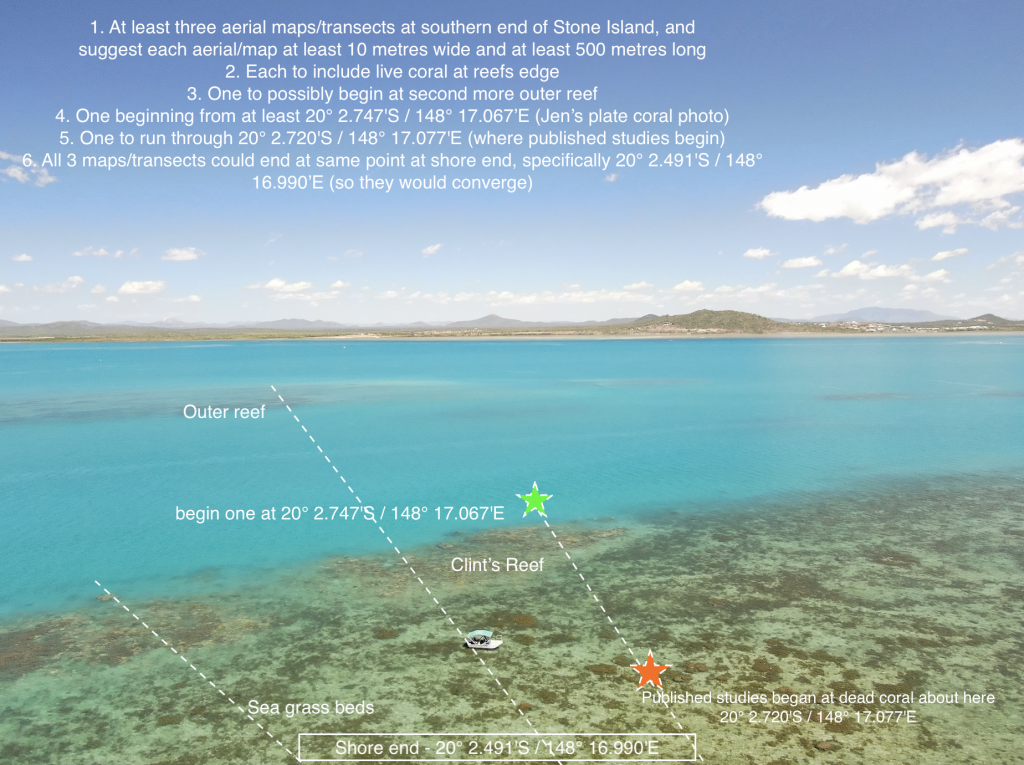
Dr Marohasy said if the transects used in the Clark analysis had been extended by 30m to the south of Stone Island they would have found a different story.

An annotated aerial photograph of Clint’s Reef, taken with my drone Skido on about 25th August 2019, for planning underwater photography and aerial mapping.

“I saw and photographed large pink plate coral on August 25 — some more than 1m in diameter — at the reef edge just 30m from where Tara Clark and colleagues ended their transect as published in Nature,” Dr Marohasy said.

Several hundred metres away, across the headland, in the northern-facing bay, was an area of 100 per cent coral cover stretching over 25ha.

Dr Ridd said the finding of the survey was that there was “good coral all over the place” around Stone Island.

“What we saw was not consistent with the proposition that the inshore reefs have been destroyed by farm run-off,” Dr Ridd said.

He said the findings were at odds to those of Dr Clark and her team.

The survey results follow a report by GBRMPA last week that downgraded the long-term outlook for the reef from poor to very poor with particular concern about run-off in onshore reef areas.

Dr Ridd said there were “lots of people around Bowen who get very angry when people say all their coral is wiped out”.

“How would people in Sydney feel if everybody was saying that the water in Sydney Harbour has turned brown from pollution, the bridge was rusting scrap and the Opera House was crumbling ruin,” he said.

Dr Wachenfeld said it was always great to see evidence of healthy coral in inshore areas.
“The body of published science tells us most of our inshore reefs are extensively degraded,” he said. “When we find healthy patches that’s good news.”

Dr Wachenfeld said a paper published in 2016 contained information about coral around Stone Island and nearby Middle Reef.

This article was first published in The Weekend Australian, and can be viewed online here.

****

The feature image, at the top of this blog post, is of me flying Skido, just south of Bowen over mudflat to the west of Bramston Reef. This drone aerial cinematography may be included in an upcoming documentary (yet to be scripted), that could be made following a short film called ‘Most Corals are Beige’ (directed by Clint Hempsall, written by Jennifer Marohasy) that is planned for release mid-October in Melbourne.

To be sure to know more about the short film and possible documentary consider subscribing for my irregular e-news.

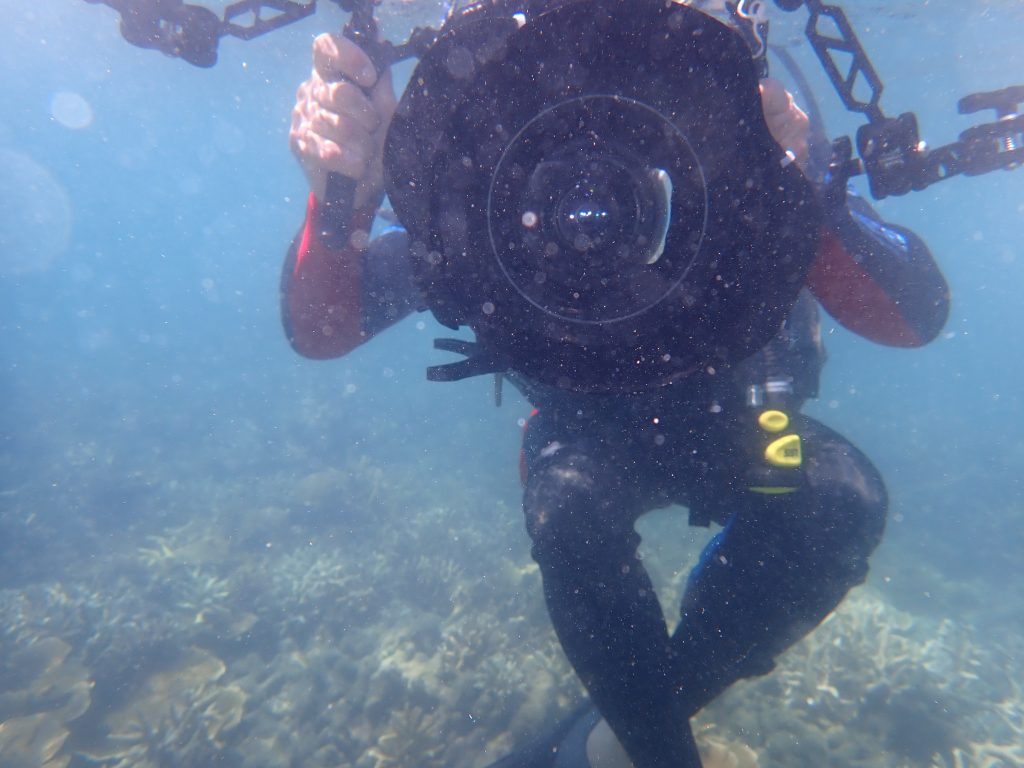
Me under the water at Beige Reef, off Stone Island, at the entrance to Bowen Harbour.

Filed Under: Information Tagged With: Great Barrier Reef, Philosophy, temperates

Found: 25 Hectares of Acropora at Stone Island

September 5, 2019 By jennifer

CORAL reefs in shallow waters adjacent to the Australian mainland are considered particularly susceptible to coral bleaching, and also smothering by sediment from turbid water. This was all lamented a week or so ago, including by Sussan Ley, the Federal Environment Minister. Relying on a review of more than 1,000 reports by academics who don’t get out enough, she told the nation that the prognosis for the Great Barrier Reef, and particularly inshore reefs, is very poor.

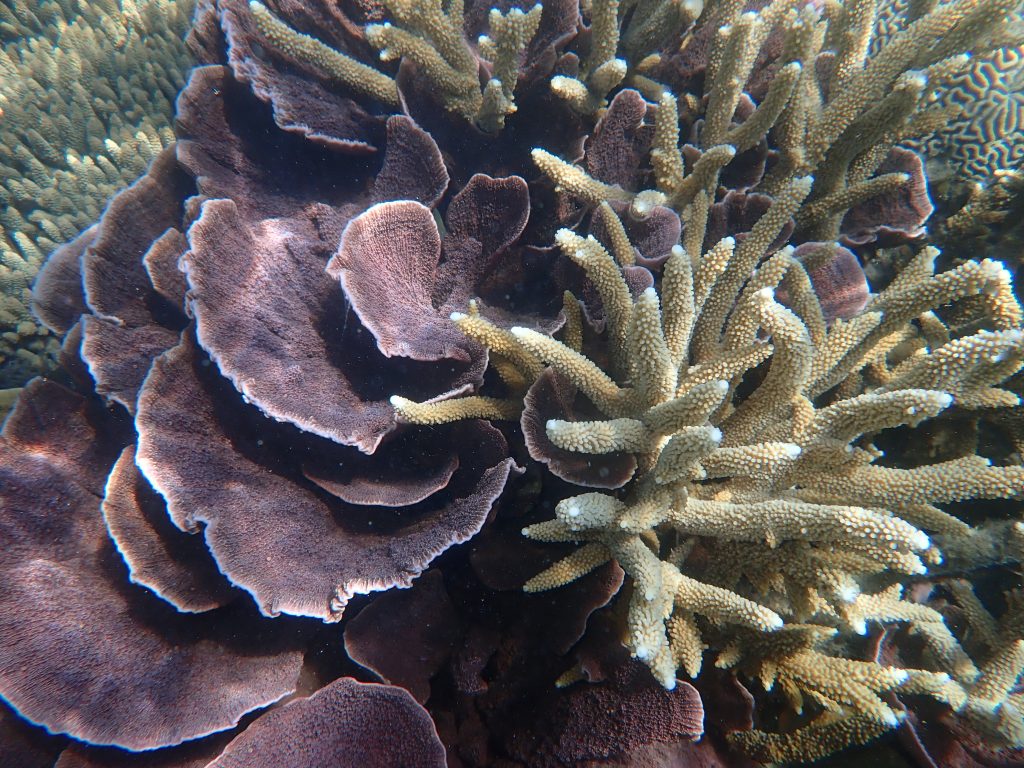
Acropora sp and Turbinaria mesenterina, both hard corals, photographed with my little underwater Olympus camera on 27th August 2019, at an inshore reef fringing Stone Island.

One of the papers that helped shaped this opinion is by Tara Clark (and colleagues) entitled ‘Historical photographs revisited: A case study for dating and characterising recent loss of coral cover on the inshore Great Barrier Reef’ published by Nature (DOI: 10.1038/srep19285).

The historical photographs were taken circa 1890 and 1915 of corals in the vicinity of Stone Island, off Bowen, and they show healthy corals including species of the branching coral Acropora spp.. The historic photographs have Gloucester Island and Gloucester passage as an iconic backdrop.

Tara Clark and colleagues concluded in the peer-reviewed paper published in 2016 that:

Using a combination of anecdotal, ecological and geochemical techniques, the results of this study provide a robust understanding of coral community change for Bramston Reef and Stone Island. In the late 19th and early 20th Century, historical photographs revealed large and abundant living tabular Acropora sp. and massive faviid colonies at Bramston Reef and high cover of both plating and branching Acropora sp. colonies at Stone Island. By contrast in 1994, no living Acropora colonies were found at either location and the majority of the large faviids that featured so prominently at Bramston Reef in c.1890 were dead, covered in algae and/or mud.

And further that:

In 2012 (eighteen years later), Bramston Reef was still characterized by many large faviid colonies, dead and overgrown by algae and sediment, as well as a large number of small living faviid colonies. Yet there was evidence of some small increase in coral cover, primarily driven by tabular Acropora sp. and other genera. In addition, living faviid colonies that appeared to be of equal size to their predecessors were also found in 2012, albeit scarc. At Stone Island, the reef crest was similar to that observed in 1994 with a substrate almost completely devoid of living corals.”

I visited Stone Island late August, and was surprised to find an abundance of Acropora spp. forming both plate and branching colonies. I saw and photographed large pink plate coral on 25th August — some more than 1 metre in diameter — at the reef edge just 30 metres from where Tara Clark and colleagues ended their transect as published in Nature.

I’ve named this coral reef — that Clark and others claim doesn’t exist — Clint’s reef after Clint Hempsall, the underwater cinematography who spent over an hour filming there on 25th August 2019.

Me (Jen Marohasy) photographing Clint Hempsall filming off Stone Island with a rather large underwater camera.

This footage will hopefully be included in the film we are making about the inner reefs of the northern Whitsundays: an area that includes Bowen harbour and Stone Island. The footage should also be archived, so that like the 1890 and 1914 photographs it is available as a historic record, a snapshot in time of the state of these reefs.

The two days later, on 27th August, we visited a reef just around the headland from Clint’s reef, in the southern corner of the north-facing bay at Stone Island. The coral coverage here was much more extensive, and this bay also has a view across to Gloucester Island and Gloucester passage.

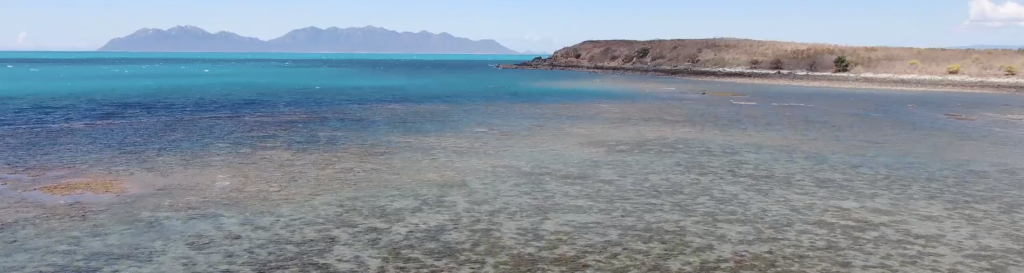
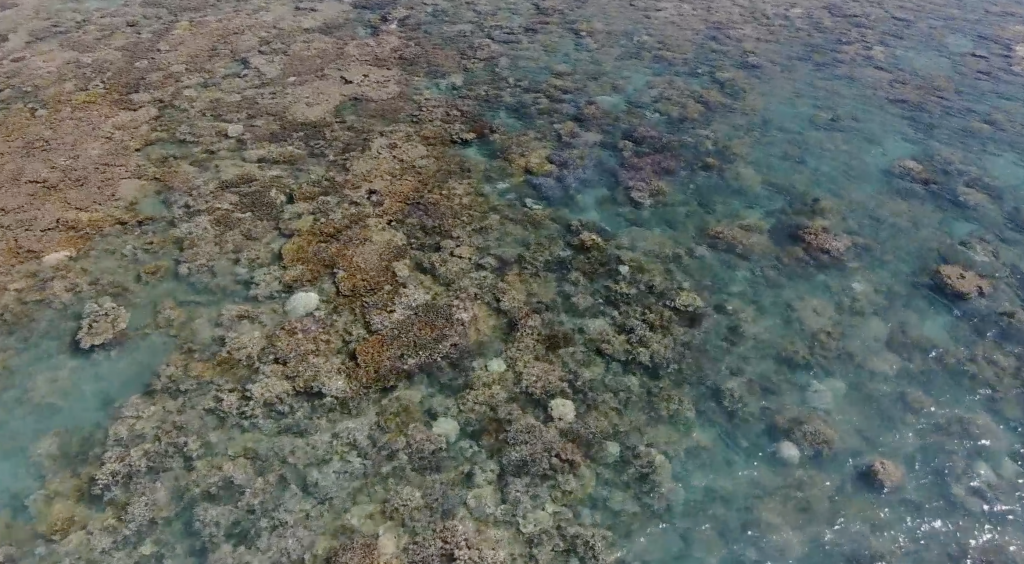
A screenshot from aerial drone footage (Skido of course) that will hopefully be in the film … showing Beige Reef beyond some seagrass in the middle distance and Gloucester Island in the background.

At this reef, that I’m calling Beige reef, my colleagues Rob McCulloch and Walter Starck estimated close to 100% coral coverage over perhaps twenty-five (25) hectares. I want to return to this reef and map it with my drone (Skido, of course).

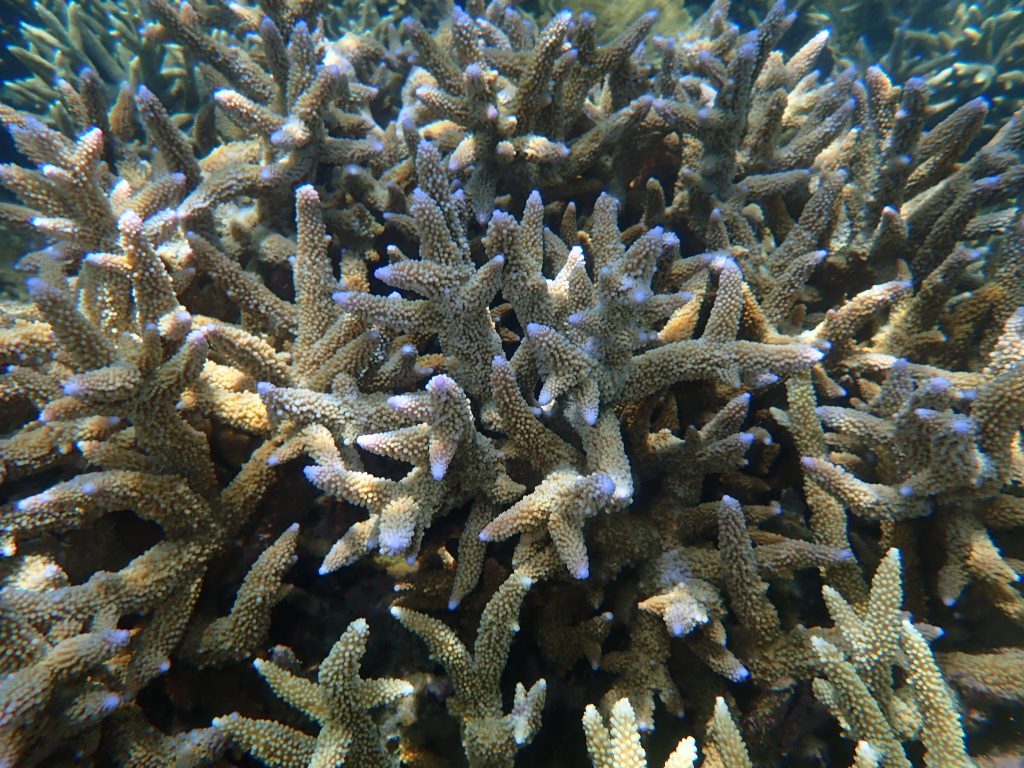
There are two dominant coral species at Beige Reef – an Acropora sp. and Turbinaria mesenterina.

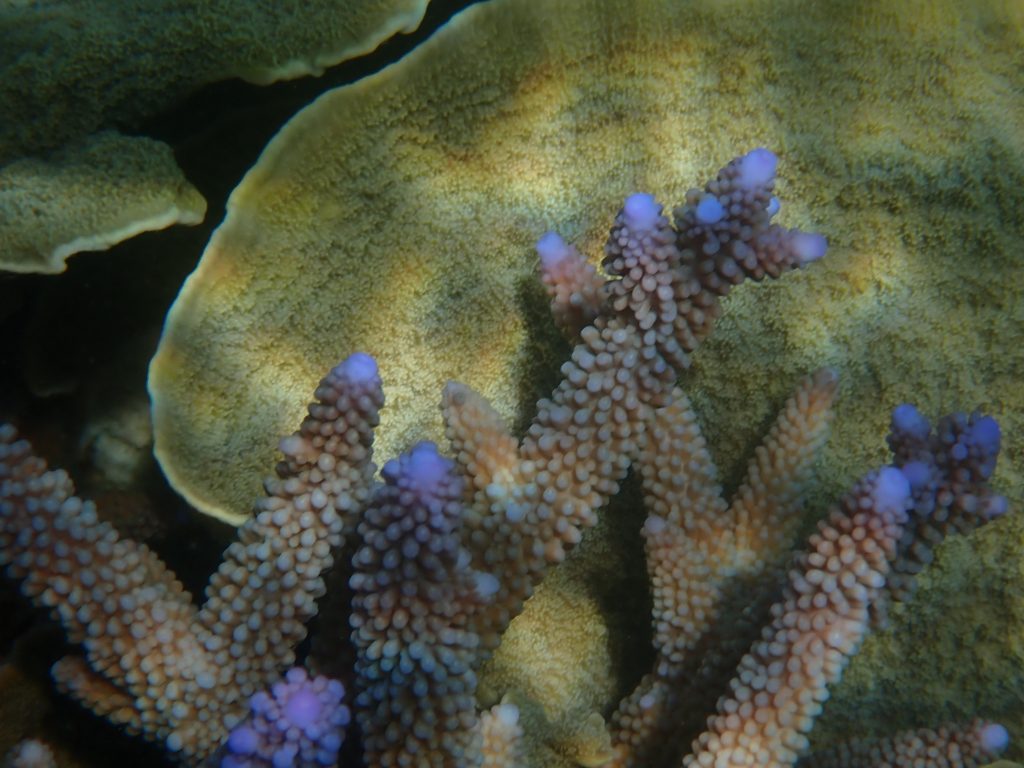
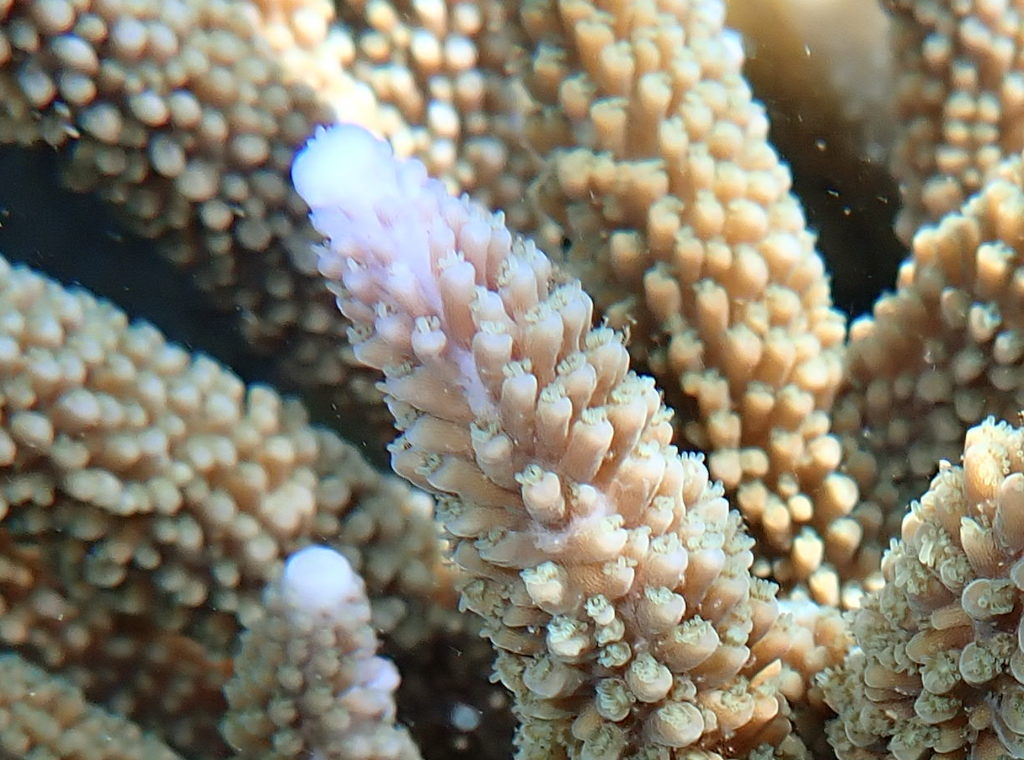
The genus Acropora is distinguished by having axial corallites at the tip of each branch, that are different in size, form and often colour from the radial corallites on the same branch. At Beige reef you can easily distinguish the axial corallites on the dominant Acropora species because they are florescent and glow either white or purple. So the branch is beige and the tip white or purple.

The beige Acropora with a florescent tip, which is the axial corallite.

I’ve read that such shallow-water reef-building corals with these photoproteins that fluoresce are more resistant to bleaching when the photoproteins are positioned above the zooxanthellae to protect them from harsh light, as is in the case with this Acropora species at Beige reef. Bleaching occurs when the symbiotic algae (zooxanthellae) are expelled when temperatures become too hot or too cold. Apparently in some deep water corals that fluoresce, the photoproteins are below the zooxanthellae to reflect the light back.

There are apparently over 130 species of Acropora and I would be keen to know the actual species at Beige reef… with these florescent tips.

This is a dominant coral species over perhaps 25 hectares at Beige reef, which is in the south-eastern corner of the northern facing bay at Stone Island in Bowen Harbour.

Does anyone want to hazard a guess as to the specific species of Acropora that I have photographed?

It is possible to see the corallite and the tentacles in the close-up photograph.

I’m just learning how to take such pictures that are important for accurate coral identification. The next stage will be to include a scale, for reference … to know the size of the corallites.

A close-up of the dominant Acropora sp. at Beige reef, showing its tentacles extended. I took this photograph on 27th August with the microscope setting on my little underwater Olympus camera.

Beige reef is a shallow inshore reef that would be more suspecting to bleaching from both exposure at low tide and also the water heating-up than any of the other reefs I snorkelled off-Bowen. Yet surprisingly there was little evidence of bleaching here — or at the other reefs.

Another screenshot from aerial footage from my drone Skido … drones could be used much more to do detailed surveys of inshore reefs with the footage archived.

The most damaged of the eight reefs that we snorkelled was at Middle Island, with much of the reef to the south-west of the island reduced to rubble by Cyclone Debbie which struck in early 2017.

The other dominant coral species at Beige Reef is Turbinaria mesenterina. This is a type of foliose coral in the family Dendrophylliidae. The individual polyps fuse to form what are called unifacial laminae, that look something like lettuce leaves made of limestone and all with a white trim.

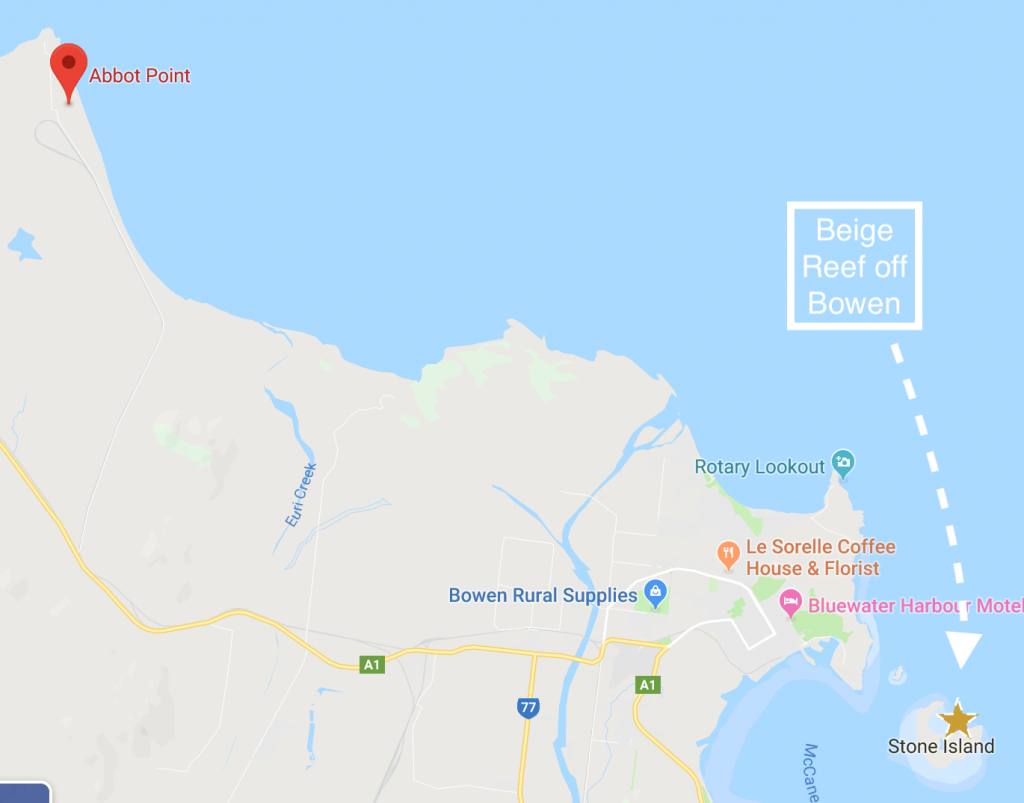
I’ve read that this coral can self-clean, which is perhaps handy given it lives in relatively turbid inshore waters. Indeed there are mudflats and mangroves at Stone Island, and the Abbot Point coal terminal is not far away, as shown on the map.

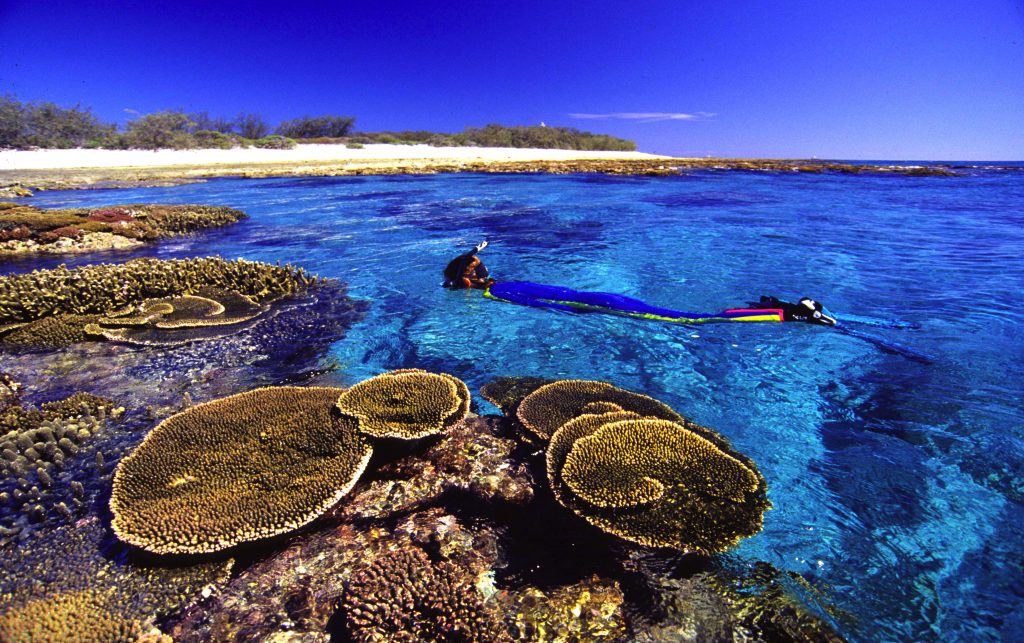
These ‘lettuce leaf’ corals were mostly beige in colour, though there were also corals of the same species (T. mesenterina) that were a deep purple, as shown in the second photograph at the very top of this blog post. Both the purple and white forms have the same white trim around the perimeter.

Of course, the colour of a coral has everything to do with the species of symbiotic zooxanthellae, which is the species of symbiotic algae that lives in the coral. So, the same species of coral may be different colours and different species of coral the same colour.

At Beige reef there are a lot of corals that are a delicate beige colour, which is perhaps not for everyone. But I thought it a most beautiful coral reef.

It is a pity that this reef, Beige reef, is denied in the scientific report by Tara Clark and colleagues as published by Nature in 2016. And I find it surprising that Minister Ley can be so negative about the inshore reef because this was not my experience at all having just spent 10 days exploring 8 mostly inshore reefs in the Whitsundays including Beige and Clint Reefs that fringe Stone Island.

UPDATE 06/09/2019: THERE WAS AN ERROR WITH A DATE (I PHOTOGRAPHED THE PLATE CORAL AT CLINT’S REEF ON 25TH, NOT 26TH) AND I’VE MADE A COUPLE OF OTHER EDITS JUST NOW … 1PM ON 6TH SEPTEMBER. THANKS FOR YOUR PATIENCE. ALSO, I’VE ADDED A PHOTOGRAPH. I SHALL STOP NOW. JEN

***
Beige reef has been flown over with my drone, and there is over an hour of underwater cinematography from Clint Hempsall. This footage all needs to be archived … but first some of it will hopefully be included as part of a short film just on Beige reef and then there will be the longer film about all eight reefs. Subscribe at my website so you know when.

Me (Jen Marohasy) on my way back to Bowen from Stone Island on 26th August 2019.

Filed Under: Information Tagged With: Great Barrier Reef

10 Days at the Magnificent Great Barrier Reef (Part 1, Whitsundays)

August 31, 2019 By jennifer

I’VE spent the last 10 days snorkelling, paddle boarding, and droning over the coral reefs of the northern and southern Whitsundays. I’ve been with a great crew including Clint Hempsall who has an underwater camera and he has taken so much footage … been filming underwater all of this time.

We started at Horseshoe bay that is right in Bowen township … in fact there is a coffee shop within perhaps 250 metres of the southern headland where there are a great diversity of colourful corals growing on the granite, and there is a lifeguard.

I was surprised to see such colourful, healthy corals straight-off the beach and so accessible from the mainland/a north Queensland town. A family can train/bus/drive to this local beach at Bowen and go snorkelling and find many of the corals found throughout the Great Barrier Reef. Indeed, the bays and headlands around Bowen offer an opportunity for anyone to see corals, without spending a lot of money.

Bramston Reef is also off-Bowen, just to the south from the end of Ocean View Drive. It is possible to park a car here and walk out across the mudflat that is teeming with life, then across the reef flat with Halimides and red starfish … then there is so much coral. This coral reef looks very different to Horseshoe Bay. The corals are mostly brown, but there are also pinks and greens and they are large and spread over perhaps 40 hectares, it would be great to map this area but much of it falls under a no-fly zone which is the approach to Bowen airport and so I haven’t been able to fly my drone there … but I have gone out over it on my paddle boat. That was so much fun.

I have also snorkelled over Butterfly reef on the Southern Whitsundays … a uniquely different reef with lots of very yellow soft corals. That day I also jumped-in at Luncheon reef and saw an old Porites (dead) now with a layer of a brilliant blue encrusting coral growing over it. And there were so many fish, and also seagulls. You look back to the islands and they are covered in Hoop pine. It is so pretty: above and below the water.

I didn’t see any coral bleaching, but there was some damage from crown-of-thorn at Luncheon reef.

Most of the last 10 days has been at Stone Island, which is just off Bowen and has so many unique and different reefs around it.

I know that at its narrowest it is 1.3 km between the mainland and Stone Island because I had originally intended to do all of this on my paddle board and was measuring distances … as it turned out my friend Rob McCulloch bought a boat down from Cairns for this part of our project.

Attached is an aerial view from my drone (Skido) looking down on Clint Hempsall with his underwater camera and oxygen tank at what I’ve named Clint’s reef, off the south western edge of Stone Island. This reef has some beautiful pink plate corals, and a lot of stoney corals (what look like Porites). There are also various soft corals. On the mud flat we saw so many sea cucumbers, and there was a whale breaching off shore that day, not to mention all the green turtles (perhaps 8 along a stretch travelling/boating slowly for perhaps 10 minutes).

Just around the corner to the north east from Clint’s reef is the eastern facing bay at Stone Island. There are large bombies covered in different corals to the north, but my very favourite reef is in the south western corner of this bay … I’m calling it Beige Reef. There is nearly 100 percent coral cover over at least 20 hectares here … and so much foliose corals that are a delicate light beige colour with a white trim: image lettuce leaves in a hard limestone in these colours. Scattered amongst these corals are off-white Acropora (staghorn corals) with fluorescent purple tips and so many little Damsel fish, mostly black in colour. This coral garden is truly a sight to behold. Not particularly colourful, but rather subtle, beautiful, textured and with the light dappled through as I swam over.

At Beige reef there were also large Wrasse fish, and also Parrot fish and also Cheatadon (Butterfly fish).

So, I’ve had a wonderful 10 days so far … and I’m still to visit Middle Island today (Saturday) and Bait Reef on Sunday.

I will be in Mackay Monday night (2nd September) to give a talk about all of this at the Ocean International Resort, 1 Bridge Road, Illawong Beach, Mackay from 7pm.

Clint Hempsall will put together a few minutes of underwater footage with a focus on Beige reef … and this will also feature the the rest of the team on the boat and also some of us snorkelling and diving.

I hope to see you there!

****
The feature image shows Clint Hempsall filming underwater off the southern end of Stone Island (off Bowen) this year on my birthday, which was 26th August. I took the picture from my drone, called Skido.

I also have many minutes of aerial drone footage of this scene with the water washing against the edge of reef. I’m hoping the scene will make it into our film documenting the 2 weeks (in total) that we will have spent exploring the Whitsundays this August/September 2019.

This adventure has been funded by the B. Macfie Family Foundation through the Institute of Public Affairs.

Filed Under: Nature Photographs Tagged With: Great Barrier Reef

Heron Island Corals: Still Constrained by Sea Level Fall

August 20, 2019 By jennifer

MY mother lived and worked on Heron Island at the Great Barrier Reef in 1955. That was the same year the young Bob Endean established the University of Queensland Heron Island Research Station. He went on to become a famous marine biologist, and instrumental in the formation of the Great Barrier Reef Marine Park Authority (GBRMPA) in 1975.

There are photographs of my mother, then Joan Edith Pearce, standing knee deep surrounded by Porites coral micro atolls that are stunted and bleached. I showed one of these at my talk entitled ‘Climate Change Concern’ at the Maroochydore Surf Life Saving Club on 14th July. This has now been made into a YouTube:

The growth of corals back in 1955 at Heron Island was constrained by their inability to continue to grow-up, because sea levels were not rising. This continues to be the situation today — despite what you might to be told on the nightly news.

In fact, a peer-reviewed technical paper by L. Scopelitis et al. published in the journal ‘Coral Reef’ (2011) and rather curiously entitled ‘Coral colonisation of a shallow reef flat in response to rising sea level: quantification from 35 years of remote sensing data at Heron Island, Australia’ explains that the period 2002 to 2007 has been the most constrained for Heron Island corals since at least 1940. This is apparently because they have reached their vertical limit for growth, and there has been no sea level rise.

The single biggest threat to the Great Barrier Reef is sea level fall. Sea levels did fall some 30 centimetres during the recent super El Nino event of 2015/2016 as I explain in the YouTube presentation.

This is not a large amount considering that the tidal range at Heron Island on any one day can be anything from 1 to 3 metres.

But 30 centimetres is enough to result in bleaching of the top 30 centimetres of a coral that may be subject to sunshine on the exposed reef flat for perhaps an hour.

Heron Island is a coral cay that formed perhaps 6,000 years ago, perhaps following a violent storm when a large pile of coral rubble and broken shells was left above the high tide mark. It has grown since then.

The incident of bleaching due to low sea levels associated with El Nino events has been documented at other Great Barrier Reef islands back 3,000 years by Helen McGregor at Wollongong University.

I’m specifically thinking of her paper entitled ‘Coral micro atoll reconstructions of El Nino-Southern Oscillation: New windows on seasonal and inter annual processes’, which was published in the journal ‘Past Global Changes’ (volume 21) in 2013. By dissecting micro-atolls — the type shown in the picture of my mother at Heron Island back in 1955 — it is possible to understand that sea level has been a constraint to coral growth at the Great Barrier reef for at least this long: at least 3,000 years.

The distinctive micro-atoll form is a result of continual exposure to heat and sunlight at extremely low tides, which result, of course, in low sea levels.

****

I’m leaving Noosa tomorrow for the Great Barrier Reef. If you would like to be updated on my work there — with a drone pilot and underwater photographer — considering subscribing for my irregular email updates:https://jennifermarohasy.com.dev.internet-thinking.com.au/subscribe/

Filed Under: Information, News Tagged With: Great Barrier Reef, sea level change

Lady Elliot, Temperature Trends

August 3, 2019 By jennifer

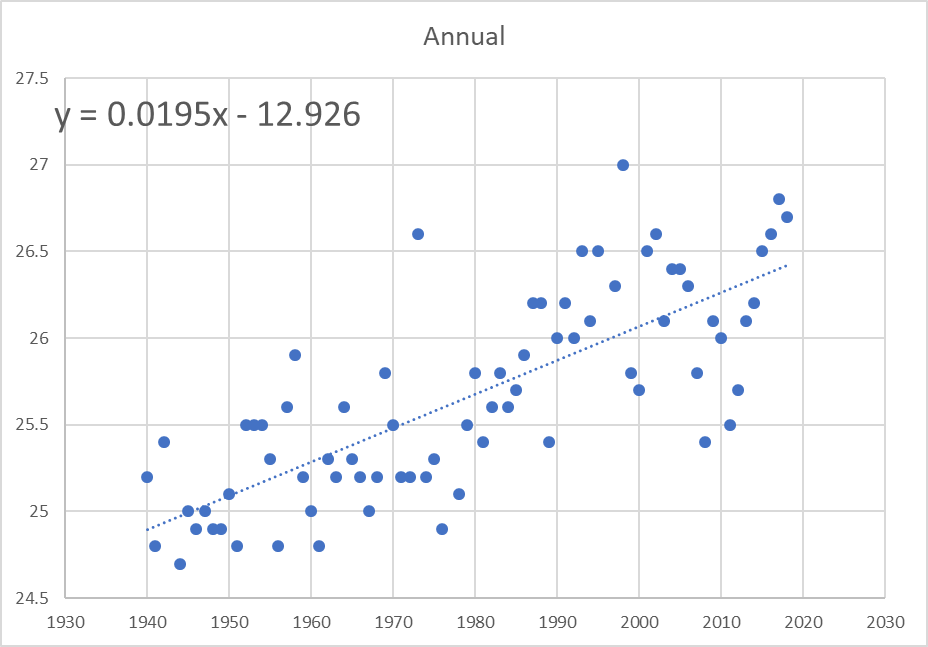
THERE is concern that if global warming exceeds 2°C per 100 years, there will be catastrophe. There are various ways of anticipating this… I tend to favour the empirical. Indeed, running a ruler over a temperature series can be useful, if we want perspective.

Considering the maximum temperature record available for Lady Elliot Island — an isolated coral cay off the Australian east coast — and after running a trend line through the numbers, we find that we are almost at this tipping point of 2°C, as shown in Figure 1.

Figure 1. Maximum annual mean temperatures as measured at Lady Elliot Island charted for the period 1940 to 2018.

There has been a consistent annual temperature rise of 0.0195°C since 1940, which would translate into a rise 1.95°C per hundred years.

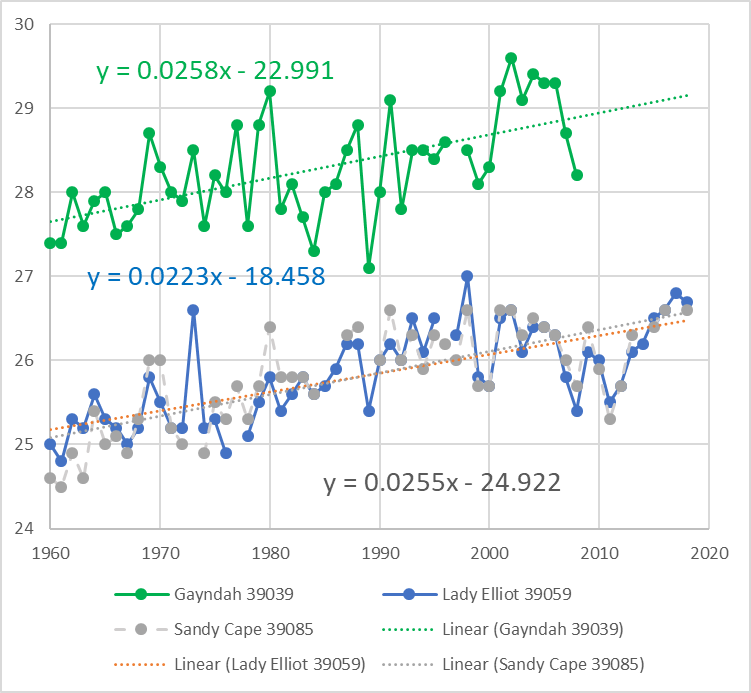
The situation appears even worse if we just consider temperatures from 1960. Then the temperature trend for Lady Elliot is more than 2°C per hundred years, as shown in Figure 2.

The mean annual maximum temperature series from the nearby Sandy Cape lighthouse has a very similar pattern for this period from 1960. There is more inter-annual variation in the temperature series from nearby Gayndah, which is typical of land series that will be more affected by droughts and floods.

Figure 2. Temperature change as measured by the annual mean maximum since 1960 at Lady Elliot and also nearby Gayndah and Sandy Cape Lighthouse

I’ve spent many years poring over temperature data from a diversity of locations across Australia, and what I’ve found is that when such records are extended back in time — even just a few decades — the overall temperature trend is quite different and ‘the catastrophe’ disappears.

The record for Lady Elliot Island only starts on 1 July 1939. To understand what temperatures were like in this region before then, we need to consider temperature measurements from neighbouring stations that begin in the late 1800s.

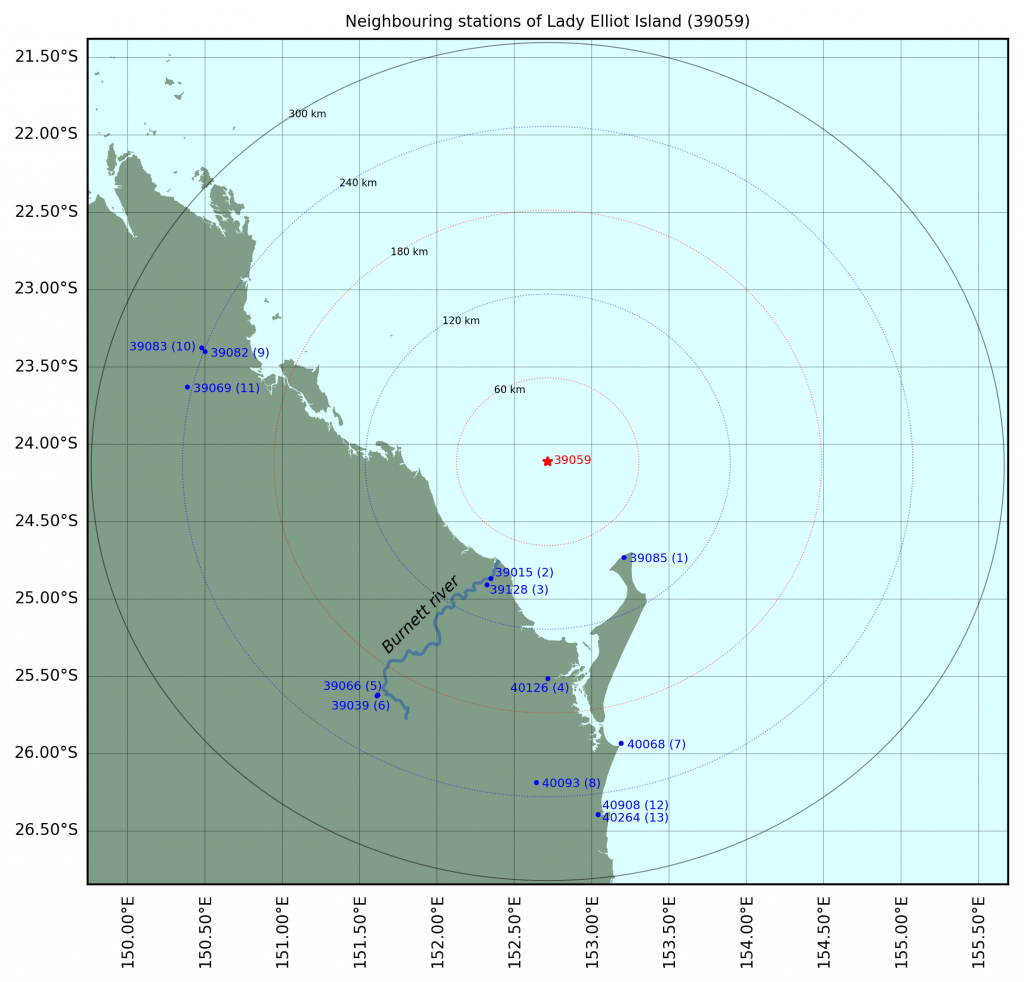
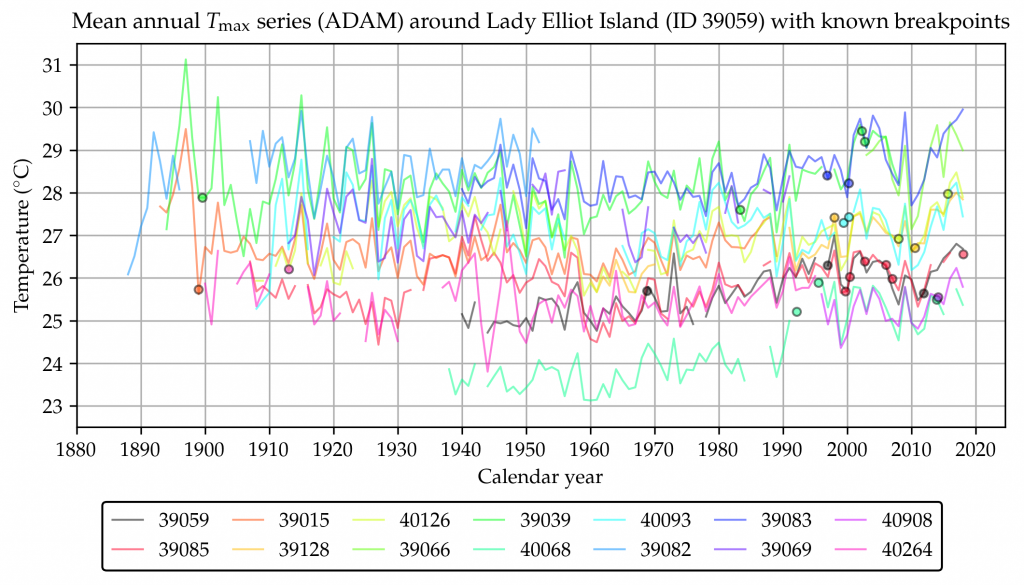
There are several weather stations within a 300 km radius of Lady Elliot Island that have long temperature records.

Locations within a 300 km radius of Lady Elliot with long and continuous series. Drawn by Jaco Vlok.

The temperature record as measured at the Gayndah Post Office (number 39039) actually begins in June 1893, and the record for Bundaberg (number 39015) in 1892, as shown in Figure 3. There is a single breakpoint in the early record for each of these two locations, marked by a circle when a Stevenson screen was installed.

Figure 3. Annual mean maximum temperatures for the 14 stations with long and continuous records within a 300 km radius of Lady Elliot. Drawn by Jaco Vlok.

Considering the longer records within the 300 km radius, maximum temperatures have sometimes fluctuated by more than 2°C within a few years. This is evident from the detail in the individual series in Figure 3. The more than 2°C variation in temperatures as measured at Gayndah between 1900 and 1904, for example, is more than the overall warming trend at Lady Elliot of 1.95°C per hundred years since 1940.

Maximum temperatures for Gayndah and Bundaberg spiked in 1915, as they did for all the other stations recording within a 300 km radius of Lady Elliot Island at that time.

So, we can perhaps assume it was also a relatively hot year at Lady Elliot Island … back in 1915. Perhaps it was as hot back then as it is now, which is quite hot considering the longer records. Then again the spike may have been a consequence of the land drought, and places like Sandy Cape Lighthouse and Lady Elliott less affected. There is no mean annual maximum value for Sandy Cape Light House (number 39085) for 1915 because of missing values … but these could be infilled (using regression and/or an artificial neural network), to better estimate the likely temperature history for this region over land and also sea.

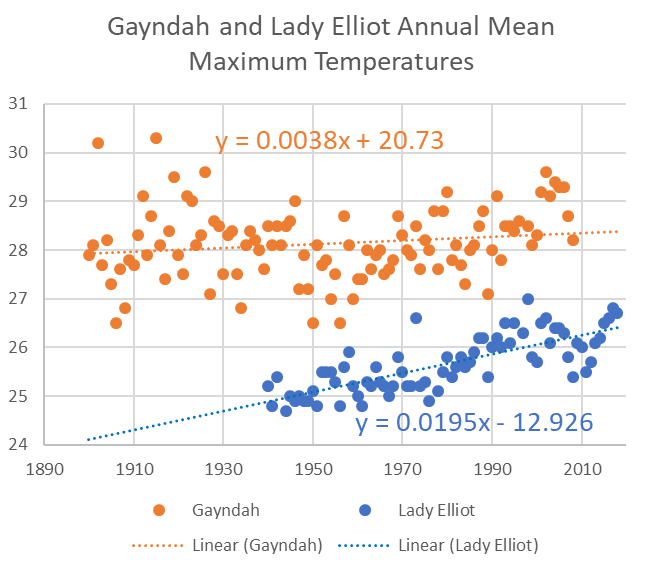
It can be difficult separating out the individual series in Figure 3. The squiggly lines are a representation of individual annual mean maximum temperatures. In Figure 4, I plot these individual values for just the Gayndah Post Office (number 39039) from 1900 (after the breakpoint, only after the Stevenson screen was installed) and for Lady Elliot (number 39059) from the beginning. Both series are plotted with trend lines.

The overall temperature trend for Gayndah Post Office, considering this longer record, is just 0.38°C per hundred years, as shown in Figure 4. This contrasts significantly with the value of 2.58°C per hundred years when we plot the same values for Gayndah but only for the interval from 1960 to 2009, as shown in Figure 2.

Figure 4. Annual mean maximum temperatures as recorded at Gayndah (after installation of Stevenson Screen) and the entire record at Lady Elliot

Whenever I take the time to run a ruler over temperature series for any particular region and considering a long enough time period not artificially warmed by a combination of Urban Heat Islands (UHI) and homogenisation, I have trouble finding catastrophe. Rather I’m inspired by the extent of the available data and the degree of synchrony between the series that tend, if anything, to be simply moving sideways.

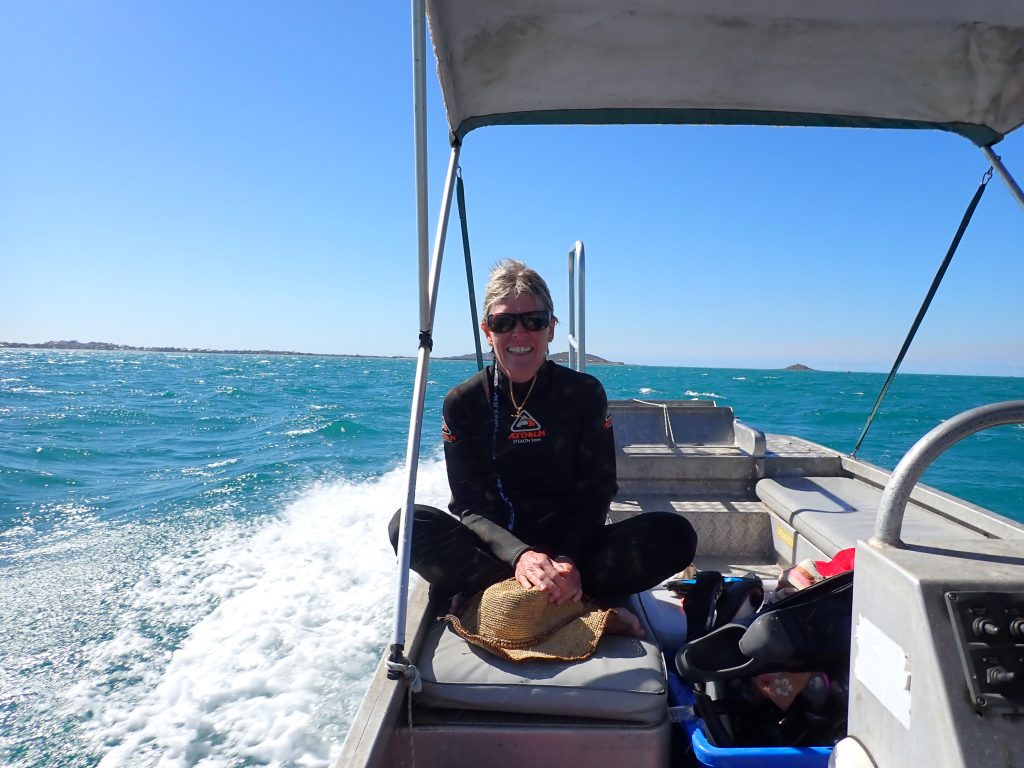
Lady Elliot Island. Photo credit Clint Hempsall.

____

This is the third post in my ‘GAT in the Hat’ series, which began when Huck suggesting we get on and develop a simple temperature index based on a good sample of well-sited stations. Jaco Vlok and I are working our way around Australia with such an index in mind … we are working anti-clockwise from Brisbane.

Thanks to the Australian Bureau of Meteorology for making all this data available at http://www.bom.gov.au/climate/data/

The feature image (very top of this blog post) is a plot of all the available maximum temperature data (from 59 weather stations) within a 300 km radius of Lady Elliot as 12-month moving averages, with the data compiled and plotted by Jaco Vlok.

This post was updated at midnight on 3rd August, with figures added, the picture changed, and the title modified …

Filed Under: Information Tagged With: temperates

  • « Go to Previous Page
  • Go to page 1
  • Interim pages omitted …
  • Go to page 12
  • Go to page 13
  • Go to page 14
  • Go to page 15
  • Go to page 16
  • Interim pages omitted …
  • Go to page 607
  • Go to Next Page »

Primary Sidebar

Recent Comments

  • Ian Thomson on Vax-ed as Sick as Unvax-ed, Amongst My Friends
  • Dave Ross on Vax-ed as Sick as Unvax-ed, Amongst My Friends
  • Dave Ross on Vax-ed as Sick as Unvax-ed, Amongst My Friends
  • Alex on Incarceration Nation: Frightened of Ivermectin, and Dihydrogen monoxide
  • Wilhelm Grimm III on Incarceration Nation: Frightened of Ivermectin, and Dihydrogen monoxide

Subscribe For News Updates

  • This field is for validation purposes and should be left unchanged.

December 2025
M T W T F S S
1234567
891011121314
15161718192021
22232425262728
293031  
« Jan    

Archives

Footer

About Me

Jennifer Marohasy Jennifer Marohasy BSc PhD has worked in industry and government. She is currently researching a novel technique for long-range weather forecasting funded by the B. Macfie Family Foundation. Read more

Subscribe For News Updates

Subscribe Me

Contact Me

To get in touch with Jennifer call 0418873222 or international call +61418873222.

Email: jennifermarohasy at gmail.com

Connect With Me

  • Facebook
  • LinkedIn
  • RSS
  • Twitter
  • YouTube

Copyright © 2014 - 2018 Jennifer Marohasy. All rights reserved. | Legal

Website by 46digital