• Skip to primary navigation
  • Skip to main content
  • Skip to primary sidebar
  • Skip to footer
Jennifer Marohasy

Jennifer Marohasy

a forum for the discussion of issues concerning the natural environment

  • Home
  • About
  • Publications
  • Speaker
  • Blog
  • Temperatures
  • Coral Reefs
  • Contact
  • Subscribe

Opinion

The Computer says NO: Tom Quirk on Why This Report from the IPCC Should Be Its Last

September 29, 2013 By Tom Quirk

THE IPCC use of computer models to predict temperatures, rain fall, sea level rises and other weather related events either global or regional has comprehensively failed to predict most of the observations made in the last twenty years and ignores any analysis that suggests natural variability as the main driver of climate. Ad hoc effects are put forward in order to explain why the model predictions parted company from the observations. This is most obvious in looking at the components of radiative (temperature) forcing where such effects as aerosols appear with 100% uncertainty. This is not a statistically derived uncertainty but rather an “expert” opinion on an effect that is needed to “balance the books”. Yet all the uncertainties are combined as if they are all well behaved statistical errors.

The report is best summed up by the classic Polish saying from Soviet times – The future is certain only the past is unpredictable. So writes Tom Quirk with his first thoughts on The IPCC 2013 Summary for Policymakers…

There are a series of points that one can take immediate objection to:

1. The temperature plateau from 2000 to the present year is dismissed as of no consequence. The report has borrowed the reply of Chou En Lai who, when asked what he thought of the French Revolution, replied that “It was too early to tell”. Yet in 1988 James Hansen appearing before a Congressional committee said he was 99% certain that the temperature rise from 1977 was not a natural variation.

2. The oceans that have been ignored up to now have suddenly become centre stage as the lodging place for the heat that should have raised the global temperature. The extra infra-red radiation from the increasing atmospheric CO2 is absorbed in the top 2 millimetres of the ocean. This is then mixed by wave motion through the top 100 to 200 metres of the oceans. But the sea surface temperature is in equilibrium with the air surface temperatures so how has the heat energy achieved this avoidance. Of course the deep ocean from 1,000 to 4,000 metres is at 40C or less and any overturning of the deep ocean would cause no end of trouble. This looks like another ad hoc explanation.

3. Sea level rises are forecast to be as much as 1 metre by 2100 yet the measurements show quite different annual rises in the Atlantic, Pacific and Indian Oceans. Indeed a good pair of gumboots should get our grandchildren through 2100 with the present measured annual increases.

4. Methane is referred to as reaching unprecedented levels in the atmosphere with no suggestion that its annual increases have fallen by a factor of eight since 1995 [1]. It is not clear in the model projections what level of methane increase is assumed. If it is taken from the original scenarios then it is quite wrong.

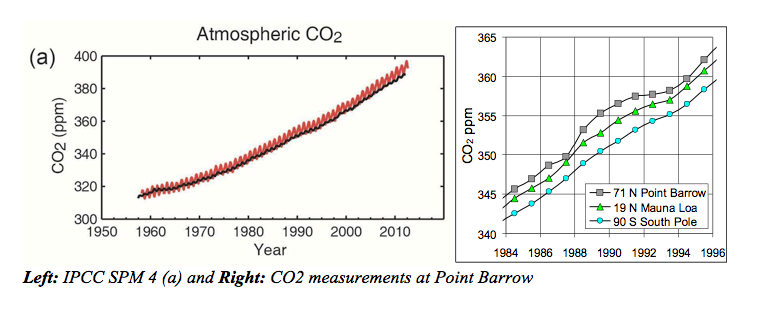
5. There is a reference (Figure SPM4 (a) ) to the long running time series measurements of atmospheric CO2 at the South Pole and Mauna Loa. What has not been pointed out is that in 1958 to 1960, there is no difference in these measurements that remains unexplained. Also there is a modest bump in 1990 that had the Point Barrow measurements at latitude 710N been included would have shown a modest 2 year plateau in CO2 concentration. This, when properly analysed, shows that about 2.5 GtC of CO2 entered and left the atmosphere in the space of 4 years when fossil fuel CO2 emissions were 6 GtC in 1990.. Yet we are taught that not all fossil fuel emissions are easily absorbed. This is at the time of the Mount Pinatubo eruption but the CO2 output has been estimated at only 0.015GtC so volcanic activity is not the cause.
carbon dioxide Quirk
Left: IPCC SPM 4 (a) and Right: CO2 measurements at Point Barrow. Click on the image for a better view.

6. The temperature plateau from 2000 to the present has been variously explained by heat disappearing into the oceans, volcanic activity and a lessening of solar radiation (dismissed in this IPCC report). The failure to acknowledge the impact of the oceans that cover 70% of the surface of the earth not only on the temperature behaviour but also CO2 is extraordinary [2]. But the explanation may be that we do not understand what triggers the phase changes in the oceans where up-welling cold water displaces warmer water and of course the reverse. So it is not possible to model such events and this would be an admission of complete failure of the computer models.

7. Regional models should not be regarded as having any useful predictive power if the global models have been unsuccessful. There is a problem with regional modelling over land as the assumption that the mean temperature is the average of the minimum and maximum temperatures can increase temperatures by up to 0.50C. This distorts the heat load over the land and thus would cause a systematic error in computer modelling results.

This report from the IPCC should be its last. Not only has the climate science research community extracted billions of dollars from politicians but tens if not hundreds of billions have been invested in schemes to reduce CO2 emissions with little to show by way of reductions.

The last word should be left to Jonathon Swift who brilliantly satirized the Royal Society in Gulliver’s Travels [4]. Gulliver is taken to the country of Balnibarbi whose enlightened rulers have adopted new methods of agriculture and building but the country appears to be in ruins as “the only inconvenience is, that none of these projects are yet brought to perfection”.

****

Notes: The Computer says No is a catch phrase from Little Britain BBC TV series.
[1] http://www.ipa.org.au/library/publication/1339463096_document_twentieth_century_sources_of_methane_in_the_atmosphere.pdf
[2] http://www.ipa.org.au/library/publication/1339463007_document_break_paper_apjas_ipa.pdf
[3] http://www.onlineopinion.com.au/view.asp?article=9213

Tom Quirk is former Chairman of Virax Holdings Limited, a biotechnology company. He is on the Board of the Institute of Public Affairs. He has been Chairman of the Victorian Rail Track Corporation, Deputy Chairman of Victorian Energy Networks and Peptech Limited as well as a director of Biota Holdings Limited He worked in CRA Ltd setting up new businesses and also for James D. Wolfensohn in a New York based venture capital fund. He spent 15 years as an experimental research physicist, university lecturer and Oxford don. Read more from Tom at OLO here and previous contributions to this blog here.

Filed Under: Information, News, Opinion Tagged With: Climate & Climate Change

Global Warming Stalls, Climate Scientists Fiddle Temperature Record

September 22, 2013 By jennifer

WHEN Tim Flannery was sacked last week as Australia’s Climate Commissioner he claimed that this last year has been the hottest on record. I don’t believe him because the raw data doesn’t support that claim, only the metadata for Australia, which has been adjusted, shows recent warming. Willis Eschenbach explains how they ‘fix the data’ in an article published back in 2009 titled ‘The Smoking Gun at Darwin Zero’ [1].

Mr Eschenbach showed how, from the hundreds of available weather recording stations in Australia, the IPCC used only three stations to cover the period 1897 to 1992 [1]. Not only were the IPCC selective in the stations used, they ‘homogenized’ the raw data from these stations before using it. Homogenization had the effect of causing a 0.7C per century falling temperature trend to show a 1.2C per century increase with the adjustments made involving a change of over 2C per century.

Mr Eschenbach made the comment that, “when those guys ‘adust’, they don’t mess around. And the adjustment is an odd shape, with the adjustment first going stepwise, then climbing roughly to stop at 2.4C.”

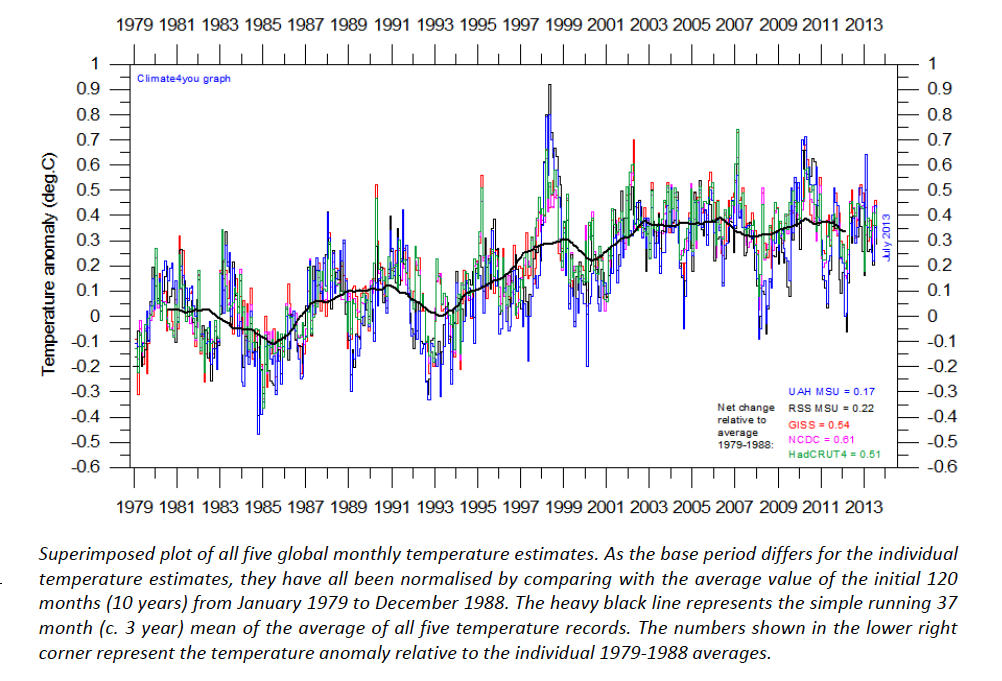
All five global temperature estimates show no increase, at least since 2002, fig. 1 [click on the image for a larger and clearer view]. There has been no increase in global air temperature since 1998, which was affected by the oceanographic El Nino event of that time [2]. Global Temps August 2013

[Read more…] about Global Warming Stalls, Climate Scientists Fiddle Temperature Record

Filed Under: Information, News, Opinion Tagged With: Climate & Climate Change, Temperatures

Can Cathy McGowan Fix the Travesty of National Water Reform?

September 14, 2013 By jennifer

MOST of the federal electorates within the Murray Darling are held by MPs from either the Liberal or National Parties. Over recent years, however, major water policies instigated by federal Coalition governments that directly impact these electorates have been to their long-term detriment. It makes no sense, until one realises that the Coalition has assumed it could take these electorates for granted, in particular that it has been implicit Coalition policy that the representatives from these electorates put the politics of the party machine first for fear of losing votes in South Australia. McGowan Mirabella

Read more here…
http://www.mythandthemurray.org/water-politics-has-traditionally-put-indi-last-and-last-can-cathy-mcgown-change-that/

Filed Under: Information, News, Opinion Tagged With: Murray River

Remembering Appalling Policies Introduced by Previous Coalition Governments (Part 1)

September 8, 2013 By jennifer

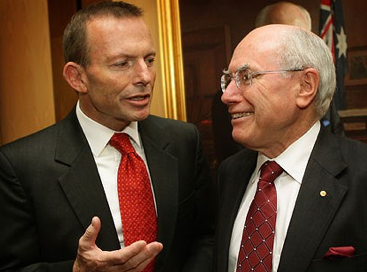
POPULAR sceptical blogger, Jo Nova, has responded to Labor’s defeat in yesterday’s Australian federal election with the headline ‘Voters crush the carbon tax and corruption – worst Australian government gone’. Howard and Abbott

I’m not so sure. It remains my view that the previous Coalition Government lead by John Howard was a disaster, particularly when it came to mismanagement of both the economy and the natural environment.

Indeed the Howard government, of which our new Prime Minister, Tony Abbott, was a senior Minister, was instrumental in introducing a raft of very damaging legislation.

Top of the list is perhaps the renewable energy certificate, an ongoing economic disaster as detailed in an article by Ray Evans and Tom Quirk entitled the ‘The Ruinous Privileges of Renewable Energy’:

“THE mechanism through which electricity consumers pay greenmail to the owners of windmills and solar panels is the mandatory Renewable Energy Certificate, introduced by John Howard in his 2001 MRET legislation. As James Delingpole explained in the Australian on May 3, writing about the ghost town of Waterloo in South Australia (now depopulated by the impacts of the sub-audio frequency vibrations generated by the nearby wind farm), a 3-megawatt wind turbine, costing $6 million, will be lucky to generate electricity worth $150,000 in a year, but will receive $500,000 in RECs, paid for by the hapless electricity consumer.
[Read more…] about Remembering Appalling Policies Introduced by Previous Coalition Governments (Part 1)

Filed Under: Information, Opinion Tagged With: Elections, Energy & Nuclear

Open Thread

August 14, 2013 By jennifer

I believe that a scientist looking at nonscientific problems is just as dumb as the next guy.
Richard P. Feynman

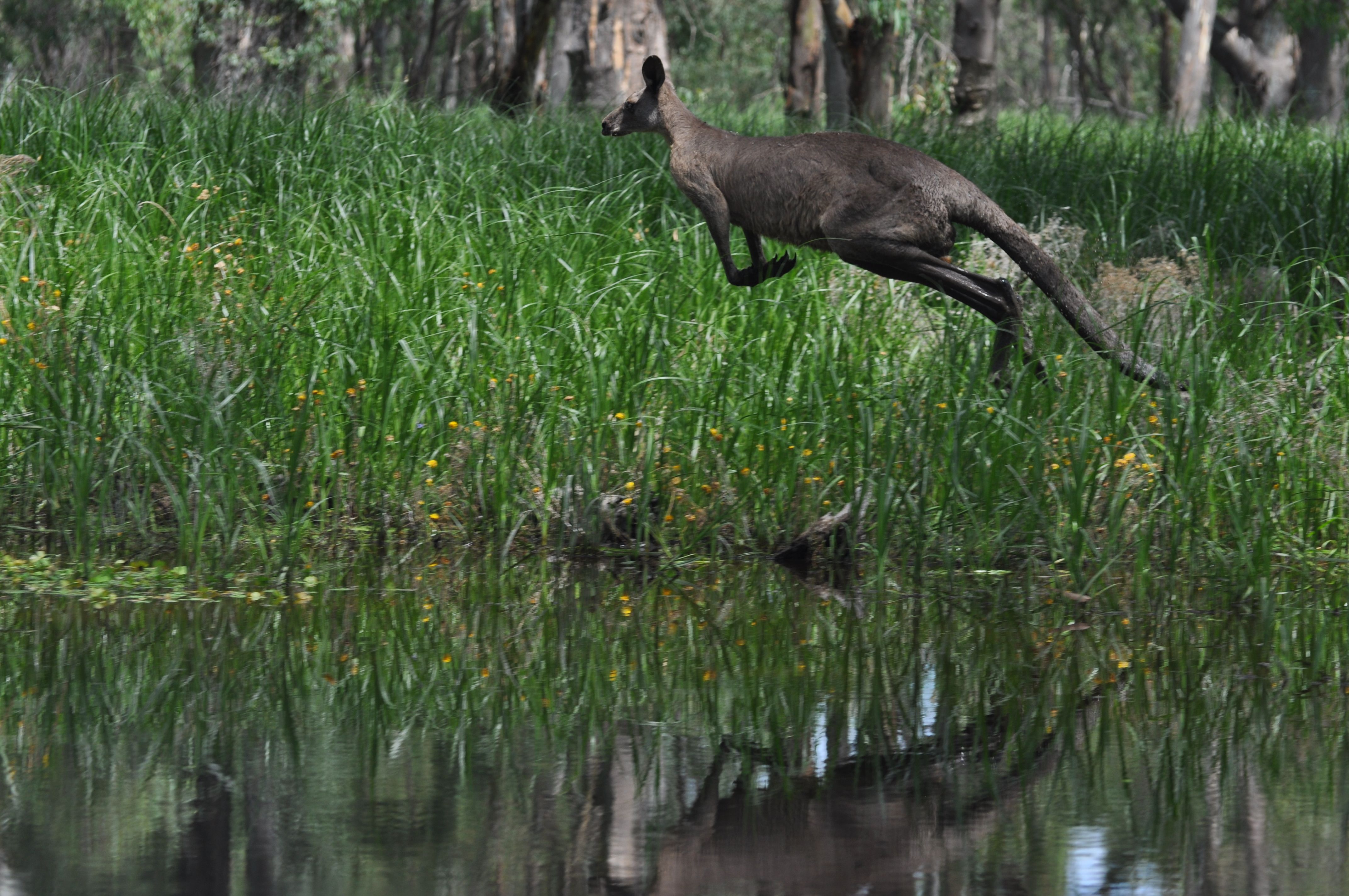
Flooding Faye 098 Kangaroo

Photograph of the kangaroo taken in the Central Murray Valley by Faye Ashwin [click on the image for a larger/better view].

Filed Under: News, Opinion

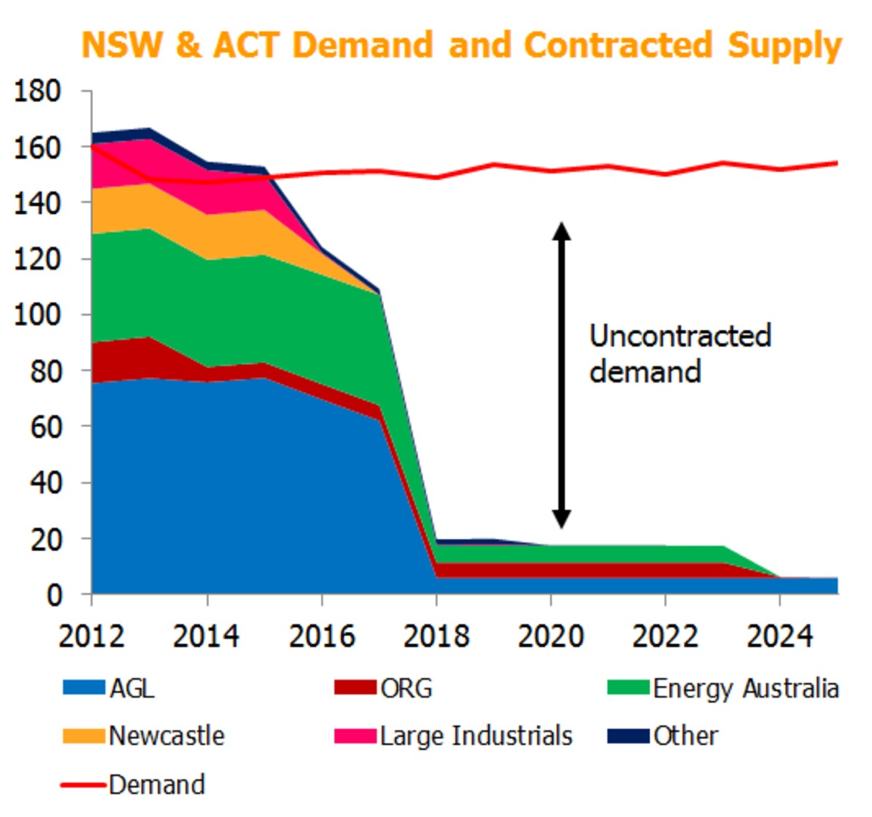
What Will Power Sydney in 5 Years, If Not Gas?

August 11, 2013 By jennifer

I’VE been some what dismayed by the approach of many agriculturalists to the development of a coal seam gas (CSG) industry in New South Wales. There have been many widely publicized claims that the CSG industry will pollute the air and water in particular through hydraulic fracturing, also known as ‘fracking’. Screen Shot 2013-08-11 at 9.31.05 AM

Some of the noisiest objectors are on the Liverpool plains and have claimed this new extractive industry threatens their groundwater aquifers. In reality, the affect of agriculture on the aquifers in the Liverpool Plains has been inadequately monitored and is probably significant. [Read more…] about What Will Power Sydney in 5 Years, If Not Gas?

Filed Under: Information, Opinion Tagged With: Energy & Nuclear

  • « Go to Previous Page
  • Go to page 1
  • Interim pages omitted …
  • Go to page 4
  • Go to page 5
  • Go to page 6
  • Go to page 7
  • Go to page 8
  • Interim pages omitted …
  • Go to page 132
  • Go to Next Page »

Primary Sidebar

Recent Comments

  • Ian Thomson on Vax-ed as Sick as Unvax-ed, Amongst My Friends
  • Dave Ross on Vax-ed as Sick as Unvax-ed, Amongst My Friends
  • Dave Ross on Vax-ed as Sick as Unvax-ed, Amongst My Friends
  • Alex on Incarceration Nation: Frightened of Ivermectin, and Dihydrogen monoxide
  • Wilhelm Grimm III on Incarceration Nation: Frightened of Ivermectin, and Dihydrogen monoxide

Subscribe For News Updates

  • This field is for validation purposes and should be left unchanged.

December 2025
M T W T F S S
1234567
891011121314
15161718192021
22232425262728
293031  
« Jan    

Archives

Footer

About Me

Jennifer Marohasy Jennifer Marohasy BSc PhD has worked in industry and government. She is currently researching a novel technique for long-range weather forecasting funded by the B. Macfie Family Foundation. Read more

Subscribe For News Updates

Subscribe Me

Contact Me

To get in touch with Jennifer call 0418873222 or international call +61418873222.

Email: jennifermarohasy at gmail.com

Connect With Me

  • Facebook
  • LinkedIn
  • RSS
  • Twitter
  • YouTube

Copyright © 2014 - 2018 Jennifer Marohasy. All rights reserved. | Legal

Website by 46digital