• Skip to primary navigation
  • Skip to main content
  • Skip to primary sidebar
  • Skip to footer
Jennifer Marohasy

Jennifer Marohasy

a forum for the discussion of issues concerning the natural environment

  • Home
  • About
  • Publications
  • Speaker
  • Blog
  • Temperatures
  • Coral Reefs
  • Contact
  • Subscribe

Opinion

After the Inlet to Rostocker Harbour Closed Over

August 4, 2014 By jennifer

There is nothing sustainable about the current management of the Lower Murray and its crippled estuary. Lakes Albert and Alexandrina are vast shallow near-coastal lagoons that started to dry-up during the recent Millennium drought (2003-2009). Despite legislation to mandate the buyback of over 3,000 GL of water, when the next drought is properly upon us it’s almost inevitable that water levels will again recede and its possible that Lake Albert (without a direct connection to the Murray River or the ocean) could dry-up altogether. If this were to happen, the South Australian government might consider reclaiming the area for farming or as a nature reserve. Indeed forested fields known as the Bøtø Nor in Denmark were once Rostocker Harbour – that was before the inlet to the Harbour became choked with sand.

The region has a similar geological history to the Lower Murray. The gradual melting of the last of the ice sheets in North America, Greenland and Antarctica resulted in significant sea level rise about 7,000 years ago. This resulted in the Southern Ocean flooding into an area of subsidence to the east of the Mount Lofty Ranges in South Australia, an area now known as the Lower Lakes. At about the same time an area of land between Denmark and Germany was flooded.

In southern Australia as the sea pushed in, the Murray River was pushed back. A new estuary began to form with the Southern Ocean initially regularly washing in to the entire area through a wide opening. From the beginning, localised wave action would have deposited sand at the margins of the seaward opening of the young estuary slowly building sand flats, then beaches. Beaches build as sand from wave action is deposited higher and higher. When dry sand from the beach is blown beyond the reach of the waves, and then a bit further, sand dunes start to form.

This process resulted in the development of a string of barrier islands across the lower Murray and also along the modern Danish and German North Sea coast.

Barrier Islands usually form perpendicular to the dominant wave direction. In the case of the Danish coastline, the islands formed about 2 km east of the main coastline, leaving a sheltered area, a fine natural harbour, between the developing peninsula and the island of Falster.

By 1135 the town of Gedesby within Rostocker Harbour was a major port. In 1571 Sofie, queen to the Danish King Frederik II ordered the building of a ferry hotel at the harbour so she had somewhere appropriate to stay en-route to her homeland of Germany. In 1716 Tsar Peter the Great arrived with his ship in Rostocker Harbour and apparently stayed at this same ferry hotel. But within 50 years the entrance to the harbour had been in-filled with sand. Today, the body of water that once provided safe passage to rulers of both Russia and Denmark is a forested field. Gedesby is now located about 1.5 km inland from the modern east coast of Falster.
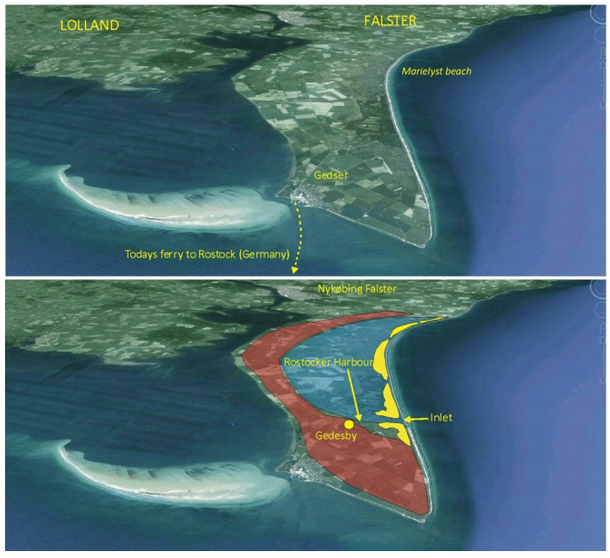
Top image shows the modern landscape.  Bottom image shows geography during the Little Ice Age with Rostocker Harbour open.  The area marked in yellow shows a chain of barrier islands, with the blue area below sea level and at that time covered in sea.
Top image shows the modern landscape. Bottom image shows geography during the Little Ice Age with Rostocker Harbour open. The area marked in yellow shows a chain of barrier islands, with the blue area below sea level and at that time covered in sea.

This article was first published at Myth and the Murray. It draws on information provided in the June 2013 issue of www.climate4you.com and the figure is reproduced from page 30.

Filed Under: Information, Opinion Tagged With: Murray River

Three Facts Most Sceptics Don’t Seem to Understand

July 26, 2014 By jennifer

A couple of weeks ago I had the opportunity to attend the Ninth International Conference on Climate Change (ICCC9) in Las Vegas. If you ever doubted scepticism towards man-made global warming as a growing social movement, well, you couldn’t after attending that conference with hundreds of enthusiastic doubters in attendance and some 6,000 watching online.

Joseph Bast addresses ICCC9

But I came away wondering about the culture that is developing around the movement, and whether it is truly one of enlightenment.

Most of us share enlightenment values. And skepticism is historically associated with the Enlightenment. But it should be skepticism of entrenched dogmas, not an automatic opposition to every new big idea. Indeed the enlightenment saw big ideas progress; ideas that once realized, dramatically improved the human condition.

Many sceptics apparently think that we have won the scientific argument, and that our next objective should be the dismantling of climate policies and climate research. But they are wrong. We have not won the scientific argument and we won’t, if we continue down the current path of suggesting that we can’t forecast weather or climate. This suggestion, that we can’t forecast, was often made at the conference and made again just last week by Jo Nova quoting Don Aitkin.

The history of science suggests that paradigms are never disproven, they are only ever replaced. Physicist and philosopher, the late Thomas S. Kuhn, also explained that competition within segments of the scientific community is the only historical process that ever actually results in the rejection of one previously accepted theory or in the adoption of another.

In short, if our movement really wants to see the overthrow of the man-made global warming paradigm, it needs to back alternatives and promote new research.

Assuming we are indeed a movement with a desire to contribute in a tangible way to climate science, and a movement looking for viable alternative paradigms, then we need a way of sorting through incommensurable perspectives, and also a way of ensuring that the most promising research is promoted.

Let me make these points in a bit more detail:

1. We have not won the scientific argument.

It was repeatedly suggested at the ICCC9 conference that those sceptical of man-made global warming have some how won the scientific argument. This is nonsense.

On my arrival back in Australia I was forwarded yet another letter from an Australian government official reiterating that: “The Australian Government accepts the science of climate change and takes its primary advice on climate change from the Bureau of Meteorology and CSIRO. This advice aligns with information provided by the IPCC and national and international organisations such as the Australian Academy of Science, World Meteorological Organisation, the Royal Society in the United Kingdom, and the National Academy of Sciences, National Oceanic and Atmospheric Administration, and National Aeronautics and Space Administration (NASA) in the United States.”

The letter goes on to state that, “The world’s leading scientific organisations have found that the Earth’s climate is changing and that humans are primarily responsible…”

Not only do these esteemed organisations accept anthropogenic global warming theory (AGW), they also work actively with the mainstream media to crush, ridicule or quarantine any criticism of AGW.

If those sceptical of man-made global warming can be accused of denial, it is of this fact. We might be having some impact on the political process, even achieving repeal of the carbon tax in Australia, but the science of anthropogenic global warming remains as firmly entrenched as ever especially amongst the media, academics and legislators.

2. Rebuttals don’t overthrow established paradigms.

Anthropogenic global warming is a fully functional, well-funded scientific paradigm that is having a major impact on social and economic policy in every western democracy.

As I explained in session 13 at the conference: Scientific disciplines are always underpinned by theories that collectively define the dominant paradigm. In the case of modern climate science that paradigm is AGW. It defines the research questions asked, and dictates the methodology employed by the majority of climate scientists most of the time. AGW may be a paradigm with little practical utility and tremendous political value, but it’s a paradigm none-the-less. The world’s most powerful and influential leaders also endorse AGW.

In a lecture to the Commonwealth Club in San Francisco in September 2003 Michael Crichton said: “The greatest challenge facing mankind is the challenge of distinguishing reality from fantasy, truth from propaganda. Perceiving the truth has always been a challenge to mankind, but in the information age (or as I think of it, the disinformation age) it takes on a special urgency and importance.”

Scientists are meant to know the difference between fact and fiction and as a first check of the reliability of a source of information they will often ask if it has been “peer-reviewed”. Peer-review means that research findings are conducted and presented to a standard that other scientists working within that field consider acceptable. This is normally achieved through publication in a scientific journal and involves the editor of the journal asking for comment on the validity, significance and originality of the work from other scientists before publication. In short, the system of peer-review means scientific research is subject to independent scrutiny but it doesn’t guarantee the truth of the research finding.

In theory rebuttals play an equal or more important role than peer review in guaranteeing the integrity of science. By rebuttals I mean articles, also in peer-reviewed journals, that show by means of contrary evidence and argument, that an earlier claim was false. By pointing out flaws in scientific papers that have passed peer-review, rebuttals, at least theoretically, enable scientific research programs to self-correct. But in reality most rebuttals are totally ignored and so fashionable ideas often persist even when they have been disproven.

Consider, for example, a paper published in 2006 by marine biologist, Boris Worm, and coworkers, in the prestigious peer-reviewed journal Science. The study was based on the meta-analysis of published fisheries data and predicted the collapse of the world’s fisheries by 2048. Publication of the article by Worm et al. was accompanied by a media release entitled “Accelerated loss of ocean species threatens human well-being” with the subtitle “Current trend projects collapse of all currently fished seafoods before 2050”.

Not surprisingly, given the importance of the finding, the article attracted widespread attention in the mainstream media and also within the scientific community. But not everyone agreed with the methodology used in the Worm study. Eleven rebuttals soon appeared, many within the same journal Science, and within months of the original article.

The rebuttals, however, scarcely altered the scientific perception of the original article.

In a comprehensive study of this, and six other high-profile original articles and their rebuttals, Jeannette Banobi, Trevor Branch and Ray Hilborn, found that at least in marine biology and fishery science rebuttals are for the most part ignored.

They found that original articles were cited on average 17 times more than rebuttals and that annual citation numbers were unaffected by rebuttals. On the occasions when rebuttals were cited, the citing papers on average had neutral views on the original article, and incredibly 8 percent actually believed that the rebuttal agreed with the original article.

Dr Banobi and coworkers commented that: “We had anticipated that as time passed, citations of the original articles would become more negative, and these articles would be less cited than other articles published in the same journal and year. In fact, support for the original articles remained undiminished over time and perhaps even increased, and we found no evidence of a decline in citations for any of the original articles following publication of the rebuttals…
“Thus the pattern we observed follows most closely the hypothesis of competing research programs espoused by Lakatos (1978): in practice, research programs producing and supporting the views in the original papers remained unswayed by the publication of rebuttals, thus significant changes in these ideas will tend to occur only if these research programs decay and dwindle over time while rival research programs (sponsored by the rebuttal authors) gain strength.”

Indeed it is the naive view that scientific communities learn from obvious mistakes. And as past failures become more entrenched it can only become increasingly difficult to distinguish truth from propaganda, including in the peer-reviewed literature.

3. Paradigms are never disproven: they are only ever replaced.

Since my return from the conference, it has been suggested to me that the ‘new paradigm’ for climate science is the one described in the Nongovernmental International Panel on Climate Change (NIPCC) reports, in particular the ‘null hypothesis paradigm’ that according to many skeptics, is far better at accounting for climate phenomena than are the General Circulation Models. I disagree.

The null hypothesis refers to the general statement or default position that there is no relationship between two measured phenomena. In the case of NIPCC the claim is that “nature not human activity rules the climate”. But this tells us almost nothing. In many ways it’s a cop-out. It’s like a theory of electricity without any explanation of charge, voltage or magnetism.

A good test of the value of any scientific theory to those external to the discipline is its utility. For example the calendars that were developed based on Nicolas Copernicus’ Heliocentric Theory of the Universe were better calendars than those based on Ptolemy’s Handy Tables. The new calendars, based on a new theoretical approach, more precisely predicted the position of the sun and the planets and thus the seasons, which, of course, influence the weather. In the same way, those who want to see AGW theory discarded need to increase their expectations of climate science and in particular demand some practical benefits. The most obvious would be better weather and climate forecasts.

Last year, aversion to a new theory attributing solar variability to gravitational and inertial effects on the sun from the planets and their satellites, not only resulted in the premature termination of a much-needed new journal (Pattern Recognition in Physics), but was also mocked by leading skeptical bloggers. More recently leading skeptical bloggers, Willis Eschenbach and Lubos Motl, were far too quick to attack a new notch-delay solar model that David Evans and Jo Nova developed in an attempt to quantify the difference between total solar irradiance and global temperatures and in the process forecast future climate.

In attempting to understand Dr Motl’s issues with Evans and Nova’s model, I was told that my work with John Abbot forecasting rainfall was also no better than “a sort of magic” because, like Evans and Nova, I was describing relationships “without a proper understanding of which variables are really driving things”. To the layman the few paragraphs of relevant jargon that Motl posted at his blog may have given the impression of some special knowledge, but in reality he was just repeating prejudices including the popular claim that climate is essentially chaotic.

Over the last few years my main focus of research has been on medium-term monthly rainfall forecasts. Not using General Circulation Models (GCMs) that attempt to simulate the climate from first principles, but rather using artificial neural networks (ANNs), which are a form of artificial intelligence and a state-of-the-art statistical modeling technique. John Abbot and I very quickly established that our method – which relies on mining historical climate data for patterns and then projecting forward – could produce a much more skillful medium term rainfall forecast than the Australian Bureau of Meteorology’s best GCM.

Of course the use of statistical models for forecasting is not new, nor is pattern analysis. Many long-range weather forecasters and astrophysicists rely on lunar, solar and planetary cycles to forecast both weather and climate.

So, I was somewhat surprised to hear so many big names at the conference claim from the podium that it would never be possible to forecast weather more than a few days in advance, some going as far to suggest, like Lubos Motl, that climate is essentially a chaotic system.

Such claims are demonstrably false. Indeed that our ANNs (see Atmospheric Research 138, 166-178) can generate skillful monthly rainfall forecast up to three months in advance, is evidence that we are not dealing with a chaotic system.

Until skeptics start thinking about these issues and the need to back something, rather than perhaps always being too keen to knock the next big idea, we won’t truly make progress towards replacing the current dominant paradigm in climate science.

Filed Under: Information, Opinion, Philosophy Tagged With: Climate & Climate Change

Science Fiction & Climate Change: A Speech by George Christensen MP in Vegas

July 15, 2014 By jennifer

“I KNOW good science fiction when I see it. And that is what I have seen in the climate change debate – a lot of fiction dressed up as science. Most great works of fiction end up on the silver screen so it was inevitable that climate change would become a “major motion picture”.

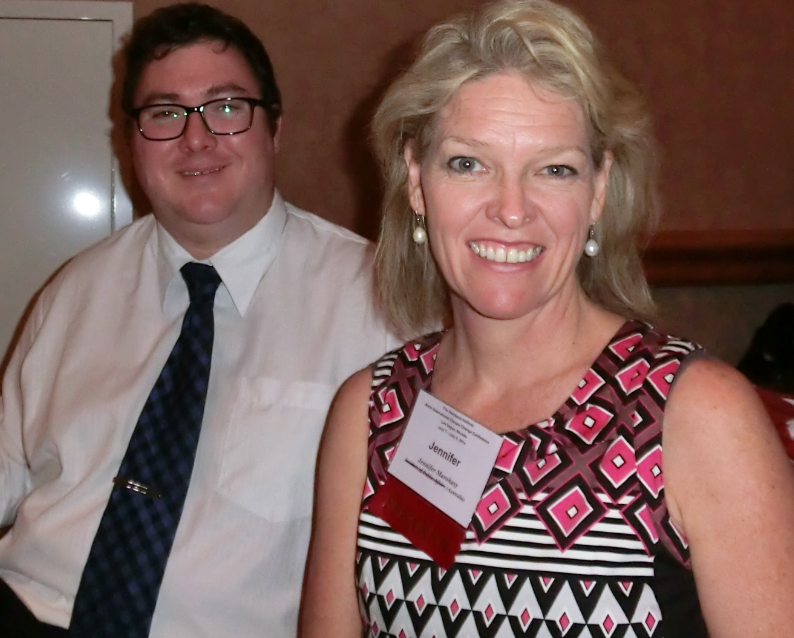
Jennifer Marohasy and George Christensen in Vegas

But a screenwriter has several angles to work with and which one they choose depends on whereabouts on the climate change timeline they pick up the story.

Early on in the piece, it is a disaster-cum-thriller plot as prophets warn of the impending doom of mankind and the planet. The story then lurches towards a slasher-style horror flick as ever more graphic descriptions are used to scare people into submission. Finally, the plot descends into a farcical comedy as government and environmental terrorists make ridiculous suggestions about how mankind will control the planet. In Australia, we have crossed that point where the horror genre is descending into a comedy…”

So, these were some of the words George Christensen MP used to open his speech to the Ninth International Conference on Climate Change in Las Vegas last week. It was entertaining with snippets of real information about what has been the economic cost of this folly to the Australian nation. You can watch the entire presentation from the link below (it starts at 29:00) or here (Keynote Lunch Tuesday), and read the text here.


Broadcast live streaming video on Ustream

Filed Under: Information, Opinion Tagged With: Climate & Climate Change, Conferences

Open Thread

June 28, 2014 By jennifer

“While some have likened global warming skeptics’ scientific research to Big Tobacco-funded research that supposedly showed smoking was not dangerous, I would say that the media’s refusal to report on skeptics’s peer-reviewed research is like the tobacco company executive’s suppression of evidence. Some may claim that the media’s silence is a way of trying to help people – that the tobacco executives were trying to save their own butts, so to speak. But this would mean that the media are putting themselves in the position of deciding what is good for people, rather than just keeping us informed.” Roy Spencer, The Great Global Warming Blunder, 2010, page 36 Roy Spencer

Filed Under: Information, Opinion Tagged With: propaganda

Solar Cycle Could Point to Mega-Drought

June 1, 2014 By jennifer

THROUGH the Millennium drought of 2001 to 2009, I was optimistic that it would rain again, that the drought would end and probably with flooding rains.

The drought did break, and the aggregated average annual rainfall for the Murray Darling Basin as calculated by the Bureau of Meteorology (BOM) shows 2010 was the wettest year on record. The last time it was nearly as wet was 1956 and before that 1950.

The BOM only provides an official average annual rainfall for the Murray Darling back to 1900, but if we consider individual locations, like Bourke, the previous really wet year is 1890. That year the township of Bourke flooded, with historic photographs showing men in boats rowing down the main street.

There are exactly 60 years between 1890, 1950 and 2010.

While believers in anthropogenic global warming claim the climate is on a new trajectory with continuous warming, there is an alternative scientific literature that recognises these 60-year cycles. For example, Nicola Scafetta’s 2010 paper ‘Empirical evidence for a celestial origin of the climate oscillations and its implications’ in the Journal of Atmospheric and Solar-Terrestrial Physics (volume 72, pages 951-970).

Bendigo-based long-range weather forecaster, Kevin Long, uses such patterns for his forecasts, and is very pessimistic about rainfall in the Murray Darling.

Mr Long is predicting that from 2016 there will be a rapid return to the cooler and drier climate of the early 1800s.

Remember Charles Sturt discovered the Darling River near Bourke in 1828 as a series of stagnant, saline ponds.

Mr Long is forecasting that this drier climate may last for the duration of the solar minimum cycle or approximately 30 years. The Maunder Minimum of 1645 to 1715 and the Dalton Minimum of 1790 to 1830 are the last examples of recurring solar hibernation periods.

Theoretically the Murray Darling should be in a much better position to deal with prolonged drought, given the water infrastructure built over the 20th century and recent water reform mandating the buy back of many irrigation licenses.

But in reality water reform has done nothing to reduce the dependence of the Lower Lakes on the upstream reservoirs and this creates an unsustainable burden on the entire system, particularly during drought.

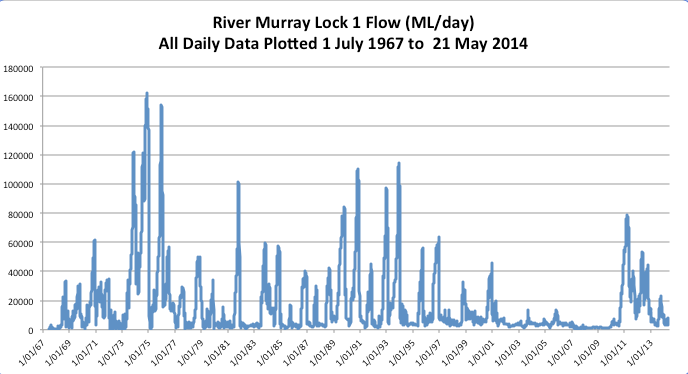
Furthermore, there should be more awareness and concern about the relatively low flow at Lock 1 – indeed diminishing flow for the same quantity of rainfall since the 1980s. This is probably a consequence of improved land management throughout the Basin meaning water soaking into the soils rather than running off, as well as more trees, and salt interceptions schemes evaporating more water.

Daily flow data for Lock 1 is available back to 1967, and it shows that while rainfall might be cyclical, flow volume has been in general decline over recent decades. Historic low volumes were recorded at Lock 1 during the Millennium drought. Even with the record rainfall in the Murray Darling during 2010, flow at Lock 1 never reached the heights it did during the early 1990 and was a long way short of the peaks during the early 1970s.

flow data

****
The text of this article was first published as one of my regular fortnightly columns in The Land newspaper on May 29, 2014. Data used to construct the chart shown in this blog post was sourced from the Murray Darling Basin Authority. Click on the chart for a better view, that begins in 1967.

Filed Under: Information, News, Opinion Tagged With: Drought, Murray River

CSIRO Has Lost Its Way, and Soon Its Funding

May 2, 2014 By jennifer

INNOVATION is critical to staying competitive.

Government-funded science and technology have played an important role in the past, but key institutions like the CSIRO have increasingly lost their way. Megan Clarke

Indeed the CSIRO, probably more than any other organisation, deserve the big funding cut that I hope is coming their way in the May Budget.

Australian agriculture has a bad reputation in many quarters. To a large extent this can be blamed on the many pronouncements by the CSIRO in their rush to corner funding first for salinity, then for biodiversity and water quality and more recently climate change research.

Between the 1950s and 1970s Australia built an outstanding national capability in real science.

At the time leadership did come from CSIRO, university researchers and also many state and federal government agencies.

With the 1980s, however, came a restructuring of the way things were done and how agencies and individuals were funded.

There was a move to project-based funding of a limited duration. So scientists had to identify problems and promote these problems if they were to secure funding – if they were to keep their jobs.

The Native Vegetation Act 2003 and the Murray Darling Basin Plan are direct consequences of the many CSIRO reports that have suggested Australia’s environment is ruin: give us more money to solve the problem.

These reports pronounce catastrophe, subtly paint the farmer as villain and have provided fodder for politicians ever keen to announce a funding allocation to solve a problem, and of course green-groups who’s very existence depends on saving an environment.

Dr Bill Johnston worked within the NSW departments concerned with natural resource management for 30 years. He recently sent me a note explaining that:

“A keystone report relating to the Murray Darling was ‘The Assessment of River Condition’ report published by CSIRO Land and Water in 2001. A snapshot of the Murray Darling’s health was modelled against a pre-European (1750) pristine baseline, for which there was no data.

“Unsurprisingly it found that by its definitions, most rivers were stuffed. Despite very thin data; supported by second and third tier modelling and a huge leap of baseline-faith, it was used relentlessly to on-market Murray Darling Basin facts for all that followed.”

Dr Johnston laments the disbanding of the NSW government’s research capability. He claims the Centre for Natural Resources (CNR) was the most active field-based Murray Darling Basin-focussed research group. He says, “CNR was disbanded, staff were moved so they were under the umbrella of CSIRO or an allied university institute.
“These and other changes left CSIRO and the Bureau of Meteorology dominant providers of natural-resource information and policy advice; modelling, as the preferred methodology; bell-ringing as the preferred communication strategy; and public discourse by scientists, especially about organisational policies and direction muzzled.”

*****

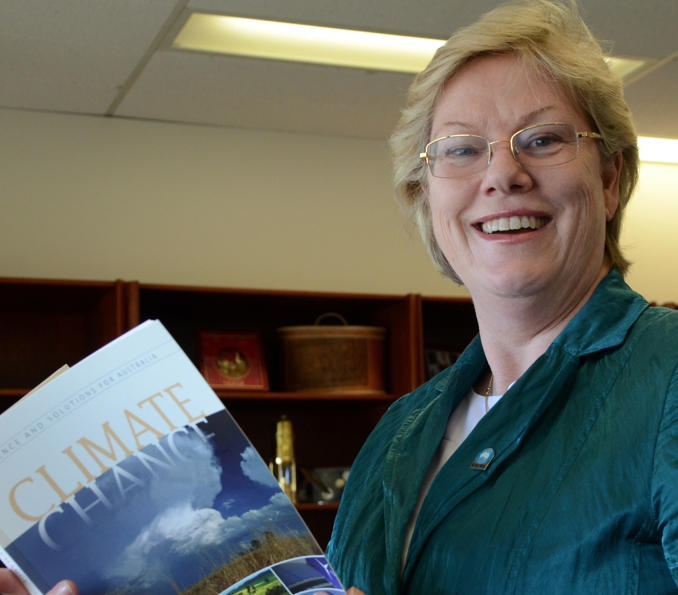
The image is of CSIRO Chief Executive Dr Megan Clarke.

This article was first published by The Land newspaper on May 1, 2014. A reader of The Land tells me the trouble started at CSIRO in about 1986 when management arrangements at the CSIRO changed, with the appointment of a Board headed by the politician Neville Kenneth Wran.

Filed Under: Opinion Tagged With: funding

  • « Go to Previous Page
  • Go to page 1
  • Go to page 2
  • Go to page 3
  • Go to page 4
  • Go to page 5
  • Interim pages omitted …
  • Go to page 132
  • Go to Next Page »

Primary Sidebar

Recent Comments

  • Ian Thomson on Vax-ed as Sick as Unvax-ed, Amongst My Friends
  • Dave Ross on Vax-ed as Sick as Unvax-ed, Amongst My Friends
  • Dave Ross on Vax-ed as Sick as Unvax-ed, Amongst My Friends
  • Alex on Incarceration Nation: Frightened of Ivermectin, and Dihydrogen monoxide
  • Wilhelm Grimm III on Incarceration Nation: Frightened of Ivermectin, and Dihydrogen monoxide

Subscribe For News Updates

  • This field is for validation purposes and should be left unchanged.

December 2025
M T W T F S S
1234567
891011121314
15161718192021
22232425262728
293031  
« Jan    

Archives

Footer

About Me

Jennifer Marohasy Jennifer Marohasy BSc PhD has worked in industry and government. She is currently researching a novel technique for long-range weather forecasting funded by the B. Macfie Family Foundation. Read more

Subscribe For News Updates

Subscribe Me

Contact Me

To get in touch with Jennifer call 0418873222 or international call +61418873222.

Email: jennifermarohasy at gmail.com

Connect With Me

  • Facebook
  • LinkedIn
  • RSS
  • Twitter
  • YouTube

Copyright © 2014 - 2018 Jennifer Marohasy. All rights reserved. | Legal

Website by 46digital