• Skip to primary navigation
  • Skip to main content
  • Skip to primary sidebar
  • Skip to footer
Jennifer Marohasy

Jennifer Marohasy

a forum for the discussion of issues concerning the natural environment

  • Home
  • About
  • Publications
  • Speaker
  • Blog
  • Temperatures
  • Coral Reefs
  • Contact
  • Subscribe

Information

Subscribe Against Net Zero with Aynsley Kellow

October 26, 2021 By jennifer

For those of you who want a blow-by-blow, day-by-day, account of what transpires at Glasgow the Institute of Public Affairs will be providing commentary via my dear friend and colleague Professor Aynsley Kellow.

An email just went out today to members explaining:

To keep you updated on the events of Glasgow and how they impact mainstream Australians, I am excited to let you know the IPA will be publishing a Say No To Glasgow daily email bulletin featuring expert commentary from our Director of Policy, Gideon Rozner, and Climate Policy expert Emeritus Professor Aynsley Kellow, starting tomorrow Wednesday, 27 October.

Australians have repeatedly voted against a tax on carbon dioxide and against a policy of net zero emissions. As Jennifer Oriel put it so eloquently:

Climate change is the country where Australian prime ministers go to die. It featured in the demise of former Labor prime ministers Kevin Rudd and Julia Gillard. It sank the political career of Malcolm Turnbull twice, leading to his removal as opposition leader in 2009 and prime minister in 2018. It was the promised land for former Labor leader Bill Shorten in 2019 until it turned to dust on election day.

Scott Morrison was elected Prime Minister at least in part because he differentiated himself from Bill Shorten by explaining he was not going to impose a net zero emissions policy. He has completely ignored this mandate in changing his policy position and promising to go to Glasgow advocating the exact opposite of what the Australian people voted for.

Shame. Democracy is undoubtedly the worst form of government, except for all the others.

I’m yet to meet an Australian who denies that the climate changes, but there is an amount of scepticism about the science and a general understanding that we are a rich nation that can afford things like social security and free education and hospitals because we have a very profitable mining industry based on things like coal, that provides cheap electricity for not only Australians but also those in many other parts of the world. All of this would be placed in jeopardy should our government adopt a radical energy policy only superficially transferring dependence to renewables, which in reality are dependent on coal as Michael Moore explains in ‘Planet of the Humans’.

I’ve spent time in rural Indonesia, Madagascar, Zimbabwe, the Sudan, and Kenya. I know what poverty looks like and smells like, and I have always been grateful that I was born into privilege simply by being born Australian. It is the case that the opportunity for any one individual in a community to be fed, clothed, and educated depends to a large extent on the collective wealth and wellbeing of that society and that it doesn’t squander its opportunities. As Mr FOIA wrote back in 2019 just before the elites gathered in Copenhagen:

It makes a huge difference whether humanity uses its assets to achieve progress, or whether it strives to stop and reverse it, essentially sacrificing the less fortunate to the climate gods.

As far as I can make out Scott Morrison is about to throw all of that away at Glasgow – Australia’s competitive advantage and our sources of wealth and independence – by subscribing to a massive hole-digging-and-filling-up endeavour marketed as ‘net zero’.

Anyway, I’m leaving for Heron Island soon to make another short film. I’m turning off from Glasgow. But if you want to stay informed sign-up to hear what Ansley Kellow has to say by clicking here: https://ipa.org.au/netzero

*******
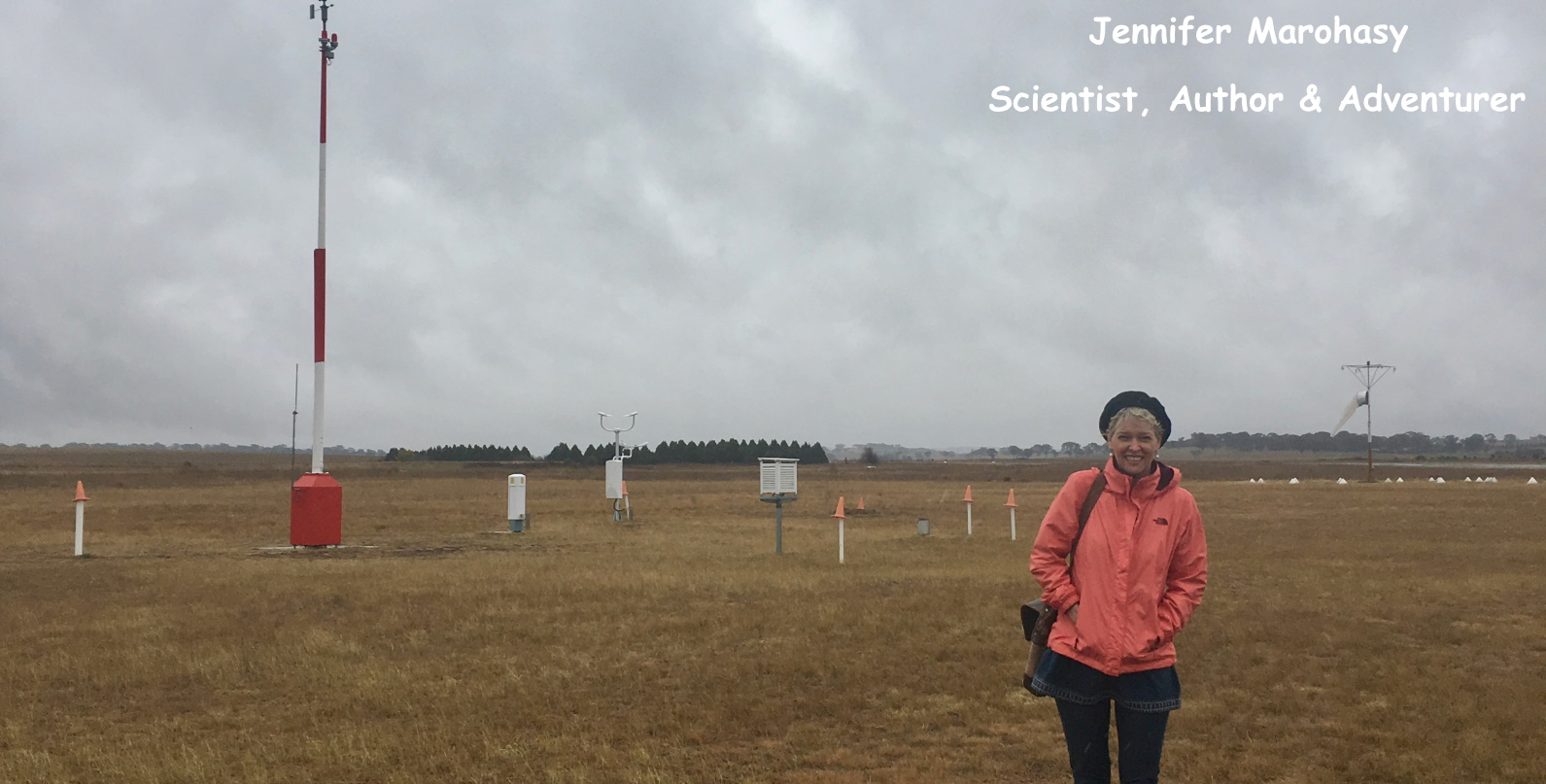
The feature image is of me some years ago in Norfolk County, in England, where there are wind turbines just off shore.
Filed Under: Information Tagged With: Net Zero

Ivermectin Banned, Leunig Sacked: No Opportunity for Dissent When it Comes to Covid

October 26, 2021 By jennifer

I’ve just put a pen through the name of the doctor who prescribed the triple therapy (Ivermectin, Zinc and Zithromax) for me back in September, as either a prophylaxis or cure for Covid. That same doctor gave me the AstraZeneca vaccine. They are potentially complementary, according to that registered Australian doctor.

I crossed out his name on the medicines I have, not because I don’t like him or trust him, but because I don’t want him to get in any more trouble – but I wanted to post a picture of the medicines he prescribed for me, when it was still legal to do so.

I got my tablets (see feature image) the week before they were banned by the TGA for use against Covid.

These medicines are now banned, because here in Australia, we are not allowed to make up our own minds when it comes to best medicines, especially when it comes to Covid.

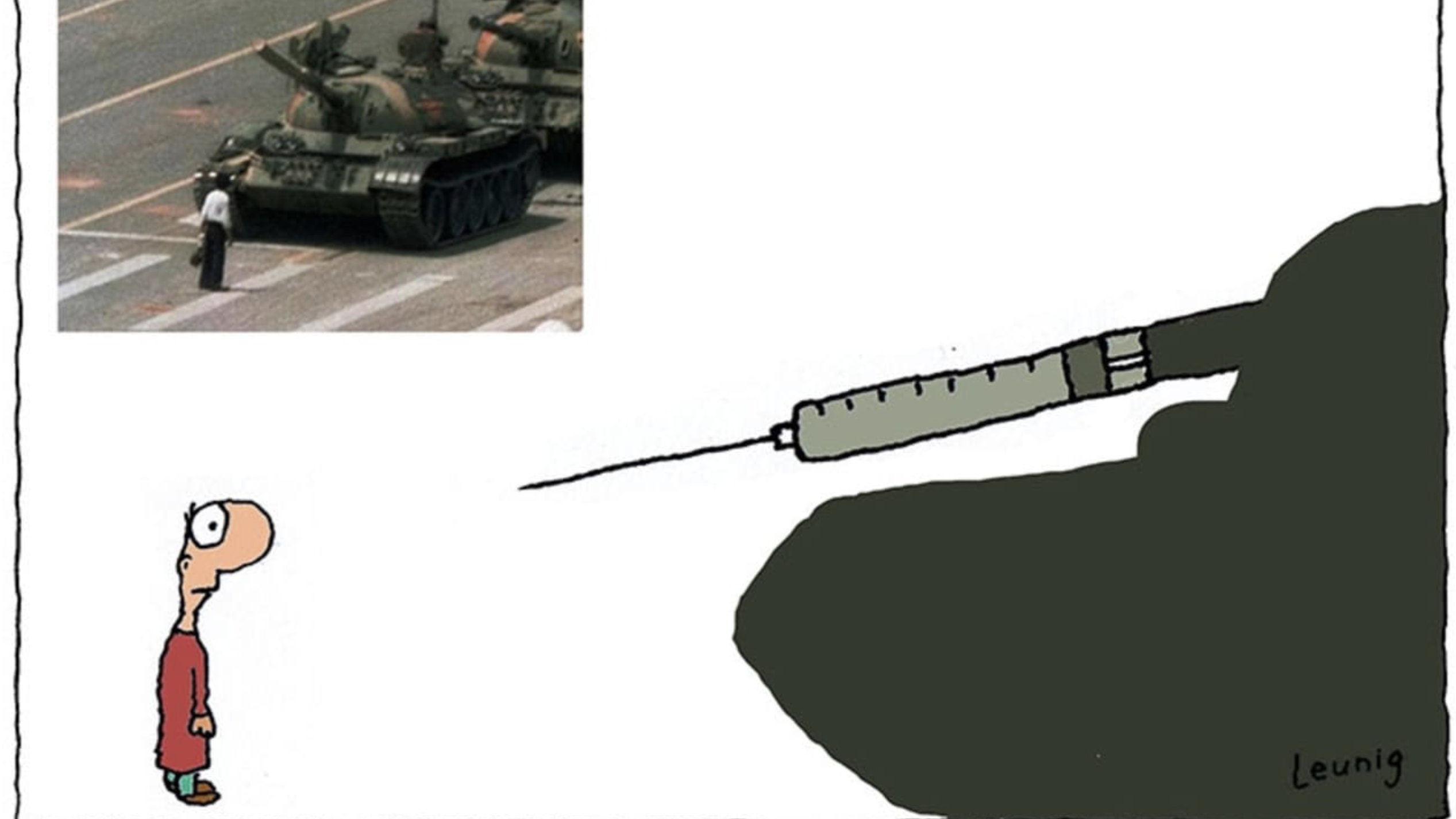
Should you have an informed opinion chances are you will be cancelled by one or more of the institutions. Indeed, that is what has just happened to one of Australia’s best-known cartoonists. Michael Leunig has just been sacked for questioning the government’s covid vaccine mandate.

A cryptic 39-word statement on the newspapers letters page last Monday said that they were “trialling new cartoonists”. The cartoonist confirmed to The Australian newspaper just yesterday that he was axed from his prized Monday editorial page position by The Age, after it dumped a cartoon in which he compared Daniel Andrews’ threat of “vaccine mandates” for Victoria to the famous Tiananmen Square vision of “Tank Man”, the Beijing dissenter who defiantly faced off against the Chinese government’s tanks in 1989.

The offending cartoon posted to Twitter, it was never published by the newspaper.

We are all expected to just get vaccinated never mind that this potential solution might not be the best option for everyone. It could even turn out that there are long term consequences. When I gave my daughter antibiotics back when she was two years old, I thought I was doing the right thing, it was what my doctor recommended. Chances are that it had a negative effect on the development of both her teeth and her gut microbiota, with long term consequences. Not that I’m against antibiotics but sometimes they may exacerbate a problem, rather than solve it. If I had my time over again, I would have done some research, and probably dissented.

Right now, when it comes to best public health responses, I’m no expert, and neither is Rebecca Weisser but I think she makes some good points:

Overlooked by almost everyone is the possibility that the pandemic could end with an effective treatment. If there were an outbreak of plague (which still exists in parts of the US and Africa) would the Australian government lock down the country because there’s no vaccine? Let’s hope not since there’s a perfectly effective antibiotic to treat the Black Death. When HIV emerged in the 1980s, there was no vaccine to prevent it. There still isn’t. Yet Aids-related deaths have been reduced by over 60 per cent, thanks largely to effective treatment.

The first essential element in responding to any pandemic is not a vaccine, which does nothing for people already infected, it is treatment. Indeed, an effective treatment reduces the circulation of a virus reducing the chances of mutations and makes a mass vaccination program safer and more effective.

It is to Australia’s credit that one of the most effective treatments was identified at Monash University along with the Doherty Institute which showed that ivermectin kills the Sars-CoV-2 virus within 48 hours. Yet to our national shame, the researchers have been starved of resources and the discovery ignored.

Not so in Indonesia where an enterprising philanthropist, Haryoseno, leapt into action and made ivermectin available to the masses for free or at low cost. As a result, Indonesia has had an extremely low Covid mortality rate. That is until the Ministry of Health decided, in line with the WHO’s recommendation, that ivermectin would only be used in a clinical trial. Haryoseno has been threatened with a fine and a ten-year jail sentence and the supply of ivermectin has dried up. Result? Deaths per million have increased five-fold since withdrawal of ivermectin on 12 June.

In Australia, one of the few doctors brave enough to use the drug to treat patients and save lives, Dr Mark Hobart, was reported to the Australian Health Practitioner Regulation Agency (AHPRA). Thankfully, AHPRA advised that there had been no infringement. Indeed, federal Health Minister Greg Hunt wrote to one of the doctors in Australia who prescribes ivermectin confirming that he was aware that some physicians are prescribing ivermectin off-label for Covid and that they were quite within their rights as the practice of prescribing registered medicines outside of their approved indications is not regulated or controlled by the Therapeutic Goods Administration (TGA)*, it is at the discretion of the prescribing physician*. Yet the silence persists. Ivermectin is the drug that dare not speak its name.

Some doctors prescribing ivermectin* are members of the Covid Medical Network. They can be contacted via their website and provide prescriptions for prophylaxis and treatment anywhere in the country (covidmedicalnetwork.com). Many follow the protocol established by world-renowned researcher Dr Thomas Borody who, largely at his own expense, has run a trial of an ivermectin triple therapy which has shown a reduction in mortality of 86 per cent in patients who were seriously ill with Covid. The only patients who died in the study – which has been published on preprint server medRxiv – were those that declined treatment.

Demonstrating the complete lack of urgency with which it treats repurposed drugs, the TGA last updated its advice on ivermectin on 1 June. It claims that there is currently insufficient evidence to support its safe and effective use. Yet since 1 June results of 15 new trials and meta-analyses of ivermectin have been published almost all showing steep declines in mortality. The question that the TGA has to answer is how is it possible to approve an experimental gene therapy vaccine with plummeting efficacy, significant short-term safety signals and unknown longterm side effects and yet not recommend a drug with an outstanding safety profile, which is supported by Nobel laureates and multiple randomised controlled trials?

* This situation has now changed, it is now illegal to prescribe Ivermectin for the prevention or treatment of Covid in Australia. And if you are a cartoonist of some standing dare not question the logic of this, or the vaccine mandate.

Filed Under: Information Tagged With: Covid

Plain English Lost on the High Court of Australia

October 13, 2021 By jennifer

Coral reefs can be messy, and so can court cases. And so it is with the case of Peter Ridd, sacked by James Cook University because he exercised his intellectual freedom. The only thing that is neatly settled from this case is apparently ‘the science’, never mind that this is only because anyone who publicly disagrees with it is censored or sacked. In the case of Peter Ridd, even after he managed to raise over A$1.4 million to appeal his sacking by James Cook University all the way to the High Court of Australia, he lost.

In a unanimous decision handed down this morning, the Court concluded that Dr Ridd’s right to intellectual freedom is constrained by the procedural requirements of James Cook University’s Code of Conduct. The High Court found his freedom of speech is limited only to his area of expertise. Those freedoms do not extend to issues about how the University is run, or whether the pronouncements made by its research institutions are trustworthy.

These matters are apparently internal; the University’s academics are obliged to follow procedure over these and, in particular, must be mindful when disciplinary matters are deemed confidential.

This sends a very strong message to all politically astute academics: if they are likely to make findings that do not accord with the consensus, these findings should be hidden within phrases that are unintelligible gobbledygook. In other words, their findings should be communicated in language that is meaningless, or is made unintelligible by the excessive use of technical jargon. They should certainly not translate their findings into plain English, or, worse, air them on national television, because that way the average Australian would have some understanding of what they are actually funding with their hard-earned taxes.

The climate science literature is replete with hidden meaning and technical jargon. The extent of the gobbledygook is such that the United Nation’s Intergovernmental Panel on Climate Change (IPCC) recently concluded that humans are the main cause of global warming and the role of the sun is inconsequential, never mind that there is an extensive prestigious scientific literature that arguably comes to the opposite conclusion – which is that much of the global warming we have been experiencing can be explained in terms of solar variability. This extensive literature was recently reviewed by Ronan Connolly, Willie Soon and 20 of their colleagues from 14 countries and published in the international journal Research in Astronomy and Astrophysics (Volume 21). However, it appears that tenured academics are not allowed to argue, at least not publicly.

There was a sense of irony this morning that made me smile. As I waited for the High Court judgement, I looked through a paper by Peter Ridd’s former colleagues – Emma Ryan, Scott Smithers and others – entitled ‘Chronostratigraphy of Bramston Reef reveals a long-term record of fringing reef growth under muddy conditions in the central Great Barrier Reef’ published in the very respectable journal Paleogeography, Paleoclimatology, Palaeoecology (Volume 441).

It would be difficult for the non-specialist to decipher this jargon-filled technical analysis that essentially supports what Peter Ridd has been saying for some years – and which earned him his first censure by the University, but, in short, it says there is still healthy coral reef in Bowen Harbour. It’s cold comfort, by the way, for the High Court to find in passing that the 2016 censure was unlawful, especially when it led directly to the 2018 censure, which, in turn, resulted in Peter’s employment being terminated. Anyway, I’m told Scott Smithers is a very competent scientist and an all-round good guy. He never replies to my emails. Perhaps this is because I could translate his gobbledygook into plain English. His potentially subversive publications would then be understood by the intelligent layperson for what they are – which is that they back up what Peter Ridd is saying in plain English and provide a very detailed explanation of how many inshore reefs of the Great Barrier Reef have been in decline for more than 1,000 years because of falling (yes, falling) sea levels.

The deceleration of reef growth occurred long before European settlement of the Queensland coast and was driven by natural constraints, probably associated with limited accommodation space due to late-Holocene sea-level fall. Our results demonstrate that mainland-attached reef initiation and accretion can occur in muddy inshore environments over long timeframes (centuries to millennia).

Because academics are not allowed to speak freely about controversial subjects most people have no understanding of the cyclical nature of sea levels. The general public are under the misconception that the most important global trend is one of sea-level rise. There are cycles within cycles and the most significant cycle has been one of sea-level fall, by some 1.5 metres over the last 2,000 or so years, notwithstanding that there has been sea-level rise of some 40 centimetres since the industrial revolution, which coincides with the end of the Little Ice Age (circa AD 1303 to AD 1835).

To put all of this in some context, along the Great Barrier Reef there is a large and variable daily tidal range. For example, at Hay Point the tide varies by as much as 7.14 metres; at Mackay by 6.58 metres; and at Gladstone by 4.83 metres. Sea levels have changed even more dramatically over geological time frames. For example, just 19,500 years ago, during the depths of the last major ice age, sea levels were 120 metres lower (yes, lower) than they are today. And the Great Barrier Reef did not exist. This very long record shows changes in temperature precede their parallel changes in carbon dioxide by 800 to 2000 years. This vital point establishes that carbon dioxide cannot be the primary forcing agent for temperature change at the glacial-interglacial scale, but this reality is mostly hidden by the modern astute geologist and ice-core expert who arguably cares more for his career than the truth. If this were not the case, they would be marching on Glasgow.

The modern Great Barrier Reef is the largest coral reef system to have ever existed on planet Earth, according to Peter J. Davies writing in the Encyclopedia of Modern Coral Reefs. It is but a thin veneer growing on top of at least five previous extensive reef systems, each destroyed by dramatic falls in sea level in the past. The modern reef has grown up on top of extinct reefs, the last of which existed 120,000 years ago. In some places the depth of the coral growth since the last ice age, which had begun by 100,000 years ago, is 28 metres – layer upon layer. This growth is now constrained by sea level.

Filming far offshore with Clint Hempsall at one of the Ribbon Reefs on 21st January 2020. Many of the Ribbon reefs have dead reef crests. What Peter J. Davies describes as flat-topped platforms with live coral growth only around the perimeter. The evolution of these barrier reefs, found a long way off shore, is explained in my short documentary film, ‘Clowns on the Ribbon’s Edge’.

Many of the nearly 3,000 reefs that make up the modern Great Barrier Reef have a crest that is flat-topped because the most recent 1.5 metre drop in sea level has sliced this much off their tops. So, the crests of these reefs are dead coral that is thousands of years old, sometimes capped with coralline algae. These reef crests were dead long before European settlement. Yet it is surveys that include exactly this reef habitat, taken from the window of a plane by Peter Ridd’s nemesis Terry Hughes flying at an altitude of 150 metres, which have made media headlines around the world, and which suggest that the Great Barrier Reef is more than half dead.

Worse, they were used in a recent Australian Academy of Sciences report (March 2021) to claim the imminent demise of the Great Barrier Reef due to carbon dioxide emissions and thus the need for a commitment to net zero greenhouse gas emissions in Glasgow. It is all nonsense, and politics. But beware the academic who explains as much in plain English, especially following this morning’s ruling by the High Court of Australia.

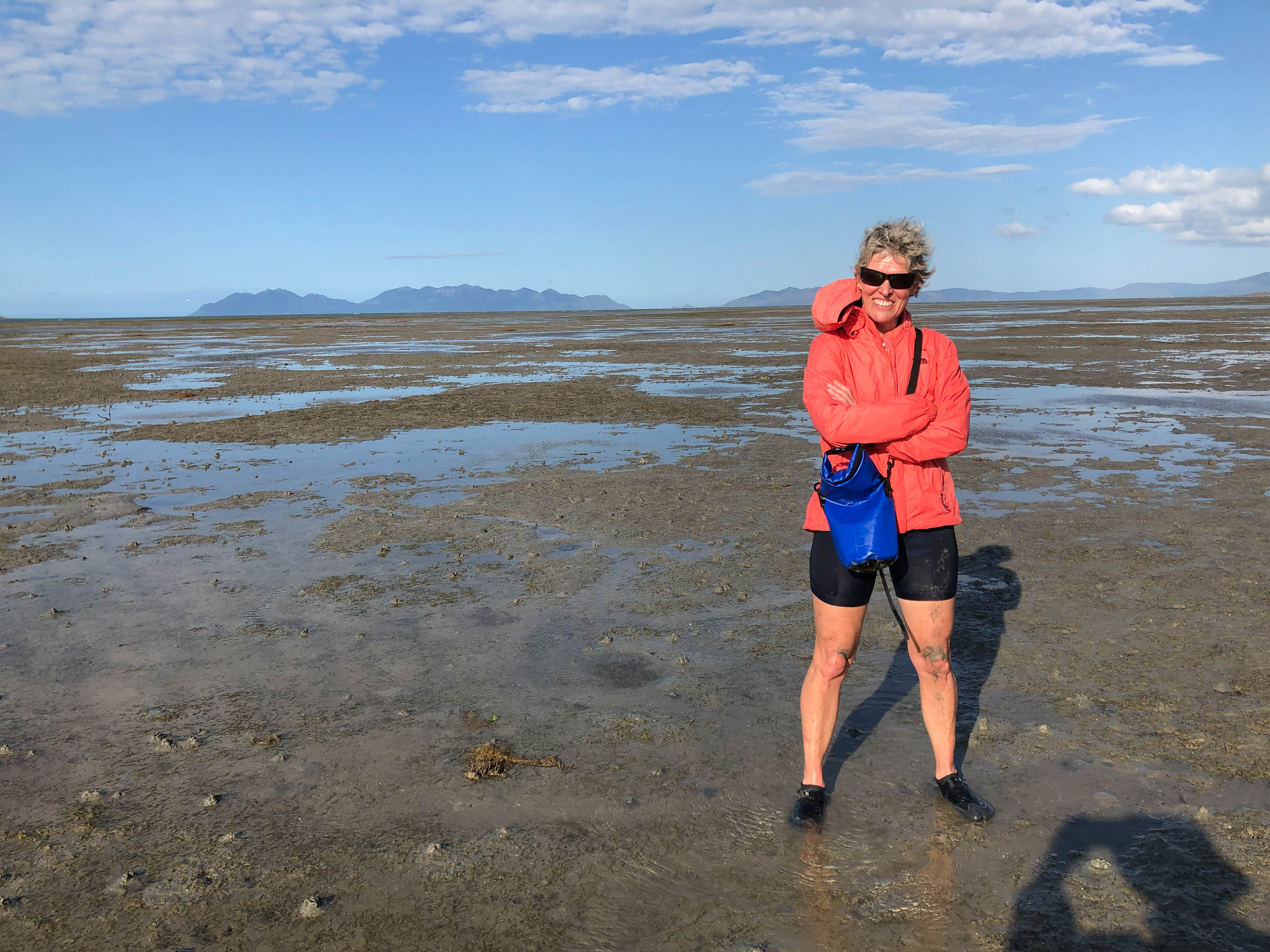
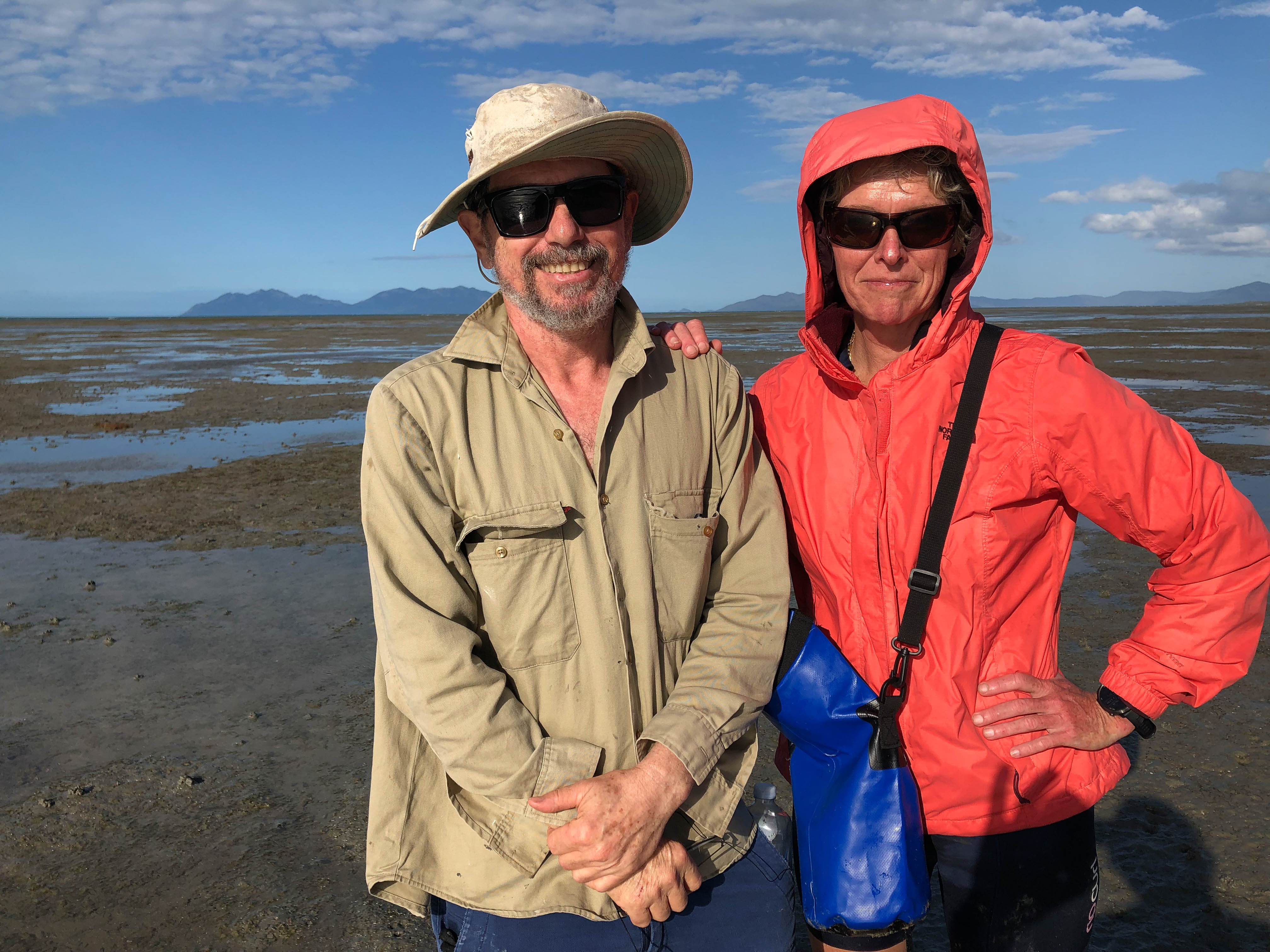
Jennifer Marohasy at the mudflat to the west of Bramston Reef on 29th August 2019. Professor Hughes showed a photograph of this mud flat to 2,500 marine scientists who attended a conference in Cairns on 9th July 2012 and told them that the mud now covers what was once healthy coral reef, and that this reef is an example of the ‘sad decline’ of the Great Barrier Reef. In fact, Bramston reef is prograding to the seaward side beyond this mudflat as shown in the feature photograph with Peter Ridd at the very top of this blog post. Both photographs were taken on 29th August 2019, on the very lowest day tide for that year at Bowen.
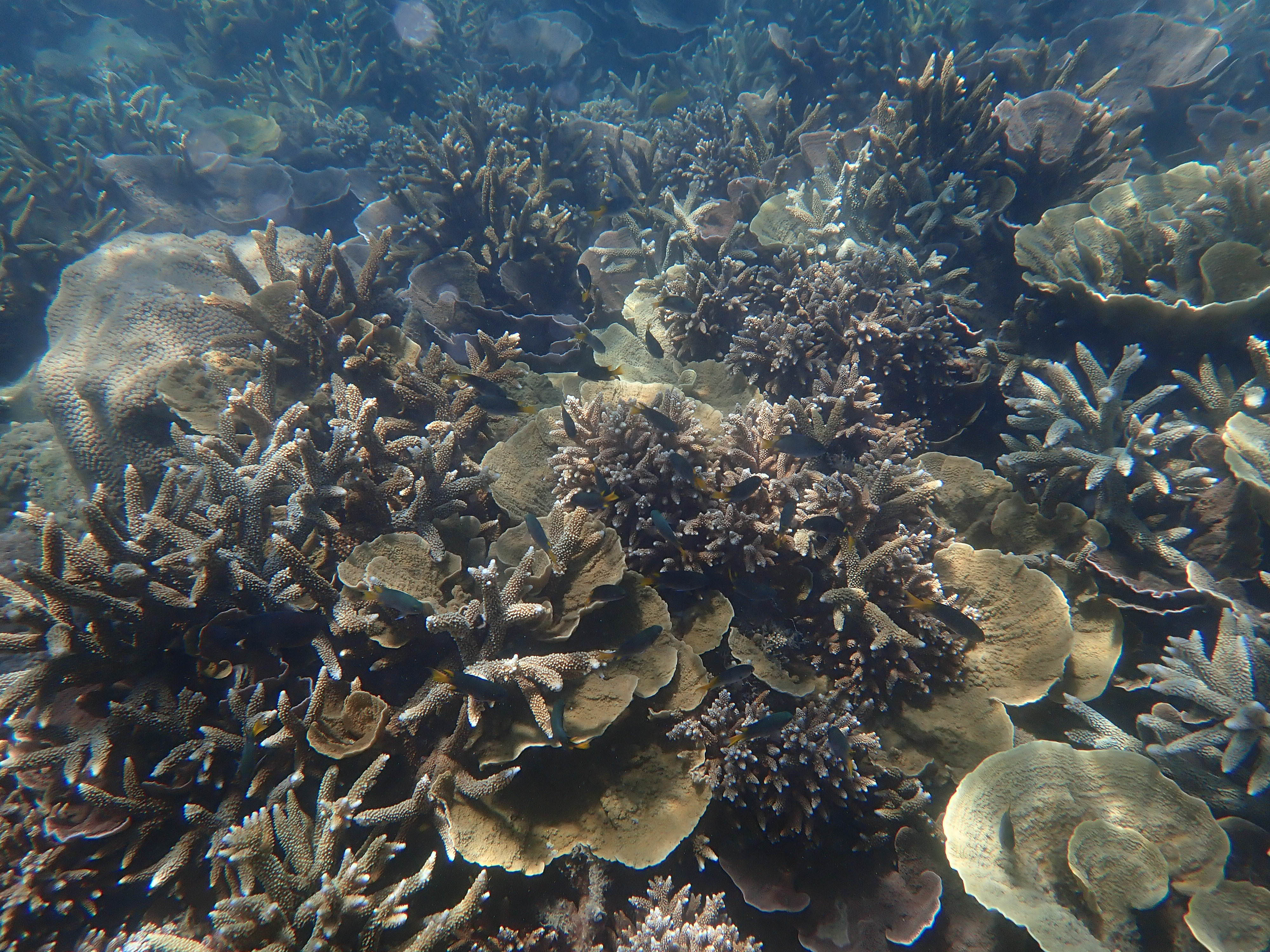
Beyond the mudflat is Bramston Reef, and beyond Bramston Reef is Beige Reef. I took this photograph at Beige Reef on 25th August 2019. Corals at most reefs across the world are beige in colour.

On 2 May 2018, Peter Ridd was sacked by James Cook University for serious misconduct. It all started when he called-out Terry Hughes, whom he believed was falsely claiming that the inshore coral reefs at Bowen, specifically Bramston Reef, were dead because of climate change and the deteriorating water quality. It is the case that Professor Hughes was showing photographs of the mud flat as though it had replaced the coral reef that still exists to the seaward side.

Professor Ridd had been complaining quietly for years. He had already published peer-reviewed papers explaining in detail some of the serious issues with the official science. It was nevertheless a tough decision to go public, which he made in full knowledge that there could be consequences. At the same time there was a feeling of optimism; eventually, the truth would win out and the University would acknowledge the importance of implementing some form of quality assurance over the various pronouncements made by one or two high-profile academics. These academics, whom he believed were speaking beyond their area of expertise and hammering the theme of the reef being dead in order to progress their own personal political agenda and, at the same time, their careers.

Former Chairman of the Institute of Public Affairs, Janet Albrechtsen, wrote in The Australian on 25 July 2020:

Remember that Ridd wasn’t querying the interpretation of Ovid’s Metamorphoses. He was raising questions, in one particular area of his expertise, about the quality of climate change science. One of the fundamental challenges of our generation is to get the science right so we can settle on the right climate change policies. JCU told Ridd to keep quiet, then it sacked him.

Peter Ridd did win the first round in the Federal Circuit Court back in April 2019. Judge Salvatore Vasta found in his favour and order that the 17 findings made by the University, the two speech directions, the five confidentiality directions, the no satire direction and the censure and the final censure given by the University and the termination of employment of Professor Ridd by the University were all unlawful.

Then the University appealed, and the Federal Court of Australia overturned the decision of the Federal Circuit Court. That decision, according to Dr Albrechtsen, has sent intellectual inquiry down the gurgler in the 21st century at an institution fundamental to Western civilisation:

Is that to be the legacy of JCU’s vice-chancellor Sandra Harding? And what oversight has JCU’s governing council provided to this reputational damage, not to mention the waste of taxpayer dollars, in pursuing a distinguished scientist who was admired by his students?

Following this decision, no academic can assume that an Australian university will allow the kind of robust debate held at Oxford University in 1860 between the bishop of Oxford, Samuel Wilberforce, and Thomas Henry Huxley, a biologist and proponent of Darwin’s theory of evolution.

The Historical Journal records how this legendary encounter unfolded: ‘The Bishop rose, and in a light scoffing tone, florid and fluent he assured us there was nothing in the idea of evolution: rock-pigeons were what rock-pigeons have always been. Then, turning to his antagonist with a smiling insolence, he begged to know, was it through his grandfather or his grandmother that he claimed his descent from a monkey? On this Mr Huxley slowly and deliberately arose. A slight tall figure stern and pale, very quiet and very grave, he stood before us, and spoke those tremendous words … He was not ashamed to have a monkey for his ancestor, but he would be ashamed to be connected with a man who used his great gifts to obscure the truth.

Not for nothing, Ridd’s lawyers submitted this example of intellectual freedom during the first trial. In sacking Ridd, and to win in court, JCU had to argue against the means that seeks the truth – intellectual freedom.

In deciding whether to grant special leave for the appeal, the High Court considered whether the case involved ‘a question of law that is of public importance’. It was the first time the High Court had been called upon to consider the meaning of ‘academic and intellectual freedom’, a term that is used in enterprise agreements covering staff at almost all Australian universities.

We now have a judgement. For the High Court, it seems that intellectual freedom is like a delicate flower that does not survive being plucked. It can be contemplated from afar but cannot be held or given as a gift. Intellectual freedom survives in academia only if limited to gobbledygook that alludes to the truth in such a way that no member of the pubic could understand how deeply that truth contradicts the official scientific consensus. Perhaps I already knew that.

Some argue there are other legal avenues – not through the courts – that could, perhaps, have been pursued and may have achieved a different outcome, but which may or may not have provided some vindication. But as for the courts: if you have to raise A$1.4 million and put in a further A$300,000 of your own money, as Peter Ridd has done, just to run one argument all the way to the High Court, how much would you need to fight on the substance of each issue? For sure the lawyers did well out of this case.

The alternative strategy might have been to try and get the matter raised under the Queensland whistle-blower legislation. Peter Ridd would at least have been, theoretically, protected while an investigation was conducted. The focus would have been on science rather than a narrow construction of employment law and the procedures laid out in the University’s Code of Conduct. But given the determination of James Cook University to silence its critics, and the need for this to have included testimony from colleagues desperate to avoid controversy – lest they are admonished by their family and communities for failing to be respectable, thereby jeopardising their own careers – it is unclear this would have been any more fruitful.

And so to this day there has never been any consideration given by the courts or any other independent body to the actual state of the corals in Bowen Harbour, including at Bramston Reef, even though this was the reason for the first censure that the High Court has ruled should not have been issued in the first place. Yes, the ruling this morning clearly states, in agreement with Judge Vasta, that Professor Ridd’s initial comments about his colleague Terry Hughes and the state of the corals in Bowen Harbour were reasonable and that the censure should not have been issued. Yet that is where all the other allegations subsequently came from as Peter Ridd tried to defend himself in the public domain.

There is more than one coral reef in Bowen Harbour. I like to refer to Bramston reef as the one the other side of the mudflat, it is the muddiest. There is a much prettier reef the other side of the channel and in the northeast facing bay of Stone Island at the entrance to Bowen Harbour, a reef that I have named Beige Reef. I produced a short documentary film about the extent of the scientific misrepresentation of these corals, to watch it scroll down at this link. The film, Beige Reef, was funded by the B.Macfie Family Foundation through the Institute of Public Affairs. In the film, I let people see for themselves rather than engage in gobbledygook. But sadly that’s a freedom no longer available to any serving academic at an Australian University.

Following today’s decision, Peter Ridd has accepted an invitation to join the Institute of Public Affairs as a Research Fellow, without salary, to lead a newly established project for ‘Real Science’. The Project’s aims are to improve science quality assurance and to support academics speaking out for integrity in science and research. You can support this project by way of a tax deductable donation to the IPA. It is the case that long ago scientific inquiry was mostly privately funded, now is your opportunity to be a part of this new initiative for open and honest inquiry.

Peter Ridd and Jennifer Marohasy in front of the mud flats which are to the west of Bramston Reef just to the south of Bowen. While at James Cook University, Peter Ridd studied suspended sediments in the coastal zone as an important natural limiting factor for the growth and health of inshore coral reefs.

Peter released the following statement today, immediately following the decision by the High Court:

It is with a heavy heart that I inform you that we have lost the appeal in the High Court. We lost, in my opinion, because JCU’s work contract, under which I was employed, effectively kills academic freedom of speech – and the contract is effectively the law.

So, JCU actions were technically legal. But it was, in my opinion, never right, proper, decent, moral or in line with public expectations of how a university should behave.

I often ask myself, if I knew what was going to happen, would I have handled that fateful interview with Alan Jones and Peta Credlin in 2017 differently. Would I still say that, due to systemic quality assurance problems, work from a couple of Great Barrier Reef science institutions was “untrustworthy”?

It has cost me my job, my career, over $300K in legal fees, and more than a few grey hairs.

All I can say is that I hope I would do it again – because overall it was worth the battle, and having the battle is, in this case, more important than the result.

This is just a small battle in a much bigger war. It was a battle which we had to have and, in retrospect, lose. JCU’s and almost every other university in Australia and the western world are behaving badly. We have shown how badly.

Decent people and governments can see the immense problem we have. The universities are not our friends. Only when the problem is recognised will public pressure force a solution.

The failure of our legal action, and JCU’s determination to effectively destroy academic freedom of speech, demonstrates that further legislation is required to force universities to behave properly – especially if they are to receive any public funding. The Commonwealth government introduced excellent legislation in parliament early this year, partly in response to our legal case, to bolster academic freedom of speech. It is an excellent step in the right direction. If my case had been fought under this legislation, I would have had a better chance of winning. But it would still have been far from certain. There would still have been a clash between the new legislation and the work agreement.

There needs to be major punishment against universities for infringement of academic freedom of speech, such as fines or losing their accreditation. There needs to be active policing and investigations of the universities to make sure they comply and do not threaten academics with expensive legal action to stop the university’s behaviour becoming public. Universities must be told that they cannot spy on academic’s email communications (this should only be done by the police) or use secrecy directives to silence and intimidate staff. And all this protection for academics MUST be written into the work contracts to put the matter beyond legal doubt.

I am very mindful that I asked for, and received, donations of about $1,500,000 (in two GoFundMe campaigns of around $750k#) for the legal battle – from over 10,000 people. And I lost. Some of those donations were from people who have very slender financial resources. All I can say is that it weighs heavily on my conscience, but I hope they agree that it was still worth the battle.

A last thank you

I would like to express, one last time, my thanks to Stuart Wood AM QC, Ben Jellis, Ben Kidston, Colette Mintz, Mitchell Downes, Amelia Hasson and the rest of the team. They were fabulous. They did everything that was possible.

Thanks also to John Roskam, Gideon Rozner, Evan Mulholland, Morgan Begg and the Institute of Public Affairs. They backed me when things got tough. They are one of the few institutions in the country that will fight on issues of freedom of speech. I’d like to make a special mention of the IPA’s Jennifer Marohasy. She has been a great support over many years and played a crucial role in the critical early days of this fight.

Thanks to the National Tertiary Education Union. They supported the cause in court, even though my views on the Reef may well be opposed to the views of many of their members.

There are many politicians who have gone into bat on my behalf such as Matt Canavan, George Christensen, Pauline Hanson, Bob Katter, Gerard Rennick, Malcolm Roberts, Dan Tehan, and Alan Tudge (in alphabetical order). They obviously could not interfere with the legal proceedings, but were instrumental in bringing in the new academic freedom legislation.
There are many journalists and bloggers who helped spread the word, but I would particularly like to thanks Graham Lloyd from The Australian, Jo Nova, and Anthony Watts (WUWT).

There are also many other people, far too many to list, that I am thankful to. They will know who they are.

And finally, thanks to my family, and especially Cheryl.

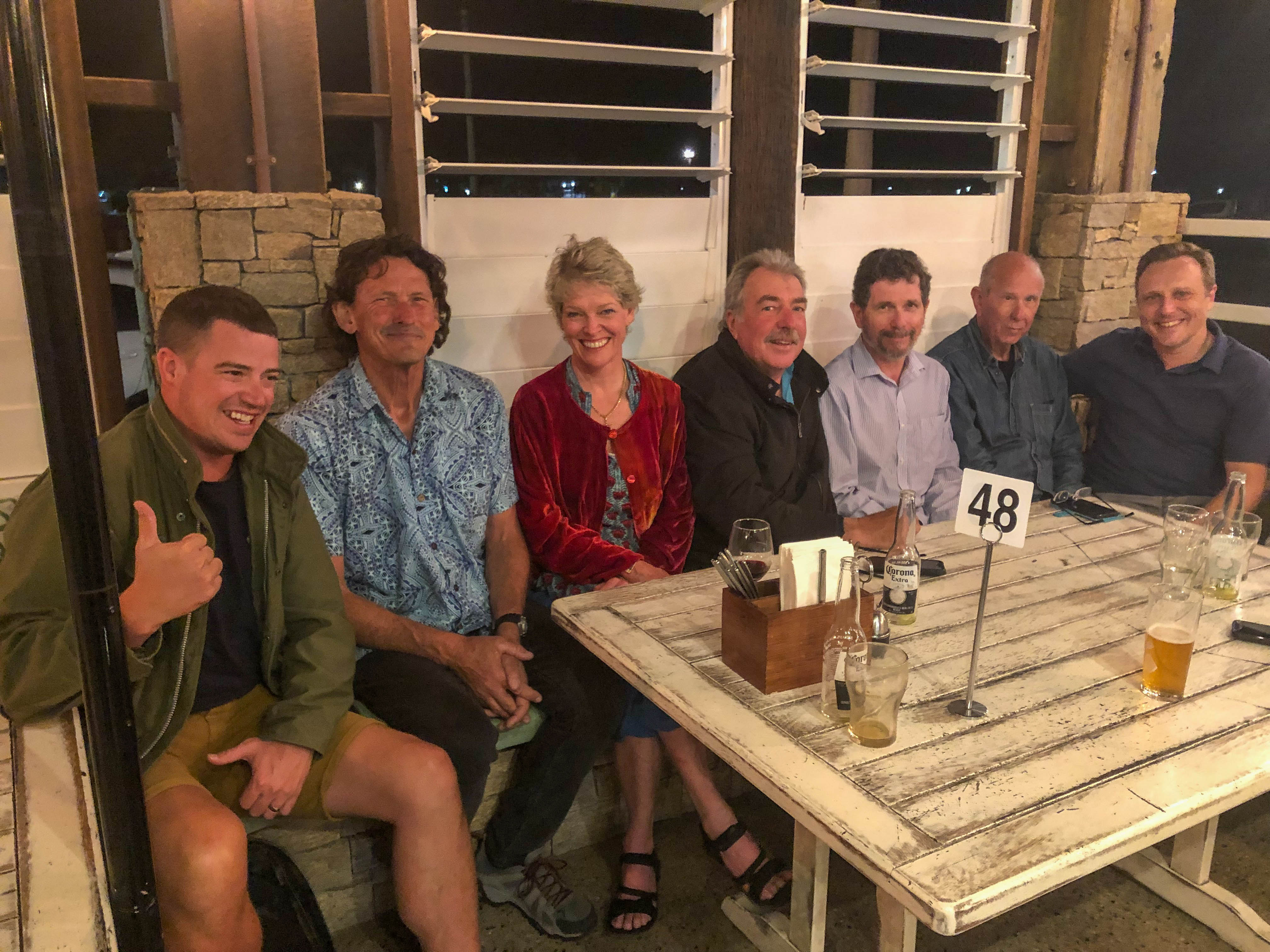
On 29th August 2019 a few of us gathered in the pub at Bowen with Peter to yarn about Bramston reef, and how you need to walk the other side of that mudflat to find the corals. Beige Reef is the other side of Bramston Reef, across the channel and around the headland. Skipper Rob McCullough (sitting between Peter and me) gave freely of his time for the filming of Beige Reef, and sadly passed away earlier this year. Vale to Rob McCullough, and thank you for your enthusiasm. You would have said about today: it is but one battle lost, we will keep fighting for the truth.

Your donation to Peter Ridd’s ‘Project for Real Science’ will contribute to the production of more short documentary films. Thank you for reading this far, and don’t forget:

The only thing necessary for the triumph of evil is for good men to do nothing.

Beyond Bramston Reef, still in Bowen Harbour, is the very pretty Beige Reef. This photograph was taken at Beige Reef on 25th August 2019. You can watch a film about this reef on YouTube, https://www.youtube.com/watch?v=HqFFqBuFVqU&t=77s

If public policy is to be based on evidence, as opposed to myth, then there is a need for all of us to fearlessly seek out the truth. Beyond this there is a need for expertise to be recognised, and valued, and the claims of activists to be always tested against the evidence. If we turn the other way, and choose to ignore these facts, on the basis they offend or are unkind to those we hold in high esteem, we cannot honestly consider ourselves, or our community, to be very civilised or educated. And finally, I have explained the four myths behind Peter Ridd’s sacking in a short report, that can be downloaded here.

Filed Under: Information

Bleached from a Distance

September 26, 2021 By jennifer

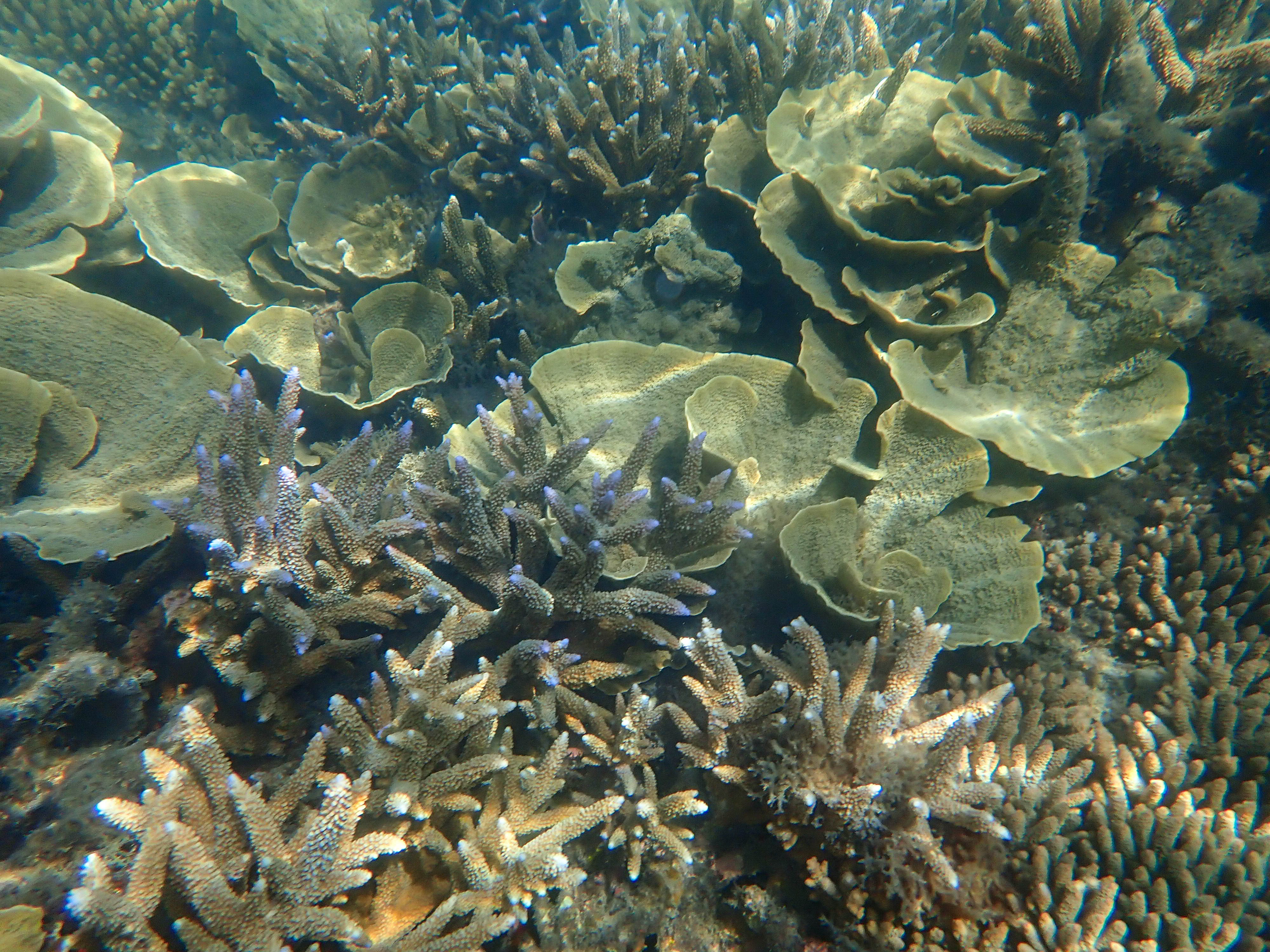
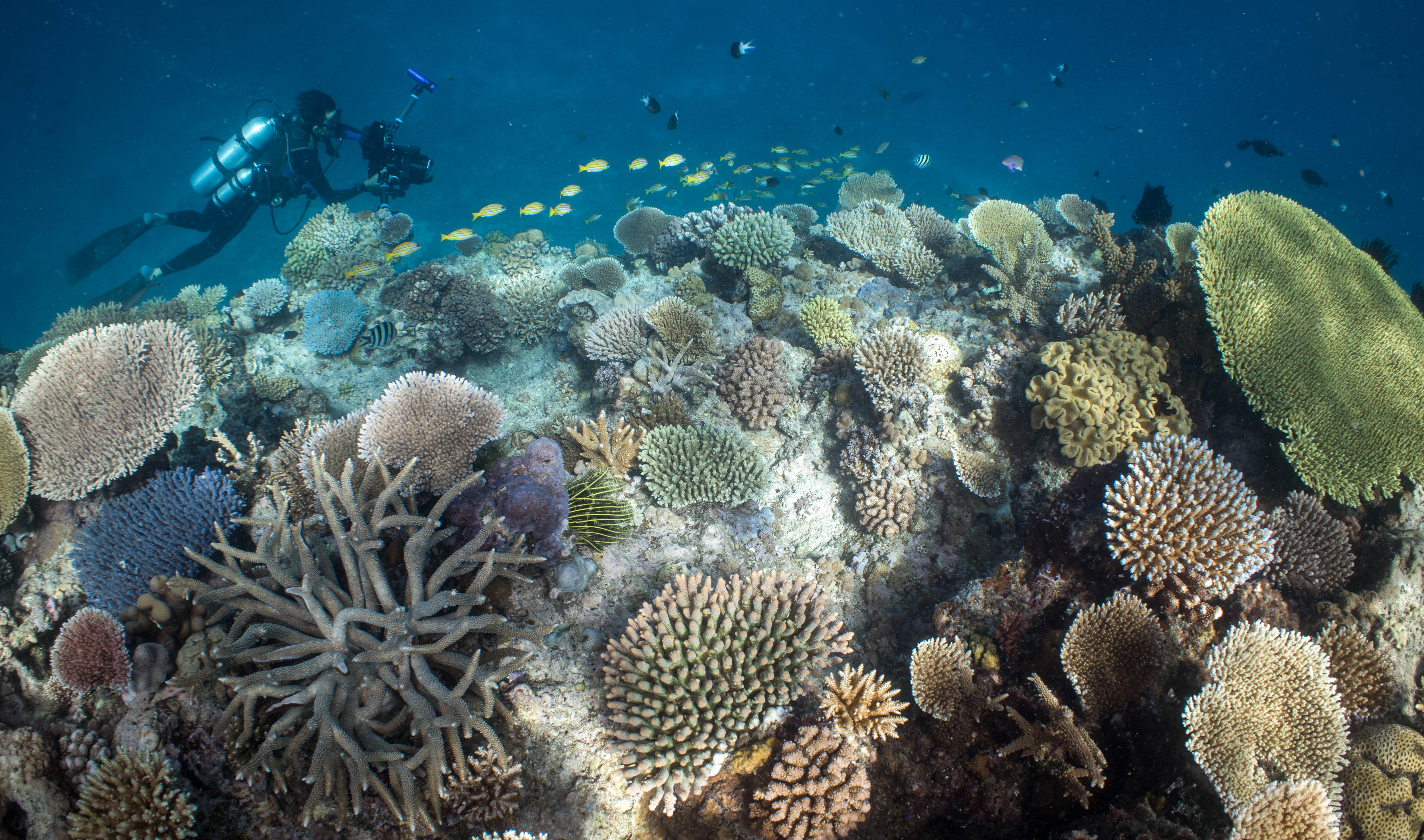
I lent my underwater camera (Olympus TG-6) to a dear friend who recently visited Lady Elliot Island at the Great Barrier Reef. She came over last Sunday to return the camera, and to show me some of her photographs. My favourite is of the Parrot fish just beyond the magenta-coloured corals, shared above. Over the ledge the water is deeper, and the corals have a blue haze. This is because wavelengths in the blue part of the visible light spectrum penetrate water to some few metres, while all the wavelengths in the red part of the spectrum are absorbed by 5 metres under the water.

For those who have never snorkelled or scuba-dived, and who like to lament the dying Great Barrier Reef, the corals beyond the parrot fish in Jessica’s picture might all look bleached. But that is how corals look in the distance when visibility is good, because the water is so clear. It is only when you swim up to them, when you are nearer to the corals, that you can see their real colour.

When I see photographs online and in newspapers of corals described as bleached, I often wonder how the photograph was taken – at what depth and whether it was colour corrected. I wrote to a journalist, Michael Foley from the Sydney Morning Herald, back in April about a picture purportedly showing bleached coral.

Hi Michael

I’m really impressed with your interview with Terry Hughes and particularly how much online media has republished your article ‘Reef on path to destruction and clever science can’t fix it’ and that photograph.

I was curious about the image of the bleached corals. Where it was taken, and how it was colour adjusted. I sent an email via the Catlin Seaview Survey contact page, asking for this information last Tuesday (13th April) and to Sara Naylor at UQ. The email to Sara bounced, Catlin hasn’t replied.

This image was featured in many news reports back in April 2021, republished from a Sydney Morning Herald article with the Catlin Survey credited for the image, but otherwise providing no details.

What I would really like is the original full resolution raw image. Could you please send me this?

Also, where was the image taken/which reef, and when/which year?

If it was taken back in 2015 or 2016 or 2017 it would be important to know the state of that coral now?

Michael Foley never replied.

There is a wonderful library on Lady Elliot Island, at the resort in a room tucked behind the museum. I spent some time there most evening when I was on the island for a week back in May. I found a photograph very similar to the one I queried Michael Foley about. It is in a book entitled ‘Coral Whisperers’ by Irus Braverman published by the University of California Press in October 2018.

This picture is from the introduction to Irus Braverman’s book ‘Coral Whisperers’

The caption to this photograph provides a lot more information than the Sydney Morning Herald article by Michael Foley published on 8th April this year (2021). So, the photograph used in the article by Michael Foley was perhaps taken at Heron Island and back in February 2016.

It would seem somewhat disingenuous for a news story published on 8th April 2021 to be accompanied by a photograph from 2016 but without including this important information: that the photograph is five years old. It would also be useful if the publisher explained that visible light of a blue wavelength penetrates water, while red is absorbed, so corals even just a few metres away can have a blue haze and even appear bleached.

Also, if the Sydney Morning Herald are going to include a photograph from five years ago in a news story, why don’t they also show a more recent photograph – so we have some idea whether the coral is still there, or not?

The Sydney Morning Herald/ Catlin Seaview Survey photograph with the coral changed to beige by my friend Michael who first alerted me to this photograph and how easy it was for him to ‘fix’ what he described as the ‘blue cast’.

Of course, beige is the most common colour of corals at reefs around the world, as I explained in my short documentary film ‘Beige Reef’, that you can watch on YouTube.

Update Tuesday 28th September 2021

Much thanks to Steve Messer for finding a higher resolution image of the ‘bleached corals’ here: https://www.flickr.com/photos/stopadani/33675818851
(more detail with his comment in the following thread). Reproducing just a section of this photograph from Flickr (below) it is apparent that the branches are a dark tan in colour with white axial corallites and/or white tentacles extended from the corallites. This coral is not bleached at all.

A section of the photograph from Flicker and closeup to show that each branch of coral is a brown stem with white corallites and/or white tentacles.

Considering my SST course notes on low visibility and night diving it is apparent that with depth orange/beige begins to look very dark and then eventually black. So, if we could lift this coral to the surface the stems would perhaps be orange/beige and covered in white corallites with white tentacles extended.

Reproduced from my SSI Scuba diving course notes/ manual.

I’m including a picture of an Acropora cervicornis from page 206 (volume 1) of Charlie Vernon’s ‘Corals of the World’, see below. This species of coral is from the Caribbean, not the Great Barrier Reef, but the photograph illustrates my point.

This is an example of a beige coral with white axial corallites.

So, which species of Acropora, or perhaps Anacropora, have the experts mistaken for bleached?

****

The feature image, at the very top of this blog post, was taken at Lady Elliot Island in September 2021 by Jessica with my TG-6 camera. I also like how Jessica’s photograph so clearly shows that the Parrot fish’s teeth are fused together. These fishes eat live coral. I’ve seen them scrap the massive Porites and bite into pretty Acropora.

Filed Under: Information Tagged With: Great Barrier Reef

Willie Soon Explains About the Sun, and How to Better Report Science

September 11, 2021 By jennifer

Temperatures are always changing, and the pattern of change tends to follow cycles. But most science reporters don’t understand this, because they have very little understanding of the solar system and are promoted within their organisations based on their capacity to repeat and repackage rather than to analysis.

For most locations on this Earth, temperatures change daily as the Earth spins on its axis relative to the Sun creating day and night. (Where I live daily changes in temperature are in the order of 10 degrees Celsius.) Temperatures change with the seasons because of the tilt of the Earth relative to its orbit around the Sun. Then there are the ice ages, because of changes in the orbital path of the Earth around the Sun. All these changes are essentially driven by the Sun, or at least the Earth’s distance and position relative to the Sun’s irradiance that is ever changing but in measurable and predictable ways.

Yet the elites, who control our once-independent scientific institutions, would have you believe that carbon dioxide is more powerful and has a more significant effect on temperatures than the Sun.

Instead of acknowledging the cycles, they would have you believe that temperatures are rising in a linear way and that this has created an imbalance that is causing the world to overheat and that this is all your fault. They have an agenda, it is not about communicating the complexities of the solar system, but rather about social and economic revolution.

A recent paper with many authors, including my friend and colleague Willie Soon, explains in detail that the institutions (most notably the IPCC) are mistaken in their assessment of the importance of carbon dioxide relative to the Sun, at least in part because in making their calculations they fail to adequately consider all the relevant measures of solar irradiance and are somewhat muddled when it comes to actual temperature trends for specific locations. (Of course, the Australian Bureau of Meteorology deliberately muddles temperature trends by remodelling the raw data.)

The paper by Willie and colleagues is rather long, 71 pages in the pre-print that I have. It is long because it goes into detail, explaining the potential complexity of solar irradiance including the sixteen different ways of measuring changes in ‘total solar variability’ since the 19th century and earlier, and even how the sun-climate effect is more pronounced at certain places on Earth.

The paper was recently published in the journal Research in Astronomy and Astrophysics Volume 21, beginning on page 131, and can be downloaded by clicking here:
https://iopscience.iop.org/article/10.1088/1674-4527/21/6/131

This is an important contribution to our understanding of not only total solar irradiance and how this is measured, but also how the institutions muddle the temperature, and also the solar irradiance, measurements. Perhaps not surprisingly, there is an all-out campaign to discredit this important research by Willie Soon and his colleagues. The campaign appears to be openly supported by Facebook as detailed in the following correspondence from Willie and two of the papers co-authors, Ronan and Michael Connolly.

In defence of their recent paper, and in a letter to a ‘Facebook Fact Checkers’, Willie Soon et al. suggest how science journalists might report contentious issues. Specifically, with reference to a recent paper by Danish philosopher Mikkel Gerken. They suggest:

1. Inclusive Reliable Reporting

Science reporters should, whenever feasible, report hypotheses in a manner that favours the most reliably based ones by indicating the nature and strength of their respective scientific justifications.

2. Epistemically Balanced Reporting

Science reporters should, whenever feasible, report opposing hypotheses in a manner that reflects the nature and strength of their respective scientific justifications or lack thereof.

Obviously, this type of reporting would be somewhat time consuming, certainly much more so than the current approach where journalists tend to simply and conveniently assume that the more important the affiliation the more reliable the science. Of course, in this age of disinformation where the populous is mostly held in contempt by the elites, it would be a revolutionary way to report science. A first requirement though would be a level of scientific literacy from science reporters.

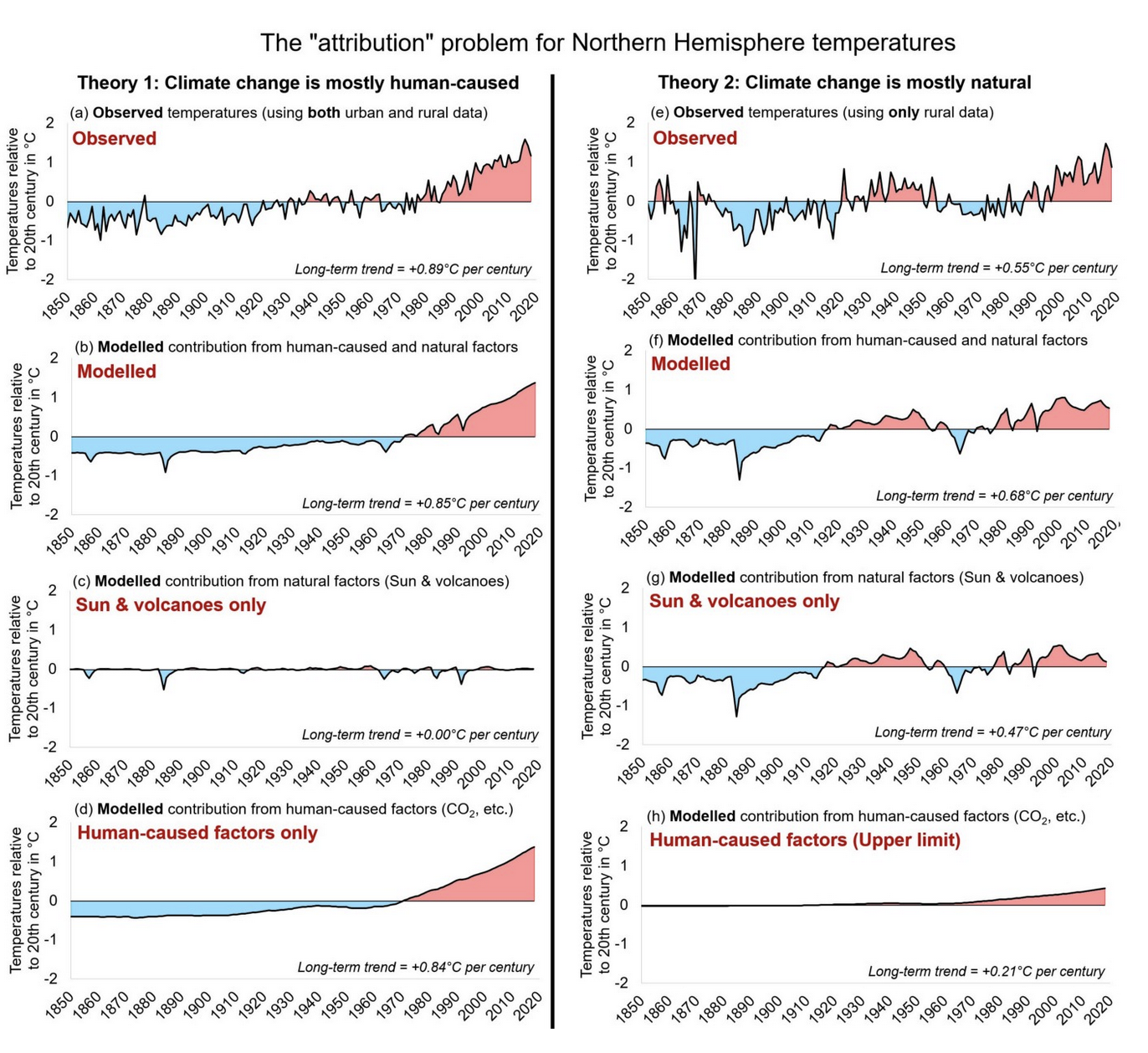
A chart from the important new paper by Connolly, Soon et al. 2021

The feature image at the top of this blog post is of the Sun going down over Darwin.

Following is the recent letter from Willie and colleagues to the misguided Facebook ‘Fact Checker’.

**********

Dear Drs. Vincent and Forrester,

We are writing this open letter to you because it has recently come to our attention that your Climate Feedback website has published an article making multiple false or misleading claims about an Epoch Times newspaper article (by Alex Newman) that reported on a new peer-reviewed paper we co-authored. Your website’s “fact- check”/”feedback” also made false or misleading claims about our paper.

This means your website is effectively spreading the very misinformation that you purport to be trying to fight. Additionally, because your website is currently one of Facebook’s approved “independent fact-checkers”, anybody who shared or tries to share a link to the Epoch Times article now receives a warning.

In other words, not only is your “fact-check” promoting misinformation, but you are effectively hindering the public from sharing important information with their friends and family.

We are writing to you to ask you to immediately correct this erroneous “fact-check” and to inform any groups that may have been using your website as an “independent fact-checker” (including Facebook) of the error.

We are also cc’ing and bcc’ing various parties who are either directly affected by the consequences of this “fact-check” or may be more generally concerned about the arbitrariness of the “fact-checks” offered by websites such as yours, and the problem of “who will ‘fact-check’ the fact-checkers?”

We believe the discussion below is of relevance for everybody given the recent trend of the media, social media and internet search engines towards using “independent fact-checkers” like yourselves for down-ranking, suppressing or even deleting content. Therefore, we have chosen to make this an open letter. We encourage people to share our letter and our accompanying “fact-check fact-check” with the public – although we ask people to first redact the e-mail addresses.

The article in question is this one edited by Dr. Lambert Baraut-Guinet.
Dr. Baraut-Guinet claims to have “fact-checked” an Epoch Times newspaper article by Alex Newman which compared the findings of our recent scientific review paper to the findings of the UN Intergovernmental Panel on Climate Change (IPCC) Working Group 1’s recent 6th Assessment Report (AR6).

Baraut-Guinet alleges that Newman made false claims that were “incorrect” and “misleading” in his reporting. He similarly asserts that several other media outlets publishing articles repeating some of Newman’s reporting were “incorrect” and “misleading”. Baraut-Guinet also asserts that our peer-reviewed paper makes “incorrect” and “misleading” claims.

Background to Newman’s article:

Our paper that Newman was reporting on is a detailed scientific review on the complex challenges of establishing how much of a role solar activity has played in northern hemisphere temperature trends since the 19th century (and earlier). It was co-authored by 23 experts in the fields of solar physics and of climate science from 14 different countries and was published in the peer-reviewed journal Research in Astronomy and Astrophysics (RAA).

The title of our paper is, “How much has the Sun influenced Northern Hemisphere temperature trends? An ongoing debate”, and it was published online in early August. Coincidentally, a few days later, the UN’s IPCC AR6 was published. While the IPCC AR6 had concluded that it was “unequivocal” that recent climate change was human- caused, our findings were much more circumspect and cautious, e.g., from the abstract of our RAA paper:

For all five Northern Hemisphere temperature series, different TSI estimates suggest everything from no role for the Sun in recent decades (implying that recent global warming is mostly human-caused) to most of the recent global warming being due to changes in solar activity (that is, that recent global warming is mostly natural). It appears that previous studies (including the most recent IPCC reports) which had prematurely concluded the former, had done so because they failed to adequately consider all the relevant estimates of TSI and/or to satisfactorily address the uncertainties still associated with Northern Hemisphere temperature trend estimates. Therefore, several recommendations on how the scientific community can more satisfactorily resolve these issues are provided.

That is, the IPCC was offering a remarkably confident claim about the “attribution” of recent climate change, whereas we were explicitly warning that it was too premature to be drawing such conclusions. Our analysis found an alarmingly wide range of plausible estimates for a solar contribution (in the paper itself we elaborate on how plausible estimates for the solar contribution range from 0%-100% of the long-term warming since the mid-19th century!).

Newman was apparently intrigued by the contrast between the two studies both coincidentally published at around the same time. He interviewed several of us to learn more about our findings. He also reached out to the IPCC for their response, as well as to other scientists who might disagree with our analysis as well as some who might agree. If you read his article, his efforts to carefully and openly present multiple perspectives are self-evident.

If you compare Newman’s ‘balanced reporting’ journalistic approach to the framework you provide at Science Feedback for informative reporting, it is clear that Newman was taking considerable care to avoid any of the aspects of misinformation that you identify as problematic. In contrast, as we will detail in the attached ‘fact-check fact-check’, Baraut-Guinet’s ‘fact-checking’ of Newman’s article is littered with almost all of the hallmarks of misinformation which your framework warns against.
Yet, ironically, Baraut-Guinet’s “fact-check” is currently being used by Facebook (and probably other platforms) as a justification for censoring Newman’s article.

According to your website’s “About” page “Our first mission is to help create an Internet where users will have access to scientifically sound and trustworthy information. We also provide feedback to editors and journalists about the credibility of information published by their outlets.” Therefore, we hope you share at least some of our concern about the fact that this article by Baraut-Guinet on your website is now promoting misinformation – and as a result effectively misleading editors, journalists and also several of your partners & funders that you list on your website, e.g., Facebook’s “Third Party Fact Checking program”.

We hope that after reviewing the information in this e-mail, you will get Baraut-Guinet to correct his erroneous analysis, update his flawed verdict of “Incorrect” & “Misleading” to “Correct” & “Accurate”, and also to contact the various groups (including Facebook’s fact checking program) who have mistakenly used his flawed analysis to warn them that your website had posted an erroneous “fact-check”.

In our “fact-check fact-check” we explain how the approach we took to reviewing the scientific literature in our RAA paper was fundamentally different to that taken by the IPCC. We also explain that our objectives were fundamentally different too.
The IPCC explain on their website that they were set up by the UN Environment Program (UNEP) in conjunction with the World Meteorological Organization (WMO) with the primary objective of providing “scientific information that [governments] can use to develop climate policies” (https://www.ipcc.ch/about/, accessed 5th September 2021). As we explain in the fact-check fact-check, the specific climate policies the IPCC are interested in are those that will help the UNEP in arranging international agreements to reduce greenhouse gas emissions.

On the other hand, our primary objective was “to convey to the rest of the scientific community the existence of several unresolved problems, as well as to establish those points where there is general agreement”.

That is, the IPCC’s scientific assessments are carried out to help governments in implementing the UN’s political goals, while our scientific assessments are carried out to help the scientific community (of which all 23 of us are members) to improve our collective understanding of the causes of climate change.

So, different goals. But, we also used different methods.

The IPCC’s approach is a “consensus-driven” one of trying to identify a “scientific consensus” on each of the key issues. This approach works very well when there is indeed universal scientific agreement on the point. However, it is problematic whenever there is scientific disagreement on a given issue. And ironically, most scientific research occurs when there is ongoing scientific disagreement on the subject. Therefore, this is a surprisingly common occurrence. The IPCC’s general approach to dealing with scientific disagreement appears to be to use “expert judgement” to identify the most “likely” perspective on the subject (ideally one which best suits the UNEP’s aims) and then use “expert judgement” to dismiss those studies which dissent from that perspective.

Several researchers have praised the IPCC for this “consensus-driven” approach as they say it allows the IPCC to “speak with one voice for climate science” (e.g., see Beck et al. 2014; Hoppe & Rödder 2019). This is very helpful for the UNEP’s goals, since it allows the governments to focus on their negotiations without being distracted by scientific disagreements within the scientific community. However, we believe that it is unfortunately hindering scientific progress and the process of scientific inquiry.
For this reason, we explicitly avoided the IPCC’s “consensus-driven” approach and instead chose “…to emphasize where dissenting scientific opinions exist as well as where there is scientific agreement”. As Francis Bacon noted in the 17th century, “if we begin with certainties, we shall end in doubts; but if we begin with doubts, and are patient in them, we shall end in certainties.”

These are different goals and different methods. So ultimately, it is not that surprising that we came to different conclusions on several key scientific questions.
When different scientists come to different conclusions by following different scientific approaches, it is very challenging to decide which one is “factual” and which is not. We appreciate that this can create problems for an “independent fact-checker” like your organization when asked to weigh in on a scientific disagreement. However, as we will discuss later, maybe this is not something that you should even be trying to do.

Science thrives best when scientists are allowed to disagree with each other. Rather than trying to shut down one side of a given scientific disagreement as “incorrect” and promoting the other side as “correct”, maybe we should be welcoming the fact that scientists are still “doing science”.

Who has been cc’ed and bcc’ed?

A major problem with the current set-up of your website is that you purport to provide “fact-checks” or “feedbacks” on articles, but if anybody disputes your “feedback”, the only formal mechanism you currently offer on the website is to submit a comment through your on-line “contact us” form. We were unable to find an e-mail address for Dr. Baraut- Guinet, the editor in charge of the article in question. However, you are currently listed on the Science Feedback website as the Founder & Director (Dr. Vincent) and Science Editor, Climate and Ecology (Dr. Forrester), and we were able to find your e-mails on-line. Therefore, we assume that you are the appropriate people from your website to contact, and that you can contact him.

We have also cc’ed and bcc’ed several people whose professional reputations have been directly attacked by Dr. Baraut-Guinet through his accusations, as well as several people whose reputations have directly or indirectly been used by Dr. Baraut-Guinet to justify his claims.

Specifically, we have cc’ed Alex Newman, since Dr. Baraut-Guinet is (falsely) accusing him of not having carried out his journalistic duties. We have also bcc’ed our 20 co-authors on the research paper in question (Connolly et al., 2021, Research in Astronomy and Astrophysics, https://doi.org/10.1088/1674-4527/21/6/131), since Dr. Baraut-Guinet is smearing our scientific reputations by (falsely, as we explain in our ‘fact-check fact-check’) accusing us of making “incorrect” and “misleading” claims in our scientific research.

Additionally, we have bcc’ed Prof. Tim Osborn, Dr. Britta Voss and Prof. Patrick Brown. Dr. Baraut-Guinet has taken quotes from each of them from previous reviews on your website, and copied-and-pasted them the “Scientists’ feedback” for his “fact-check” on Alex Newman’s article.

Your Science Feedback framework claims that the “Scientists’ feedback” is needed before the editor can reach a verdict:

“Process for deciding on a verdict
The final ruling regarding the verdict attributed to the claim is made by a Science Feedback editor based on suggestions by the scientists contributing to the review.”

Therefore, it should have been a warning flag that none of the three scientists listed in the “Scientists’ feedback” section had contributed suggestions specifically about Alex Newman’s reporting. Instead, their ”feedback” was copied- and-pasted from feedback on previous articles or claims.

We appreciate that Baraut-Guinet did include an explanatory note for each of them saying, “[ This comment comes from a previous review…”. But, many casual readers would miss this. Indeed, we have already heard from several friends who independently told us about the article and none of them had noticed this caveat.

At any rate, we have bcc’ed these three scientists to let them know that Baraut-Guinet is using quotes from them on different articles to imply that they had also directly commented on Alex Newman’s article.

We have also cc’ed Jonathan Lynn (Head of Communications and Media Relations of IPCC), the representative from the IPCC that provided statements to Alex Newman for his article, since Baraut-Guinet misleadingly implies in his article that Newman failed to present the IPCC’s position on the various points made. This is factually inaccurate as well as misleading, lacking in context and also a Strawman argument (i.e., 4 of the types of misinformation criticised by your framework), since Newman states clearly in his article that he specifically reached out to the IPCC for comment, and reported the IPCC’s responses. This included a clarifying statement from Prof. Panmao Zhai (co-chair of Working Group 1 AR6), who we have bcc’ed.

Finally, we have bcc’ed multiple people who we know are concerned about how influential “fact-checking” organizations like yours have become and are wondering “who will fact-check the fact-checkers?” We think they will find our “fact-check fact-check” of your fact-checker, Dr. Baraut-Guinet’s article helpful. We suspect they will also be interested to see how your organisation will respond to this problem.

Recommendation 1: We recommend you correct the existing “fact-check”/”feedback” on Alex Newman’s article. Currently, your website asserts that his reporting was “Incorrect” and “Misleading”. This should be changed to “Correct” and “Accurate” immediately.

Recommendation 2: Those groups that are using Climate Feedback as a “fact-checker” should be contacted to let them know of your website’s erroneous analysis of this article.

Recommendation 3: All of your editors should be reminded that your “framework for claim-level reviews” was
presumably not to be used as an inspiration for what to do, but rather for identifying misinformation.

However, once this is done, we would also encourage you (and others reading this open letter) to consider whether the very idea of “fact-checking” on science reporting is as good an idea as it might initially seem.

Commentary on whether this plan of “fact-checking” is working
Finally, we think that it is time for society to reflect on whether this recent trend in “fact-checking” is wise. We note that a lot of this trend can be specifically traced back to debates over journalistic approaches to the scientific reporting of climate change.

Specifically, in the early 2000s, some researchers who believed that the IPCC reports offered the definitive “scientific consensus” on climate change were frustrated that journalists would still report the perspectives of scientists who disagreed with the IPCC reports. In particular, the Boykoff & Boykoff (2004) paper argued that the journalistic norm of “balanced reporting” was leading to a ‘false balance’ by implying that the supporters of the IPCC reports and the critics represented a 50:50 split among the scientific community.

This study (and more generally the argument) was highly influential and convinced many journalists that they had a duty to stop carrying out what they assumed was ‘false balance’ and instead only report on the scientific perspectives they believed were “correct”. That is, on any given scientific disagreement, the journalists would be obliged to find out what the “scientific consensus” was. If a scientific study disagreed with this consensus, it was not to be reported on.
This alternative journalistic approach is often referred to by its supporters as “reliable reporting”, although critics might call it “narrative-driven journalism” (or “ideological reporting” if the critic disagreed with the journalist’s political ideology).

A major problem with relying on this “reliable reporting” approach to journalism is that it effectively requires the journalist to act as the arbiter of an often complex scientific disagreement. When even the scientists themselves are in disagreement, this puts a very heavy burden on the journalist. Nonetheless, over the years, the argument about ‘false balance’ has convinced many journalists to abandon the classical ‘balanced reporting’ approach.

Today, it is very rare to find journalists like Alex Newman who continue to apply the ‘balanced reporting’ approach when covering scientific disagreements. As a result, over the last decade or so, it has become increasingly difficult to find open-minded and honest discussions on these scientific issues in the traditional media.
However, until recently, it was still relatively easy to find those discussions elsewhere by using social media and internet searches. Therefore, social media platforms and internet search engines are now being criticised for still allowing people to find out about ongoing scientific disagreements. As a result, these platforms are being increasingly pressured to actively suppress “misinformation”. Essentially, they are being pressured to adopt the same techniques of suppression described above which were applied to the media.

But, since the original premise of most social media platforms and internet search engines was to allow users to share and search for the information they wanted, if these platforms engage in this suppression, it is an especially draconian form of censorship.

To try and justify this censorship as “reducing the spread of ‘fake news’ and ‘misinformation’”, platforms such as Facebook, Twitter, Google/Youtube and others have started relying on “independent fact-checkers” such as Climate Feedback. However, as we demonstrated in our “fact-check fact-check”, attempting to “fact-check” on issues where there are ongoing scientific disagreements (as Dr. Baraut-Guinet did here) is very risky – and can easily result in generating misinformation (as Dr. Baraut-Guinet did here).

Therefore, we suggest that it is time for a re-think on the current reliance on “fact-checkers”, and also for journalists to re-think the “reliable reporting” approach.
Personally, we think that a return to encouraging “balanced reporting” would be a good option. However, we note that there was a recent paper by the Danish philosopher, Prof. Mikkel Gerken, which presents several options: Gerken (2020), “How to balance Balanced Reporting and Reliable Reporting”, Philosophy Studies, https://doi.org/10.1007/ s11098-019-01362-5 [The paper is paywalled. However, if you don’t have access, but are comfortable using the controversial “sci-hub” website, you could probably find a copy that way].

Gerken describes the above approaches to journalism when it comes to science reporting as follows:

1. Balanced Reporting. Science reporters should, whenever feasible, report opposing hypotheses in a manner that does not favor any one of them.

2. Reliable Reporting. Science reporters should, whenever feasible, report the most reliably based hypotheses and avoid reporting hypotheses that are not reliably based.
He agrees that there are valid concerns about both approaches. The first approach can potentially lead to “false balance”, while the second approach can potentially lead to narrative-driven journalism, or even propaganda.

Therefore, he suggests two potential compromises:
3. Inclusive Reliable Reporting. Science reporters should, whenever feasible, report hypotheses in a manner that favors the most reliably based ones by indicating the nature and strength of their respective scientific justifications.

4. Epistemically Balanced Reporting. Science reporters should, whenever feasible, report opposing hypotheses in a manner that reflects the nature and strength of their respective scientific justifications or lack thereof.

He favours the 4th option. However, either the 3rd or 4th option rules out the necessity for the 2nd option of suppressing the existence of genuine scientific disagreements, and also avoids the risk with the 1st option of potentially creating a ‘false balance’.

In our opinion, the public are not as prone to ‘false balance’ as the proponents of Option 2 insist. We think that most people recognise that if a journalist provides two competing perspectives on a scientific issue it does not necessarily mean that the scientific community is split 50:50 on it. However, for journalists who are concerned about the risk of ‘false balance’, options 3 and 4 might be suitable alternatives to option 1.

Indeed, arguably, Alex Newman’s approach in his Epoch Times article combines elements of Options 1, 3 and 4.

Importantly, it is only with Option 2 that there is a necessity for “independent fact-checkers” for science reporting. For the other options, the readers are made aware of the existence of differing scientific perspectives and it is up to them to investigate further if they are interested.

Regards,
Dr Ronan Connolly, Dr. Willie Soon and Dr. Michael Connolly

Update 30th September 2021

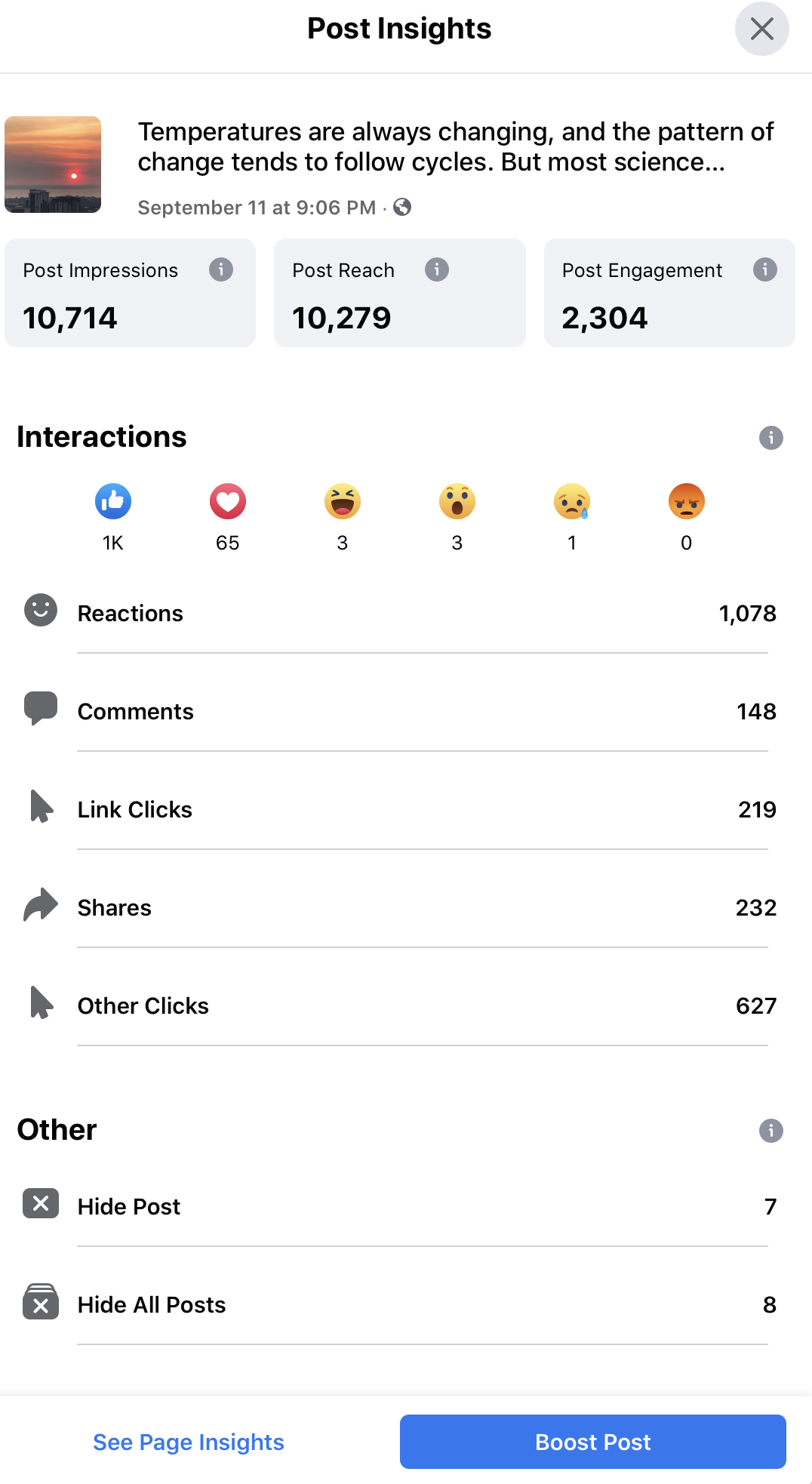
Interestingly when I cross posted this at Facebook it was very popular with more than 10,000 impressions:

Just filing this here.

Filed Under: Information Tagged With: Sun, temperates

Knowing All the Species of Coral at Pixie Reef

September 9, 2021 By jennifer

Everyone loves the Great Barrier Reef, particularly its corals. Everyone knows that a reef has different species of coral. But how many species should an average inshore reef have? How many corals are there at Pixie Reef, which is so close to the city of Cairns.

Such inshore reefs are apparently in terminal decline.

Flying at 150 metres altitude above Pixie Reef on 22nd March 2016 Peter Ridd’s nemesis, Terry Hughes, classified this reef as more than 65% bleached. This result was incorporated with flypasts from other reefs and reported by the media around the world as the Great Barrier Reef being more than half dead. But the names and numbers of the actual coral species that were bleached was never recorded.

School children around the world are now taught, based on the work of Hughes and others, that there is a need to fundamentally reject current sources of energy and many of our freedoms, in order to avoid mass ecosystem collapse — most specifically of the Great Barrier Reef. In short, the flypasts have become a source of Ativan great anxiety and a reason to support an economic and social reset.

I first visited Pixie Reef with marine biologist Stuart Ireland on 25th November 2020. Stuart suggested we dive Pixie because we didn’t have much time to test a method for measuring the diameter of the massive bolder corals that have growth rings like tree rings before leaving for a week at sea. We went back to Pixie reef in February 2021, again because it was conveniently close to Cairns, and I wondered how much photographic and video data on that one small reef we could gather via transects in just two days. Two days was as far was my budget would stretch at that time.

I wasn’t particularly surprised that we found the reef in such obviously good health and without bleaching, despite being listed in the supplement to an article in a most prestigious of marine science journals as mostly bleached. Indeed, there is no longer a good correspondence between what is reported in newspapers or scientific journals and reality when it comes to coral reefs.

Nine of the 360 photographs from Pixie Reef taken in February 2021, after importing into Adobe Lightroom. The first arrow is pointing to that section of photograph shown at the top of this blog post, and which two species of coral do you think are shown? Could one of them be a Porites? The second arrow is of course pointing to a massive Porites colony. The third arrow is to that section of photograph reproduced at a much finer scale at the bottom of this blog, showing the coral colony to be Echinopora lamellose (see below).

From the two days of diving, and thanks to the hard-work and expertise of both Stuart and underwater photographer Leonard Lim, I came away with 36 video transects and also 360 photographs taken at regular intervals along 36 x 10 metre transects across three habitats: back lagoon to 11 metres depth, front of the reef to 6 metres, and also at the shallow reef crest. Each of these 360 photographs has been uploaded at my ‘Pixie Reef Data Page 2021’. The videos will be incorporated into a documentary film about Pixie Reef.

This reef may have experienced some bleaching in March 2016 — coincident with a period of minimum lunar declination and a super El Nino. But I am unaware of any photographs or video taken at that time that document in any systematic way the extent of the bleaching. And to reiterate, it is unclear which species of coral bleached. My 360 photographs were taken five years after the acclaimed bleaching of 2016. These photographs, from February 2021, suggest Pixie reef has recovered from that cycle of bleaching.

I hypothesis that this coral reef will bleach again in the summer of 2034/2035, so in about 13 years time corresponding with the next period of minimum lunar declination which I forecast will contribute to a super El Nino.

In the meantime there is perhaps an opportunity to document the number of species of coral at Pixie Reef that I hypothesis will increase over this next ten year period. In short, I’m curious to know how many coral species there are at Pixie reef for this moment in time, and if the number increases at least until 2034.

Does anyone want to guess how many different species of coral are in just the nine photographs (shown above), that are part of Table 2.1 at the Pixie Reef Data Page 2021.

Does anyone want to guess how many different species of coral might be listed for this inshore reef as at February 2021 when all the photographs are assessed? I want to know out of curiosity, and also because these same corals are essentially denied by the experts who have told the world that such coral reefs are so badly bleached they are to be pitied rather than acknowledged. Interestingly, Peter Ridd also has little time for such coral reefs, referring to them in his book (Reef Heresy) as the “mediocre fringing reefs” simply because they are “inshore reefs”. Yet as I will show, Pixie reef is not only incredibly biologically diverse but also beautiful.

I want to show and quantify this diversity, and also I’m most curious to know how long the list for the back lagoon will be, relative to the crest. At the moment the experts make no distinction between these very different habitat types at the one inshore reef when they lament coral bleaching in the popular press.

It is going to be a lot of work classifying all the species in the 360 photographs. But not impossible because the original photographs are of such high quality, providing extraordinary resolution at the scale of the corallite. Then there are such wonderful resources, including the three volumes of Charlie Vernon’s ‘Corals of the World’.

This is a close-up section of photograph #113. Colonies of the coral species Echinopora lamellose are thin laminae typically arranged in whorls or tiers, and in this section of photograph, I can also see some tubes. The red arrow is pointing to a corallite, a structure used extensively for identification to species. Photo credit: Leonard Lim.

****

This research is funded by the B. Macfie Family Foundation through the Institute of Public Affairs. All images are from photographs taken by Leonard Lim at Pixie Reef on 22nd or 24th February 2021.

I am so grateful to Peter Ridd for gifting me the three volumes of Charlie Vernon’s fabulous ‘Corals of the World’.
Have I got these four species of bottlebrush coral correctly ID-ed?

Filed Under: Information Tagged With: Great Barrier Reef

  • « Go to Previous Page
  • Go to page 1
  • Go to page 2
  • Go to page 3
  • Go to page 4
  • Go to page 5
  • Interim pages omitted …
  • Go to page 71
  • Go to Next Page »

Primary Sidebar

Recent Comments

  • Ian Thomson on Vax-ed as Sick as Unvax-ed, Amongst My Friends
  • Dave Ross on Vax-ed as Sick as Unvax-ed, Amongst My Friends
  • Dave Ross on Vax-ed as Sick as Unvax-ed, Amongst My Friends
  • Alex on Incarceration Nation: Frightened of Ivermectin, and Dihydrogen monoxide
  • Wilhelm Grimm III on Incarceration Nation: Frightened of Ivermectin, and Dihydrogen monoxide

Subscribe For News Updates

  • This field is for validation purposes and should be left unchanged.

December 2025
M T W T F S S
1234567
891011121314
15161718192021
22232425262728
293031  
« Jan    

Archives

Footer

About Me

Jennifer Marohasy Jennifer Marohasy BSc PhD has worked in industry and government. She is currently researching a novel technique for long-range weather forecasting funded by the B. Macfie Family Foundation. Read more

Subscribe For News Updates

Subscribe Me

Contact Me

To get in touch with Jennifer call 0418873222 or international call +61418873222.

Email: jennifermarohasy at gmail.com

Connect With Me

  • Facebook
  • LinkedIn
  • RSS
  • Twitter
  • YouTube

Copyright © 2014 - 2018 Jennifer Marohasy. All rights reserved. | Legal

Website by 46digital