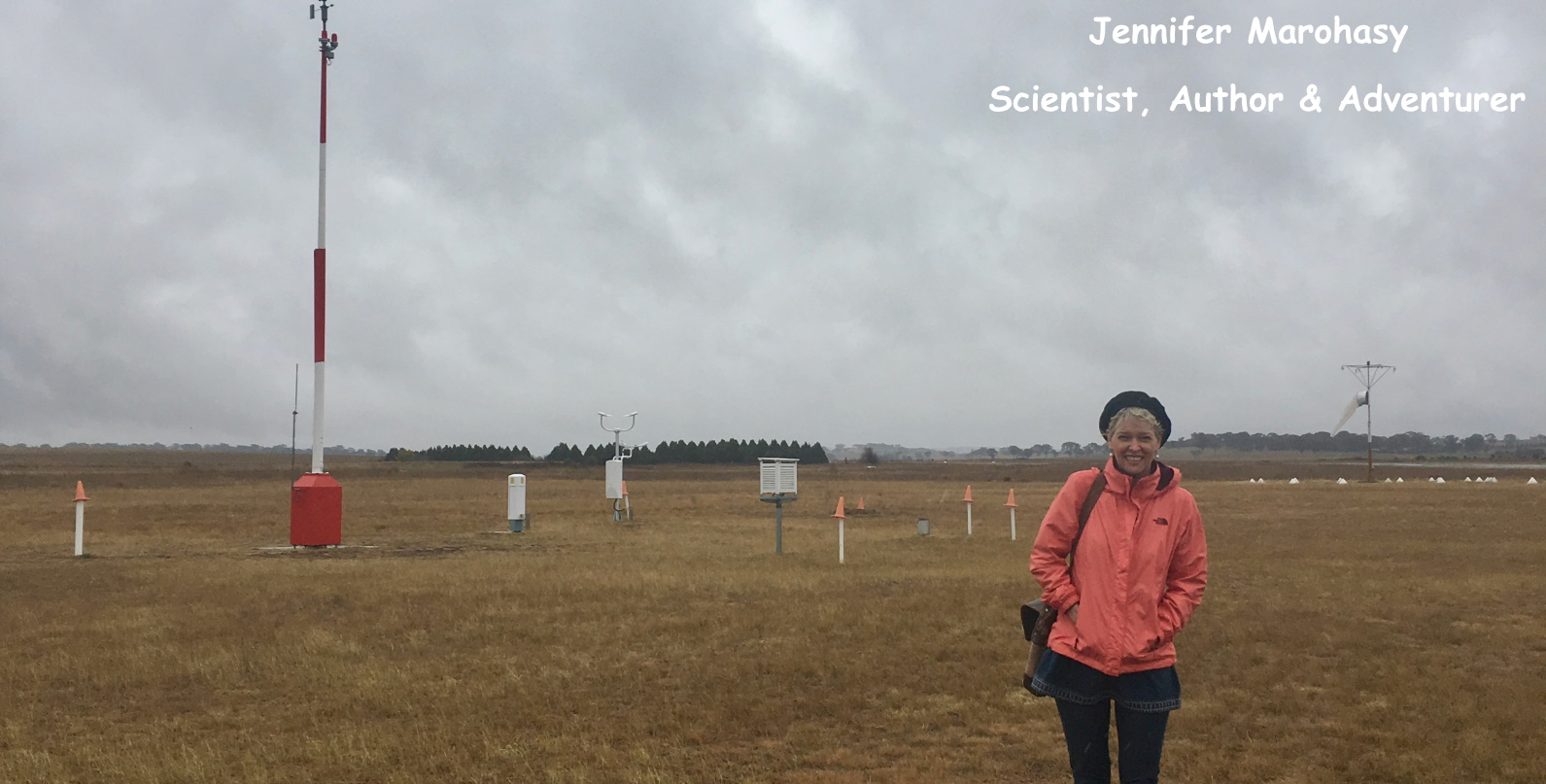
• Skip to primary navigation
  • Skip to main content
  • Skip to primary sidebar
  • Skip to footer
Jennifer Marohasy

Jennifer Marohasy

a forum for the discussion of issues concerning the natural environment

  • Home
  • About
  • Publications
  • Speaker
  • Blog
  • Temperatures
  • Coral Reefs
  • Contact
  • Subscribe

jennifer

Bureau Still Limiting Cooling to Minus 10 Degrees

July 18, 2017 By jennifer

TWO weeks ago, in response to my queries the Australian Bureau of Meteorology acknowledged that it had put in place limits on the lowest temperature that an individual weather station could record.  So, when the automatic weather station which now operates in the town of Goulburn (not far from Canberra), recorded a measurement of minus 10.4 degree Celsius, the ‘quality control’ system in place ‘corrected’ this to minus 10.0 degree Celsius. None of this is denied.  When we protested, the Bureau emailed:

“The correct minimum temperature for Goulburn on 2 July, 2017 is -10.4 recorded at 6.30am at Goulburn Airport AWS… The Bureau’s quality control system, designed to filter out spurious low or high values was set at -10 minimum for Goulburn which is why the record automatically adjusted.

The error was picked up yesterday internally and quality control processes are being reviewed for those stations where temperatures below -10 are possible.

Further attempts at clarification have been met with stonewalling. Though after three days the Bureau did insert the correct measurement of -10.4 degree Celsius into the CDO dataset, where -10.0 had previously been showing.

I reported some of this in a note for The Spectator.

I had assumed that after this unfortunate incident the Bureau would remove the new absurd limits on how cold a temperature could actually be measured.   Indeed, the implications for the integrity of invaluable historical meteorological records are too horrible to contemplate.

I suffer, however, from a propensity to always check things.  So, when I thought temperatures might yet again dip below -10.0 degrees Celsius somewhere, I set my alarm for 5am, to get up early that morning to check (yes check) the values actually being recorded by the new automatic weather stations — particularly those scattered across the Australian Alps, given the weather-setup.  Then I would be in a position to subsequently check (yes check), to be sure any values measured below -10.0 were also taken forward into the official raw temperature dataset.

So, last Sunday morning (16 July) I got up at 5am and started checking the latest weather observations for the Snowy Mountains, including the locations of Perisher, Cooma and Thredbo.  At 5.30am the automatic weather station at the Thredbo Top Station (Number 071032) showed -10.4 degrees Celsius. I took a screenshot, and saved it on my computer.
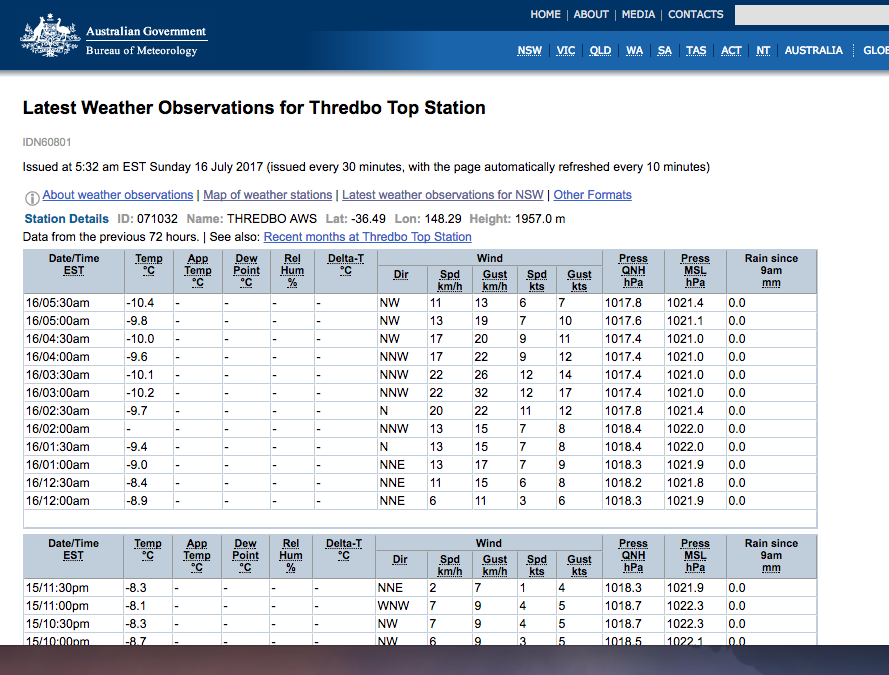
The screenshot taken soon after 5.30am on the morning of Sunday 16th July 2017. This clearly shows the Automatic Weather Station at Thredbo recorded a temperature of -10.4 degree Celsius.

This ‘latest weather observation’ pages automatically refreshes every 10 minutes. So, if this value was going to be erroneously reset to -10.0 — as the Bureau wrongly reset the -10.4 recorded at Goulburn two weeks earlier — I would want the screenshot as evidence.

I thought this would probably be the end of it.  Temperatures have actually got as low as -14.7 at Thredbo Top Station – with this value recorded on 28th July 1980.  Surely the Bureau would not reset the cold, but not exceptionally cold, value of -10.4 at Thredbo that I saw measured at 5.30 by that AWS on Sunday 16th July 2017.

Nevertheless, the next morning (Monday morning) I checked the ‘Daily Weather Observations’ sheet for the Thredbo Top Station at the Bureau website to be sure that the value of -10.4 had indeed been brought forward as the lowest value recorded so far this month at that weather station.

But alas! There was no minimum value recorded for Sunday 16th July.  And the sheet stated that -9.6 was the lowest/the coldest value so far recorded at Thredbo this July 2017.
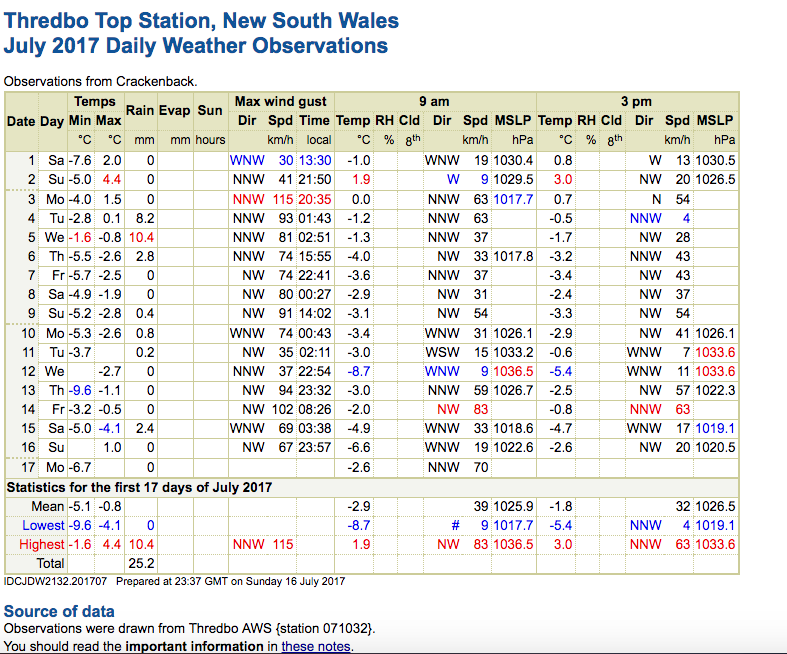
The ‘Daily Weather Observations’ page does not show the lowest minimum recorded on Sunday of -10.4. Rather it suggests no minimum temperature value was recorded on that day.

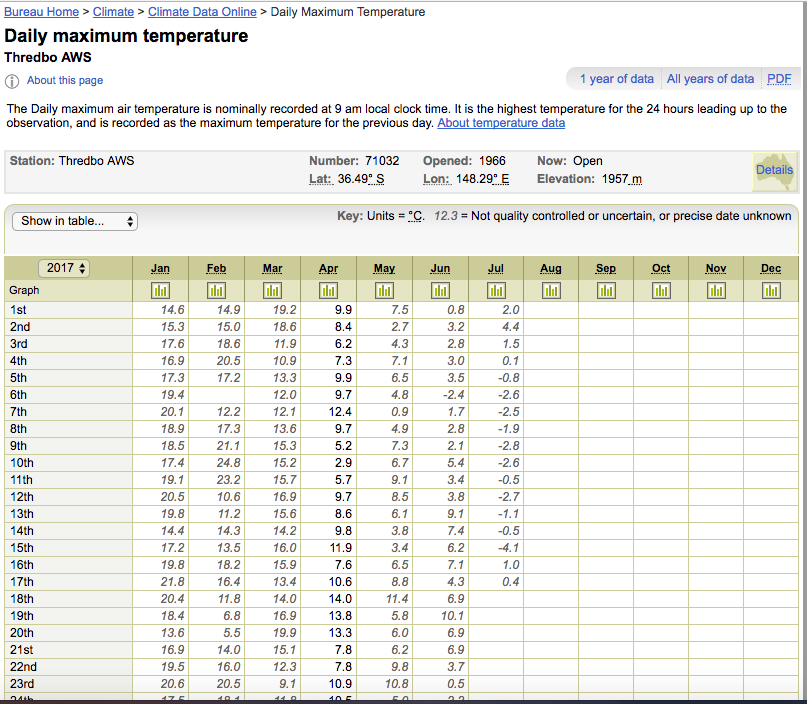
This morning (Tuesday), I held out some hope that the correct value of -10.4 would nevertheless be recorded in the CDO database as the minimum for Thredbo on Sunday 16th 2017. But alas, they are again leaving a blank.
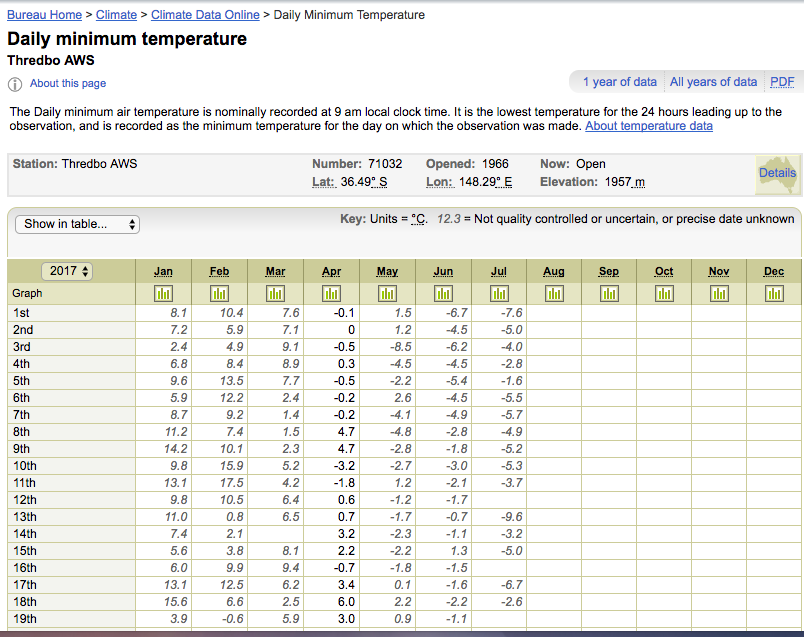
This is a screenshot of the ‘Daily Minimum Temperatures’ for the Thredbo Top Station (number 71032). These are the raw values that comprise the historical record for this location.  The value of -10.4 has not been recorded for Sunday 16th July.

This is unforgiveable, surely someone is going to be sacked?  This either reflects an extraordinary incompetence, or a determination to prevent evidence of low temperatures.

While the Bureau just two weeks ago was adjusting values below -10.0 to -10.0 creating something of a bodge at Goulburn, they now appear to be leaving a blank — at least at Thredbo.

We know from the Climategate emails that the Manager of Climate Monitoring and Prediction at the Bureau, Dr David Jones, has little regard for numbers.  He wrote in an email on 7th September 2007 (ten years ago) that: “Truth be know, climate change here is now running so rampant that we don’t need meteorological data to see it.”


*****

Additional information
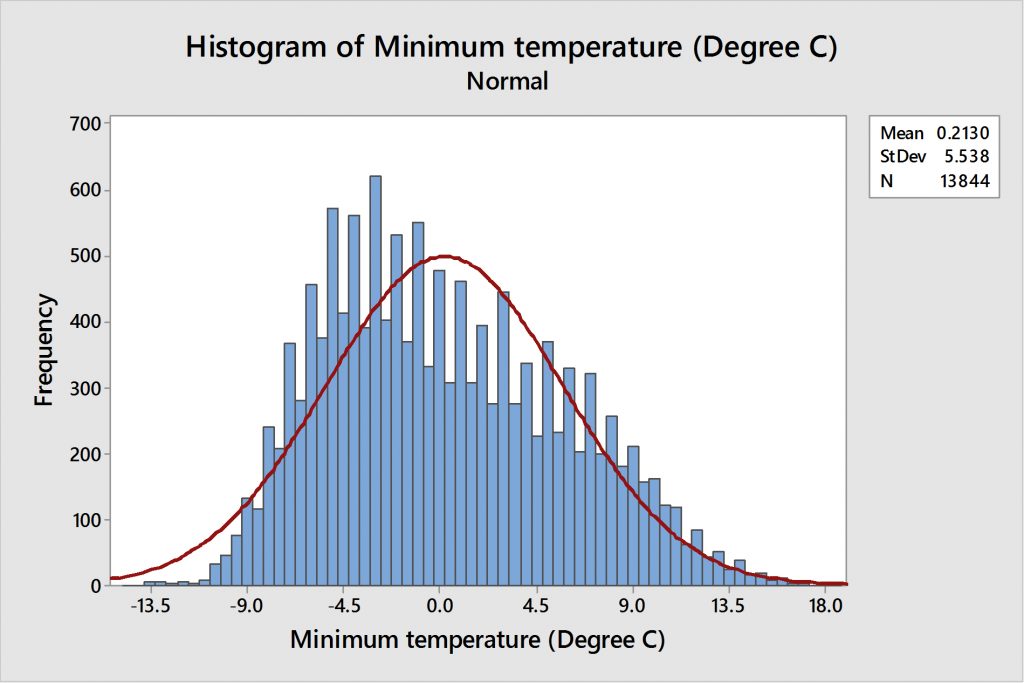
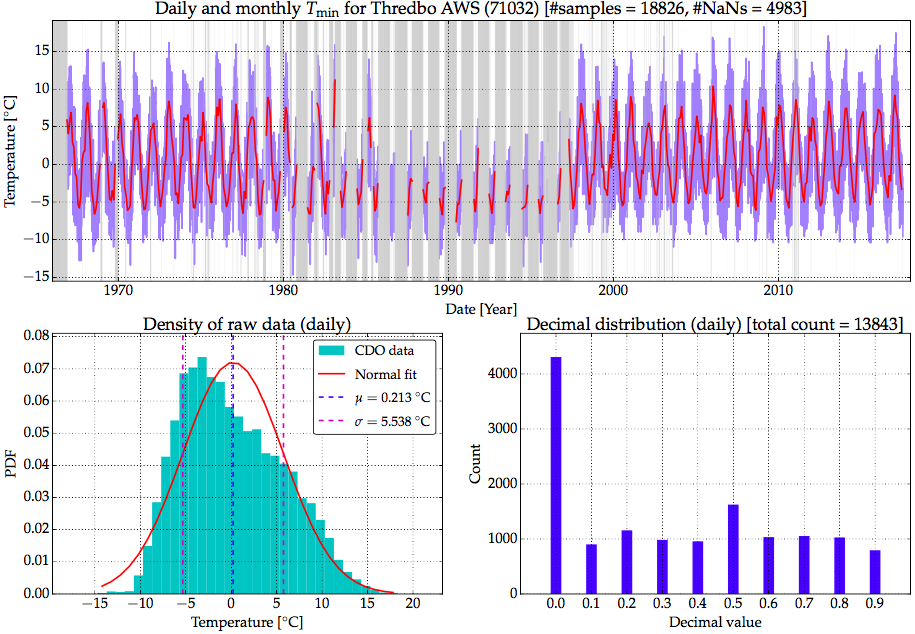
A simple frequency plot of all daily minimum temperatures record at Thredbo Top Station and entered into the CDO dataset indicates that it is likely temperatures will sometime drop below 10.0 degree Celsius.


While there is no minimum value recorded in the CDO dataset for Thredbo, a maximum value was recorded on Sunday 16th July 2017.


Thredbo is skewed normal as many data samples for the warmer months (January to April) are missing for the period from 1981-1997. Then for the period 1997-2003 nearly ALL daily values for Thredbo are rounded to the nearest degree! Thanks to Jaco for this information, and the charts.  [added 20th July]
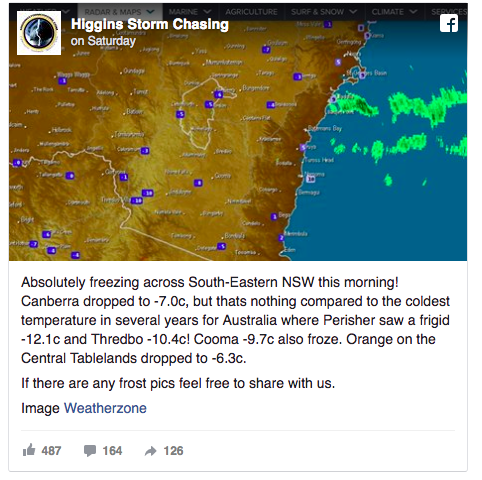
The Higgins’s Storm Chasing crew also noticed the very cold -10.4 at Thredbo. Like me they must have been up early checking – because this temperature record has since been erased. More information about how cold it was that morning can be found here: https://www.sunshinecoastdaily.com.au/news/coldest-temperature-years-australia-shivers/3200942/ .  Thanks to Bob F-J for this link, and image. [added 20th July]

Filed Under: Information Tagged With: Temperatures

In Search of a New Way

July 7, 2017 By jennifer

FIFTY years ago, on 7 July 1967, Time magazine ran a cover story entitled, ‘The Hippies: Philosophy of a Subculture’.   Modern environmentalism is in some ways a product of this Flower Power movement, but a still-born version.

It has become replete with particular moral codes – right ways of doing things – ostensibly underpinned by a scientific consensus.   Yet most leading environmentalists live energy-intensive lifestyles.  They profess to a relationship with nature, yet they have limited first-hand experience of it.  They claim their authority from science – yet they are intolerant of scepticism.

More than ever we need a new approach.  One that is free of the patriarchy so deeply embedded in the Christian tradition.  But one that is also free of the hypocrisy and intolerance that underpins an emerging new value system that places a premium on being extraverted, optimistic, popular – and passionate.

In reality the Earth is a harsh, though beautiful place. A more meaningful and resilient existence might be found with less hubris and more nature.

Filed Under: Philosophy Tagged With: Philosophy

Bureau Now Sets Strict Limits on Cooling

July 5, 2017 By jennifer

OVER recent years I have documented the blatant remodelling of temperature measurements through the process of homogenisation. I have explained that it is the homogenised datasets that are used to report climate change by the Australian Bureau of Meteorology and the CSIRO.   I had assumed, however, that the raw data, kept in the CDO dataset, represented actual measurements.

Until late yesterday.

Late yesterday it was brought to my attention that the Bureau actually sets a strict lower limit on the extent to which a weather station can record a cold temperature.

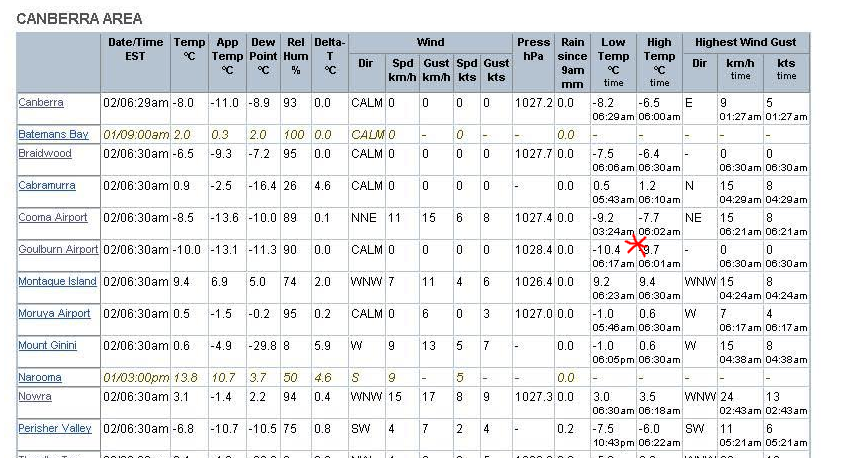
So, when the weather station at Goulburn recorded -10.4 on Sunday morning – the Bureau’s ‘quality control system’, ‘designed to filter out spurious low or high values’ reset this value to -10.0.

To be clear, the actual measured value of -10.4 was ‘automatically adjusted’ so that it recorded as -10.0 in the key CDO dataset.

This is how the Bureau has attempted to explain away my concern that the -10.4 measurement as recorded in the Bureau’s observation sheet at 6.17am on Sunday morning, was not carried forward to the CDO dataset.

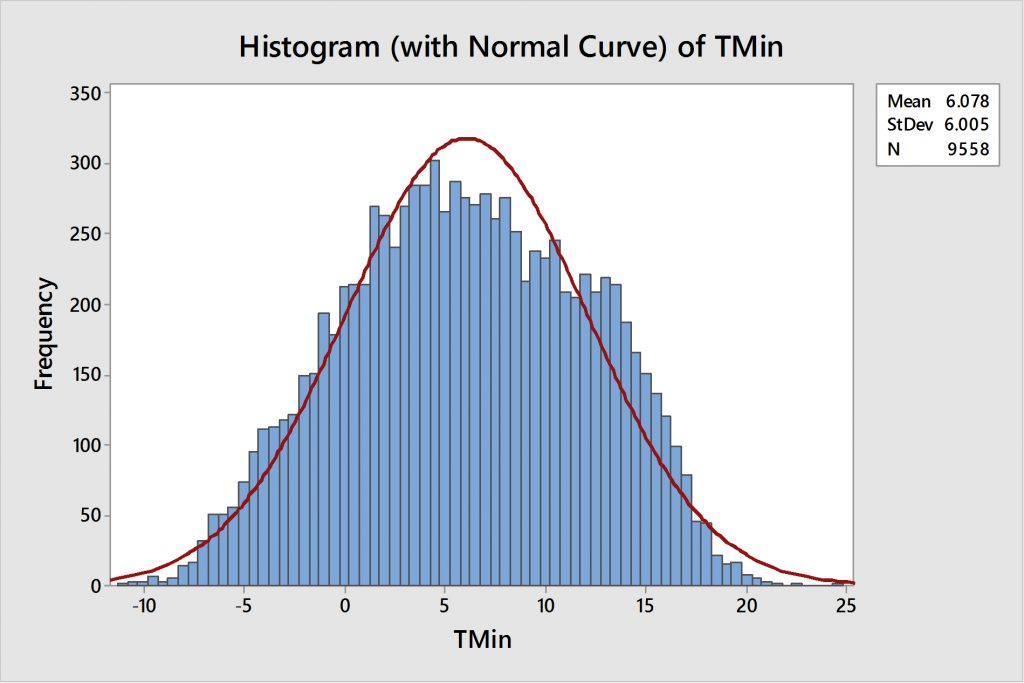
While it is reasonable to expect that the Bureau would have procedures in place to prevent the measurement of spurious temperatures, a simple frequency plot of minimum temperatures as recorded at Goulburn indicates that temperatures below -10.0 would be expected.

A simple histogram of daily minimum temperatures as recorded at Goulburn airport (station number 70330) from July 1990 to yesterday.

Which begs the question: Q1. When exactly was the limit of the daily minimum temperature for Goulburn set at -10.0 degree Celsius?

We have known for some time that through the process of homogenisation the Bureau practices historical revisionism – whereby adjustments are made to measurements so that regional and national trends better fit the theory of anthropogenic global warming – what I can now report is that procedures have also been put in place to limit the extent to which the actual measurements from individual weather station represent reality.

In particular at Goulburn, the weather station is set to adjust any value below -10.0, to -10.0.  Yet temperatures of -10.9 and -10.6 were recorded at Goulburn in 1994 – just a few years after the weather station was installed there.

So, a second question: Q2. How was it determined that temperatures at Goulburn should not exceed a minimum of -10.0?  

*******************************************************

Update 2.30 pm AEST on 6 July 2017

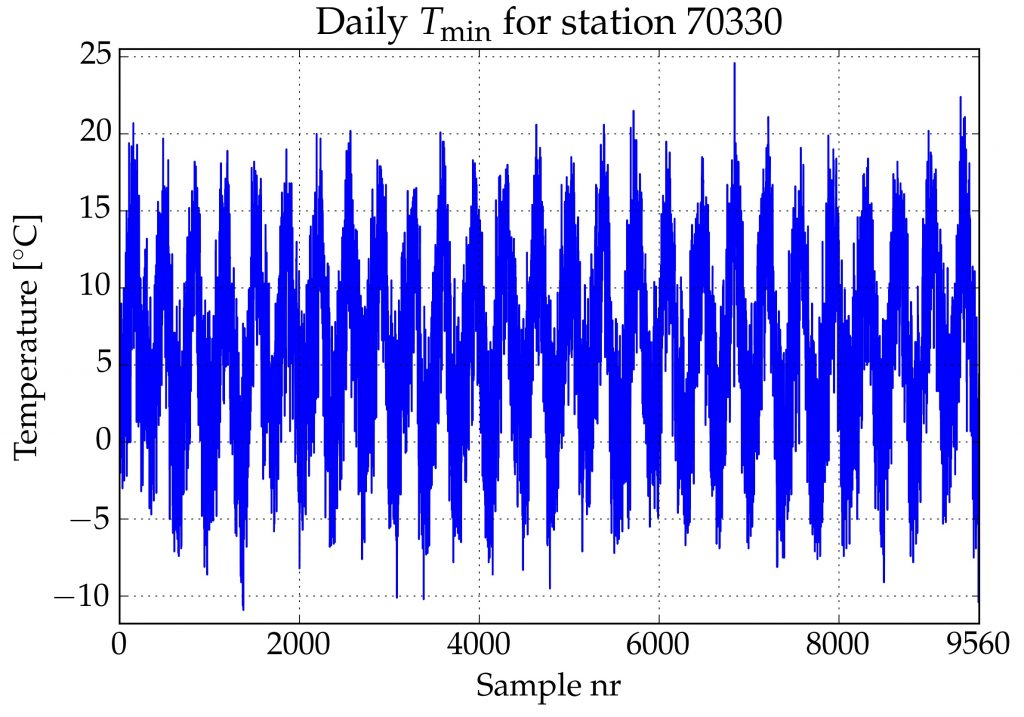
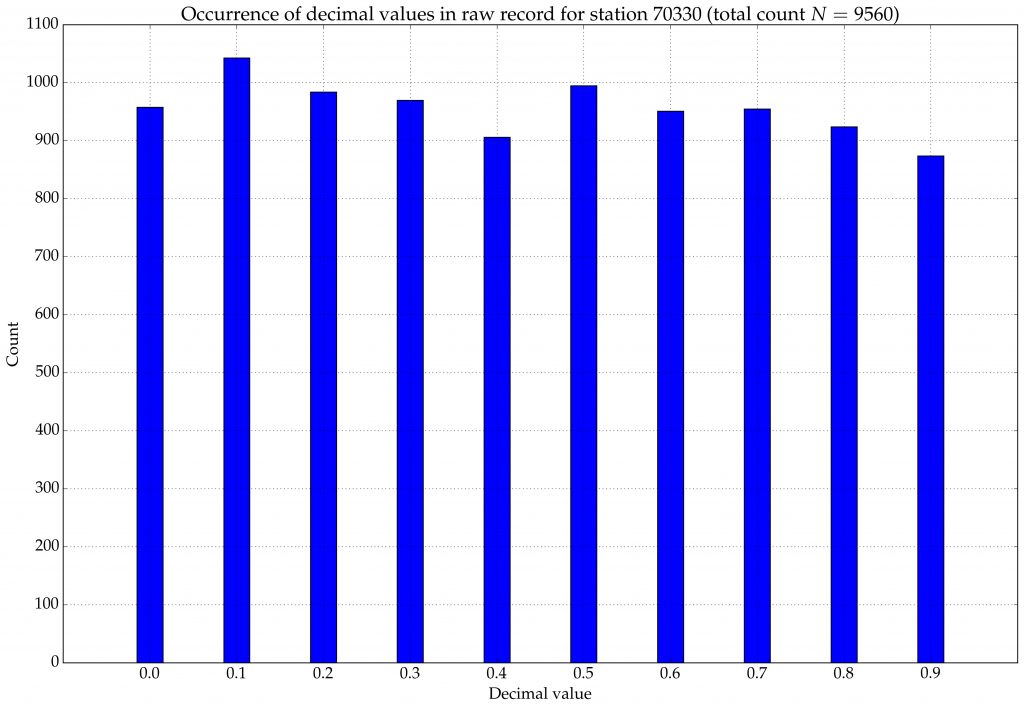
The following two charts from Jaco Vlok provide further insight into the Goulburn daily TMin data as recorded in the CDO dataset.

A time series plot of all minimum daily temperatures as recorded by the Bureau at Goulburn.
This chart shows an approximate uniform distribution of the first decimal value for the Goulburn data, there is therefore no evidence of data tampering.  Data tampering often results in an uneven distribution.

There is no unusual spike in the occurrence of -10.0.

Filed Under: Information Tagged With: Temperatures

Bureau Erases Goulburn Record Minimum Temperature: Set Sunday 2 July 2017

July 4, 2017 By jennifer

GOULBURN is a town, to the southwest of Sydney, known for its maximum-security prison. It is also a place, that by Australian standards gets quite cold. Temperatures have been measured at the airport since 1988, and the lowest temperature ever record in July is officially -9.1 degrees Celsius.

In fact, Sunday morning this record was smashed!

It got down to -10.4 degrees Celsius, at 6.17am on Sunday 2nd July. This was the official Bureau recording for Goulburn.

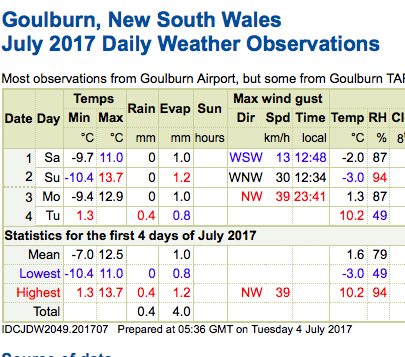
The observation sheet shows a minimum of -10.4, this temperature is recorded every second and downloaded every minute. The lowest value recorded becomes the minimum for the day. Except the Bureau has not recorded this value as the minimum.

Except, the Bureau has since erased this measurement.

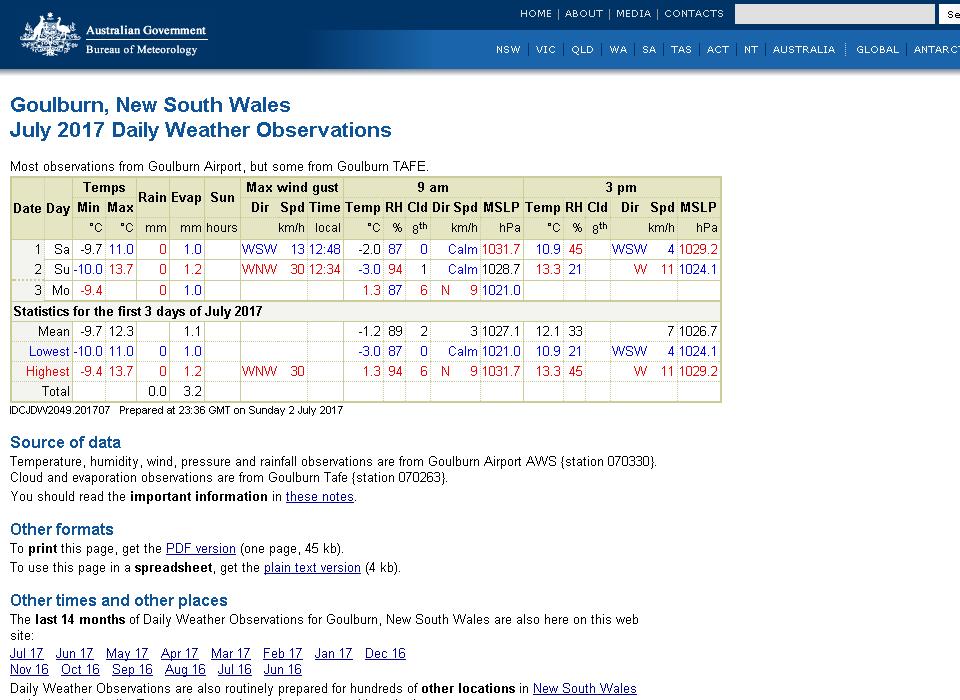
According to the Bureau’s own rules, the coldest temperature record during a 24-hour period to 9am is recorded as the minimum for that day. So, for Sunday 2 July the carry-over minimum should be -10.4 degrees Celsius. But instead the summary documentation shows -10.0. There is now no public record of -10.4 degrees Celsius.

The summary for Goulburn for Sunday 2 July 2017 incorrectly shows the minimum as -10.0 degree Celsius. It would be inconsistent with global warming theory for the current record to be smashed by a whole 1.3 degree Celsius. So, the Bureau homogenise the temperature record, changing the actual measurement to something more consistent with their perception of how reality should be – with what temperature should be.

I would have the managers at the Bureau put in the Goulburn jail.

*****

Update 9pm Tuesday evening

So, the Bureau has now acknowledged that it really was -10.4 degree Celsius at Goulburn on Sunday morning, and corrected the ‘Daily Weather Observations’ page for Goulburn.

By Tuesday evening this ‘Daily Observations’ sheet had been corrected, now showing -10.4 degree Celsius for Goulburn on Sunday morning.

However, the Bureau has so far not updated the key CDO Online database, the official record of temperatures for Goulburn airport.  This is the dataset used to calculate regional, national and global temperatures.  Rather than replace the bogus -10.0 degree Celsius with the correct -10.4, they are leaving a blank.   Not good enough.

*****

Update 6am Tuesday 10 July 

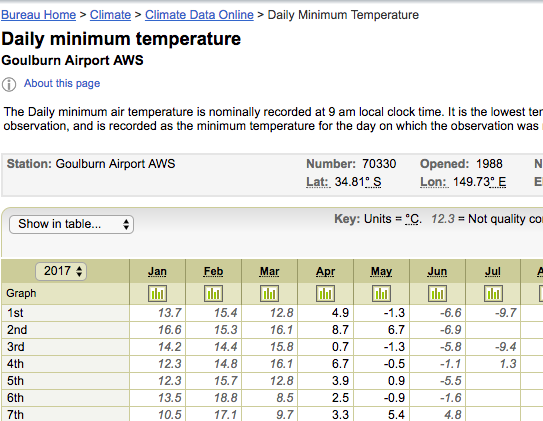
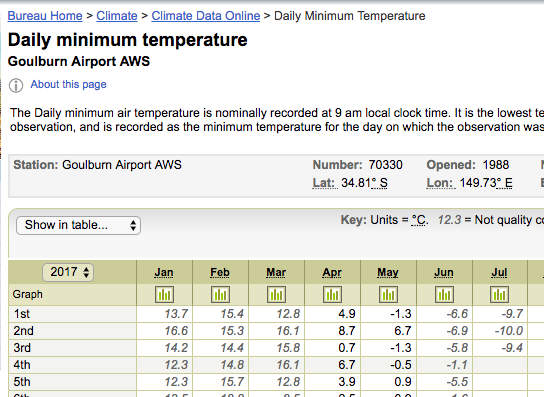
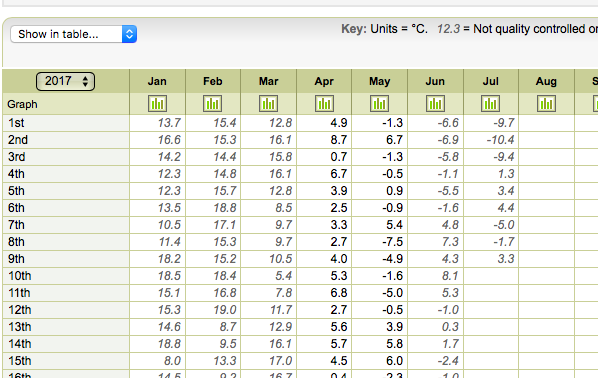
The following screenshot is provided as further evidence that the Bureau’s ‘quality control’ changed the actual reading of -10.4, to -10.0 which was then entered into the CDO database.  After protests the -10.0 value was removed and no reading recorded.  After more protests, the correct value of -10.4 was inserted.  This is unprecedented.

In this screenshot, taken on the morning of Tuesday 4 July, the bogus value of -10.0 has been entered into the CDO database.

It was not until two days later that the correct value was inserted, as shown in the following screen shot – taken this morning.

Filed Under: Information, Uncategorized

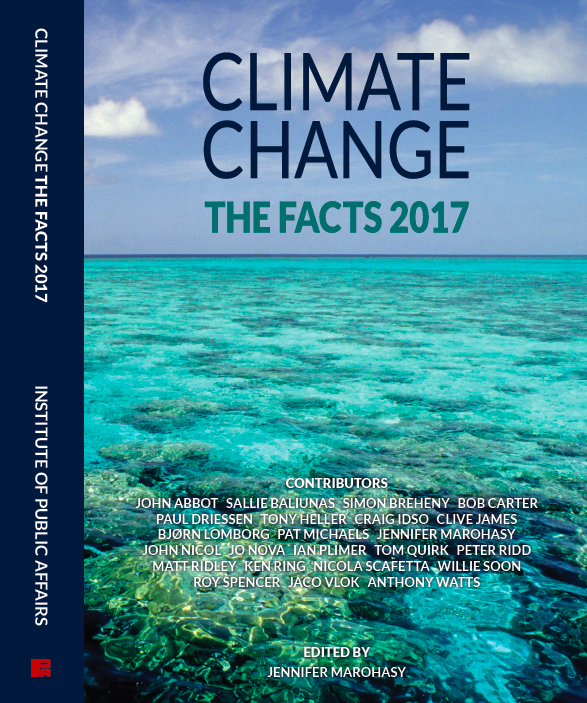
Climate Change: The Facts 2017

June 3, 2017 By jennifer

Today’s Weekend Australian includes an article that begins:

“Iconic, ailing Australian satirist Clive James has penned a savage essay on climate change alarmism, controversially cooking everyone from Barack Obama to Kevin Rudd to Tim Flannery to Al Gore to Donald Trump in the boiled and rising ocean of his wit…”

The essay in The Inquirer section of the same newspaper is an extract from chapter 22 of the book I have been working on for many months now.


front cover of book

Contributors to Climate Change: The Facts 2017 do not conform to a unitary view.   As I explain in the book’s introduction:

“An advantage of my approach in the compiling of the chapters for this book – an approach where there has been no real attempt to put everything into neat boxes – is that there are many surprises. I am referring to the snippets of apparently anomalous information scattered through the chapters. These can, hopefully, one day, be reconciled. As this occurs, we may begin to see the emergence of a coherent theory of climate – where output from computer-simulation models bears some resemblance to real-world measurements that have not first been ‘homogenised’.

“There are many chapters in this book about ‘homogenisation’ (chapters 5, 6, 7, 8 and 9 by Anthony Watts, Tony Heller, Dr Tom Quirk, Jo Nova and me, respectively). Homogenisation, in essence, involves the remodelling of data, and is now a technique integral to the development of key official national and global measures of climate variability and change – including those endorsed by the IPCC.

It is generally stated that without homogenisation temperature series are unintelligible. But Dr Jaco Vlok from the University of Tasmania and I dispute this – clearly showing that there exists a very high degree of synchrony in all the maximum temperature series from the State of Victoria, Australia – beginning in January 1856 and ending in December 2016 (chapter 10). The individual temperature series move in unison suggesting they are an accurate recording of climate variability and change. But there is no long-term warming trend. There are, however, cycles of warming and cooling, with the warmest periods corresponding with times of drought.

Indeed, some climate sceptics consider the homogenisation technique used in the development of the official temperature trends to be intrinsically unscientific. They consider homogenisation a technique designed to generate output consistent with the computer-simulation models, which, in turn, are integral to the belief that there are consistent year-on-year temperature increases – contrary to the actual measurements. Temperature series that are a product of homogenisation could be considered ‘alternative facts’ – although, ironically, this is a term newly minted by those who generally agree with these self-same homogenised (remodelled) temperature constructs.”

Climate Change: The Facts 2017 is available for pre-order http://thefacts2017.ipa.org.au

Media enquiries should be directed to the IPA’s Media and Communications Manager, Evan Mulholland on 0405 140 780 or emulholland@ipa.org.au

Filed Under: Books Tagged With: climate change

Australia’s Hottest Day on Record Ever – Deleted

February 13, 2017 By jennifer

The last few days have been very hot across eastern Australia. The mainstream media have been reporting ‘unprecedented’ conditions. This fits a popular narrative, but its inconsistent with the original historical record.

It was very hot in Australia in the late 1800s and the early years of the 1900s, particularly in outback Australia – at places like Bourke. Many of the extremely hot days were recorded using non-standard equipment, and so they are not recognised by Australia’s Bureau of Meteorology. Outrageously though, the Bureau has deleted from the raw digitised record the hottest day ever recorded in standard equipment at an official weather station. Ostensibly, because it was recorded on a Sunday – the day that the temperature-recorders normally had off in the days of manual temperature recordings.

No doubt the fellow who recorded temperatures from the thermometer in the Stevenson screen at the Bourke post office got up on the morning of Sunday 3rd January 1909, and decided he was going to work anyway. He was not going to miss what did turn out to be the hottest day of the century.

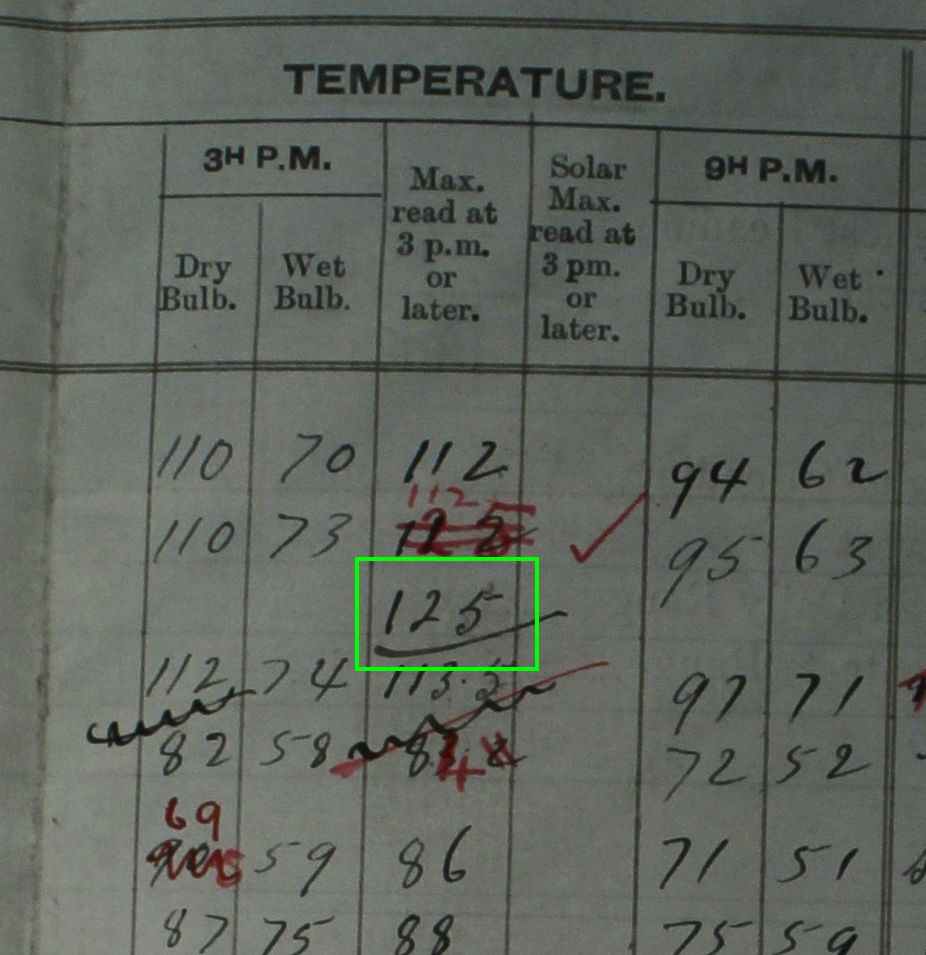
So, when I went to the trouble of getting access to the log book, now held by the National Archives of Australia, I could see that the fellow had not only written in 125 degree Fahrenheit (equivalent to 51.6 degree Celsius) – he had also underlined it!

I took a photograph of the entry, Exhibit 1.

Exhibit 1. Photograph from log book of temperature recording as made at Bourke post office in January 1909.   Photograph taken by Jennifer Marohasy at National Archives of Australia, Chester Hill reading room, on 26 June 2014.
Exhibit 1. Photograph from log book of temperature recording as made at Bourke post office in January 1909. Photograph taken by Jennifer Marohasy at National Archives of Australia, Chester Hill reading room, on 26 June 2014.

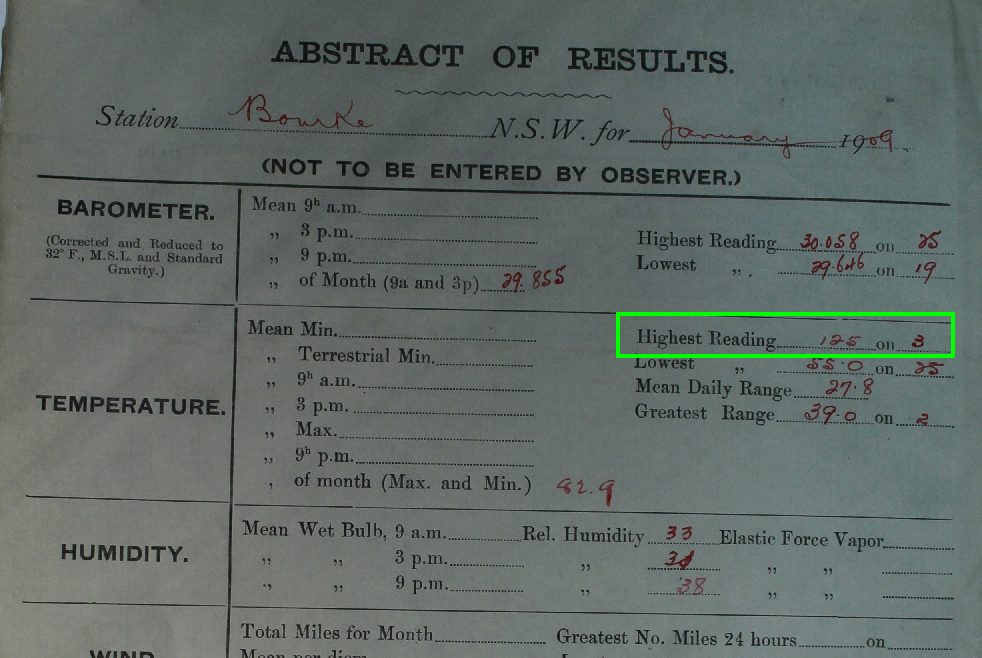
Back then the person who recorded the temperatures each day, known as the ‘Observer’, was not the same person who compiled the ‘Abstract of Results’ at the end of the month. This supervisor (who used a red pen) sometimes made changes to temperatures as recorded by the Observer; and seems to have been initially confused as to the actual temperature on Saturday 2nd January 1909 at Bourke (originally changing it from 112 to 125).

Exhibit 2. 'Abstract of Results' page from the log book.   Photograph taken by Jennifer Marohasy at the National Archives of Australia, Chester Hill reading room on 26 June 2014.
Exhibit 2. ‘Abstract of Results’ page from the log book. Photograph taken by Jennifer Marohasy at the National Archives of Australia, Chester Hill reading room on 26 June 2014.

The supervisor was clear in his summary though, writing in red that the highest temperature at Bourke for the month of January 1909 was 125 degree Fahrenheit recorded on 3rd January, as shown in Exhibit 2.

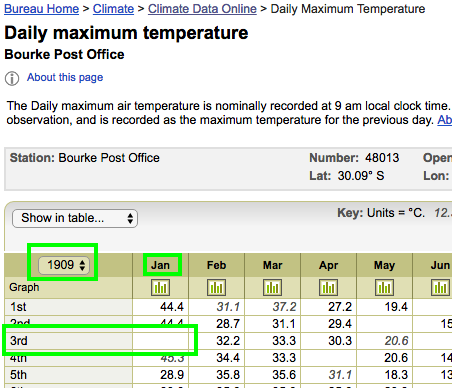
But if you go to the raw temperature data at the Australian Bureau of Meteorology’s website, there is no entry for this date, as shown in Exhibit 3.

Exhibit 3.  The 'raw data' as archived at the Bureau of Meteorology website has no entry for 3 January 1909.
Exhibit 3. The ‘raw data’ as archived at the Bureau of Meteorology website has no entry for 3 January 1909.

****

If you like what I do, consider making a goodwill contribution.

Filed Under: Information Tagged With: Temperatures

  • « Go to Previous Page
  • Go to page 1
  • Interim pages omitted …
  • Go to page 22
  • Go to page 23
  • Go to page 24
  • Go to page 25
  • Go to page 26
  • Interim pages omitted …
  • Go to page 445
  • Go to Next Page »

Primary Sidebar

Recent Comments

  • Ian Thomson on Vax-ed as Sick as Unvax-ed, Amongst My Friends
  • Dave Ross on Vax-ed as Sick as Unvax-ed, Amongst My Friends
  • Dave Ross on Vax-ed as Sick as Unvax-ed, Amongst My Friends
  • Alex on Incarceration Nation: Frightened of Ivermectin, and Dihydrogen monoxide
  • Wilhelm Grimm III on Incarceration Nation: Frightened of Ivermectin, and Dihydrogen monoxide

Subscribe For News Updates

  • This field is for validation purposes and should be left unchanged.

December 2025
M T W T F S S
1234567
891011121314
15161718192021
22232425262728
293031  
« Jan    

Archives

Footer

About Me

Jennifer Marohasy Jennifer Marohasy BSc PhD has worked in industry and government. She is currently researching a novel technique for long-range weather forecasting funded by the B. Macfie Family Foundation. Read more

Subscribe For News Updates

Subscribe Me

Contact Me

To get in touch with Jennifer call 0418873222 or international call +61418873222.

Email: jennifermarohasy at gmail.com

Connect With Me

  • Facebook
  • LinkedIn
  • RSS
  • Twitter
  • YouTube

Copyright © 2014 - 2018 Jennifer Marohasy. All rights reserved. | Legal

Website by 46digital