There is no opinion, however absurd, which men [and women] will not readily embrace as soon as they can be brought to the conviction that it is generally adopted.
Archives for May 2006
Ann Novek & A White Swan
Ann Novek was once a medical student, but quit to work as a wildlife rehabilitator. She works mostly with birds, and has a special interest in helping birds affected by oil spills.
Here’s a picture of a swan being cleaned after an oil spill, Ann’s in the yellow jacket.

She’s also a Greenpeace Nordic volunteer involved mostly in ocean issues and a new reader and commentator at this blog.
Ann lives somewhere in Sweden and has her garden fenced to keep out cats making it a “little bird heaven”. I assume the fence also keeps out the the many roe deers which according to Ann roam around in people’s gardens in Sweden eating tulips and apple trees.
In Brisbane, in Australia where I live, it is possums that roam around gardens eating roses and destroying vegetable gardens.
—————————————————-
Ann, thanks for sharing the photograph and something about yourself.
More Confident & More Precise: Next Year’s IPCC Report
The IPCC is intending to release its Fourth Assessment Report (AR4) in three parts next year. Part 1 is likely to be launched in early 2007 and focus on the physical basis for climate change. Part 2 is likely to be released mid year and focus on impacts of global warming while Part 3 will be released later in the year and focus on how to mitigate climate change.
In this week’s journal Nature (Vol 441, 6-7, 4 May 2006) there is information about the climate change predictions in the current draft of Part 1, including:
“The current draft, which represents the message that the scientific authors want to present to policy-makers, contains few statements that will surprise climate researchers, but its tone is much more confident than that of its predecessor, published in 2001. And that, say researchers, will make it harder for sceptical politicians and lobbyists to attack climate predictions.
“People won’t be punching holes in the science,” says Jay Gulledge, a senior research fellow at the Pew Center on Global Climate Change in Arlington, Virginia. Emily Shuckburgh, a climate researcher at the University of Cambridge, UK, agrees: “If you’re a sceptic, it’s difficult to see where to attack on the modelling side.”
One critical number in previous reports has been the sensitivity of the climate to increases in greenhouse-gas levels. In 2001, scientists estimated that a doubling of carbon dioxide levels would cause an increase of 1.5–4.5 °C, but acknowledged that this range was little more than a best guess. The draft 2007 WGI report describes how new models and data sets allow the range to be properly quantified. It estimates the effect of doubling carbon dioxide as a rise of 2.0–4.5 °C and, for the first time, suggests a single most likely figure: 3 °C. This estimate is already widely accepted by climate scientists.
Another set of predictions that have become much more robust are those about ‘commitment’ — the ongoing climatic changes that would be expected even if greenhouse-gas levels could be stabilized. The existence of commitment was acknowledged in the last WGI report, but no number was given in the policy-makers’ summary. In contrast, the 2007 summary stresses that even if greenhouse gases level off now, warming will continue at about the current rate for several decades.
The error bars have also shrunk substantially on one of the biggest uncertainties in 2001 — the role of aerosols such as soot from fires, which exert a cooling effect by reflecting sunlight. In addition, certainty over politically important statements about whether climate change has already been observed has increased. Data on twentieth-century changes in precipitation and sea-level rise are now more precise, and the risk of ocean acidification is detailed for the first time. Such assertions are likely to be seized on by environmental groups if they appear in the final document.”
If you have a password, you can access the draft here: http://www.climatescience.gov/Library/ipcc/wg14ar-review.htm .
Archibishop Comments on “Hysterical” Global Warming Claims
According to yesterday’s Sydney Morning Herald, Australia’s most influential catholic, Archibiship George Pell, in a speech to US Catholic business leaders, said Western democracy was … suffering a crisis of confidence as evidenced by the decline in fertility rates and that:
“Pagan emptiness” and Western fears of the uncontrollable forces of nature had contributed to “hysteric and extreme claims” about global warming.
“In the past, pagans sacrificed animals and even humans in vain attempts to placate capricious and cruel gods. Today they demand a reduction in carbon dioxide emissions.”
Elephants to Sweden?
There has been an interesting exchange between Ann in Sweden, David in Tokyo, and others following my blog post of 23rd April titled ‘Norway to Kill More Whales’.
The discussion has now moved from whales to elephants.
I lived in Kenya from 1989 through to late 1992 and visited Zimbabwe and South Africa. It was evident back then that there were too many elephants in southern Zimbabwe, while they were being shot out of Kenya.
I have previously mentioned the book by Raymond Bonner, ‘At the Hand of Man: Peril and hope for Africa’s Wildlife’ (Alfred Knopf, New York 1993, pp 322) which is about the early history of conservation groups in Africa and how their staff in Africa supported trade in ivory. But the fundraisers and executives at their headquarters in Europe and the USA wanted bans … lobbying for a ban on ivory generated membership and donations.
I’ve copied the following comment from David, because it does raise the very real issue of how ‘Africa’ can and should manage its elephants. Elephants can be so destructive and require so much space, and ‘Africa’ is being denied the opportunity to make money from ivory – which could give elephants a local value and in this way aid conservation of the species?
David wrote:
Ann,
Sorry, but your statements do confuse me. 🙂
Countries like Kenya are more than welcome to manage their elephants how they see fit.
However, they campaigned to have a ban on the ivory trade put in place because they had failed to manage their elephant populations, consequently suffering from poaching etc. The problem was, when the ban was imposed in 1989, it led to other nations being forced to abide by the ban even though their circumstances were different.
While Kenya had failed miserably to look after her elephants, nations in Southern Africa had been doing a fine job, and their elephants were in good shape. Here’s the thing – there is a demand for elephant products. Rather than ban this trade, why not permit it, make money from it, and with those funds manage and regulate the industry for the good of conservation?
Read about Zimbabwe’s CAMPFIRE approach to conservation here:
“While economic incentives are indispensable, the programme preaches and practises sustainable consumption as a vehicle for development. This is the language the Zimbabwean people and their ancestors have been practising since time immemorial.”
Unfortunately, NGO groups from the Western world seem to care more about African elephants than they do about African people.
Remembering that all parties agree that conserving elephants is a priority, which do you give more importance Ann? African elephants or African people?
As for relocation, nations in Southern Africa should be under no obligation to relocate their (valuable) elephants to Kenya, a nation which has failed abismally to look after theirs (unless Kenya wishes to pay?).
Even in Kenya, the elephant levels are growing these days – but for how long will the ecosystem be able to sustain continued growth?
Then what? Ship elephants to Sweden perhaps? 🙂
Westerners seem to love them so much, let’s see how they enjoy having them overrunning the local neighbourhood.
David
Thousands of elephants were culled in South Africa last year.
Birds, Bats & Wind Turbines, With Particular Reference to Orange Bellied Parrots: Bob McDonald
I have copied this comment by Bob McDonald from my blog post of 7th April titled ‘MInister Blocks Wind Farm for Orange Bellied Parrots’:
Wind power as generated by turbines with large blades has only recently been discovered to have a significant and avoidable impact on birds and bats. Better siting will provide most of the solution to this problem.
The difficulty is that it is very hard to count birds and bats killed by wind turbines. Predators remove kills quickly and given the size of the turbines and given the maximum blade tip speeds of around 300kph bats and birds killed can end up a considerable distance from the turbines.
Surprisingly birds like white throated needle tails, a large swallow-like bird that migrates annually to Australia feeding and sleeping on the wing, have been among the kills recorded. These birds are not only supreme ‘flyers’ but also use a form of echo location to catch their prey.
Similarly with bats it is surprising they get killed by turbines. In West Virginia the bat mortality generated by turbines only came to light when students camped below turbines and used dogs to find more than 300 dead and injured bats from a couple of dozen turbines over a few moths. This was in 2004.
These problems were not predicted, though it has been known for some time that birds have been struck by blades – but monitoring has been by turbines owners and those paid to host turbines – neither with the incentive report kills.
Companies that build wind turbines seek the most prominent locations to remind potential customers to ‘tick’ the green energy box on their power bill.
The Victorian State Government simply provided a wind atlas to these companies showing where the most reliable winds were as a guide to siting. The same reliable winds may also be used by migrating birds and bats.
Bird migration routes and travelling heights are also poorly understood. The most common known migrations are of species that arrive in flocks in the Australian Summer and depart in the autumn, also in flocks and most often at night.
The conditions at the time of departure and arrival determine what height and to an extent what route these flocks travel at.
To the bird in question, the Orange Bellied Parrot, it is the rarest of 17 species of national and international significance found likely to be killed by turbines if constructed at Bald Hills wetland.
No-one could be reasonably expected to predict the extent and nature of this problem. Now that it has been identified far more care must be taken with the siting of wind turbines and State Governments have a responsibility to decide where wind turbines should not be located.
Some basic rules for siting turbines could be –
1. Not within 30 kilometres of the coast, wetland or lakes. This safety margin is to allow for the full range of weather conditions that may bring migratory birds and bats within the range of spinning blades.
2. Not on ridges frequented by birds of prey from a given region, (not all ridge lines are used as ‘lofting areas’.)
3. That alternative energy consumers and property owners, who are paid for having turbines on their land, pay for and allow monitoring of existing turbines for birds and bat kills.
4. That turbines that are found to cause kills (by monitoring) are shutdown for the high risk periods and that alternative energy consumers cover these costs.
5. The available infra -red monitoring technology by used extensively for monitoring of sites for proposed wind farms before agreements with land owners to site turbines are reached and monitoring of existing turbine sites.
The very low numbers of Orange Bellied Parrots, less than 200, makes them vulnerable to even normal predation. The spend winter on the increasingly rare Victorian saltmarsh fringes scattered along the coast, as small and hard to identify. The estimate of the blades of the proposed Bald Hills windfarm being likely to kill one Orange Bellied Parrot per year are better understood as there is a good chance in 30 years that a flock of 30 will be killed.
There are a wide range of issues regarding wind turbines, but the impact on birds and bats is new and unpredicted as may be amplified by the area of turbulence around blade tips that could be equally fatal to small birds and bats aa blade strike.
Better siting will avoid most of the bird/bat interaction issues. Barrel shaped turbines currently be developed may solve this problem completely.
Bob McDonald, Naturalist
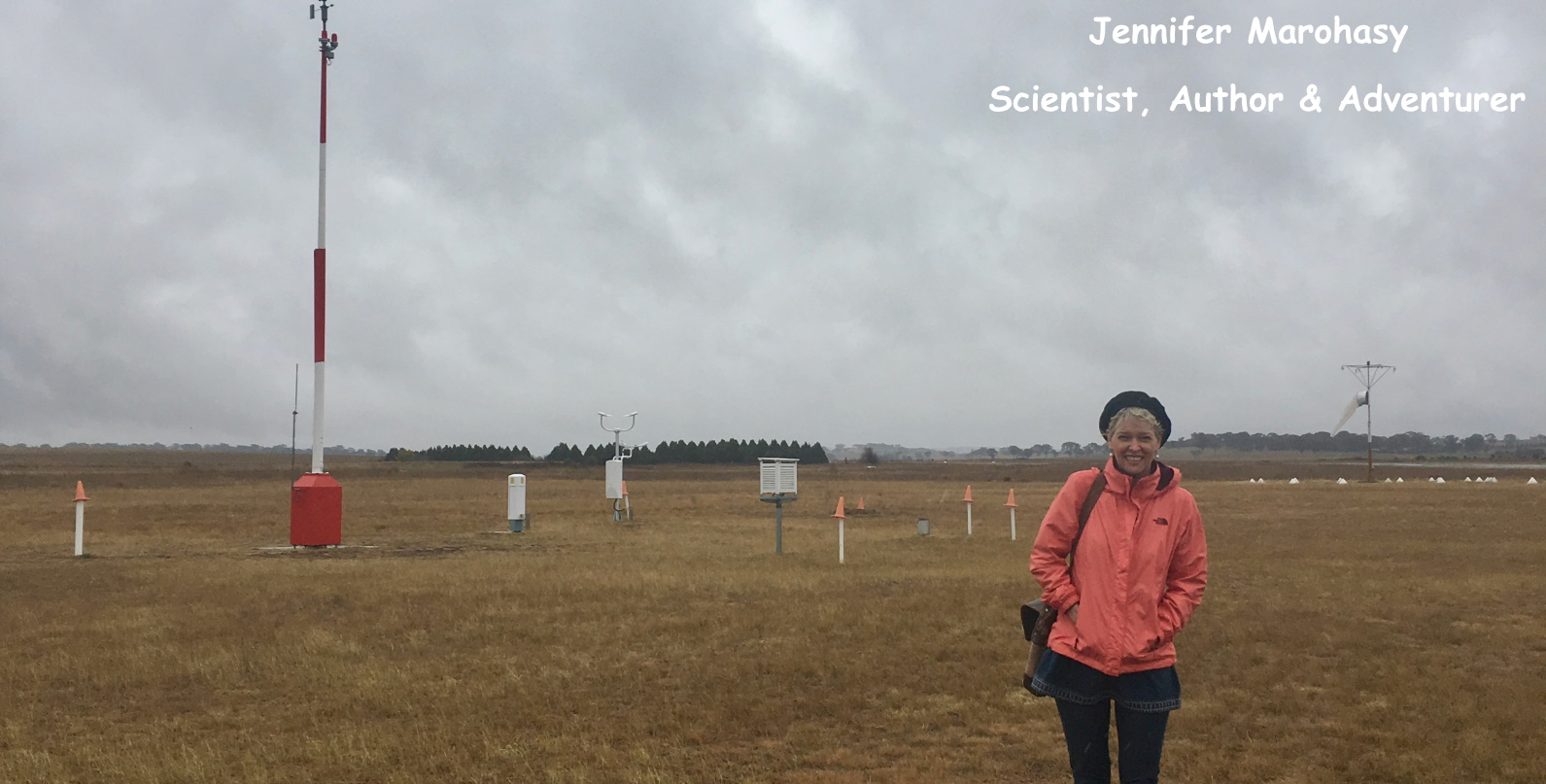
 Jennifer Marohasy BSc PhD has worked in industry and government. She is currently researching a novel technique for long-range weather forecasting funded by the B. Macfie Family Foundation.